

Neal Milner: When ‘Public’ Means ‘Inferior,’ Democracy Is In Trouble
It’s a downward spiral as citizens become more and more cynical about the government’s ability to provide services.
You probably don’t think about democracy when you encounter busted water mains, filthy park bathrooms, overheated schools, inhumane prisons and an airport project that seems to be stuck in reverse gear.
You should. In her book, “Public Things: Democracy in Disrepair,” author Bonnie Honig argues that “Public things are necessary conditions of democratic life.”
The lack of a decent public sector walls us off from one another in both physical and emotional ways. This squeezes the essence out of vital democratic civic life by discouraging us from looking outside ourselves.
A good democracy enhances engagement. A sterile democracy makes people withdraw into themselves.
Public facilities like parks, roads, bridges and airports create shared space where very different people encounter one another. The public square.
Other public places, like schools and prisons, remind us that we all share a responsibility for others.
Punchbowl National Cemetery, the state Capitol rotunda, or the Kapiolani Park shell bring diverse people together. But many Hawaii public facilities do just the opposite, because public services foster attitudes and behavior that limit the possibility of a vital civic life.
Hawaii’s government has lost faith in itself. State and local officials now pretty much start with the assumption that government no longer can solve significant problems.
Here are some common responses to Hawaii’s governmental incompetence: “What did you expect, it’s Hawaii.” “Government is corrupt.” “Locals resist change.” “Don’t make waves because the nail that stands out gets hammered.” “It’s just the way things are. I wouldn’t live anywhere else.”
Understandable views, but so sad. They reflect such stilted, cripplingly pessimistic, racially tinged views of civic life.
When government here says it is going to fix things, we don’t see this as a promise. We see it as an invitation to disaster — what’s going to go wrong this time?
So it is not surprising that with Hawaii’s bad public facilities, people wall themselves off from others.
To understand how this walling off works, try putting the word “public” in front of the following words: housing, prisons, schools, bathrooms, transportation and workers.
Making something public in Hawaii stigmatizes it. In our minds there is a difference between a worker and a “state worker,” between housing and public housing, a public school and a private one, or public bathrooms and private ones.
In every one of these cases, “public” means inferior, possibly dangerousness, a service used by people who have no choice. “Public” separates “us” from “them,” the facilities’ users from those who can avoid using them.
When was the last time you went to a picnic in Aala Park, took a leisurely stroll around the Mayor Wright public housing project, or chose to send your child to a public school even though you could afford Punahou?
Your choices may be understandable considering what the public sector has become, but look at what it does to us.
Just what democracy needs, another sorting mechanism between the haves and the have-nots. And there are signs that this sorting is getting worse here.
Recently the city of Honolulu moved forward on a plan to build a bike and pedestrian bridge across the Ala Wai Canal.
This bridge is a perfect example of desirable urban space. It conveniently connects two parts of the city. Walking or biking over a bridge brings us closer to different people. Democratic connection-wise, what could be better than a bridge?
In fact, according to the Star Advertiser, the plan for the bridge that the city has been pursing for years is controversial. The Moiliili Neighborhood Board and others in the adjoining neighborhoods oppose it. They worry that it will bring undesirable people — including criminals and loiterers — into their neighborhoods.
Difference as dreadfulness. A wall versus a bridge. Where have we heard that before?
What makes things worse is that Hawaii’s government has lost faith in itself. State and local officials now pretty much start with the assumption that government no longer can solve significant problems.
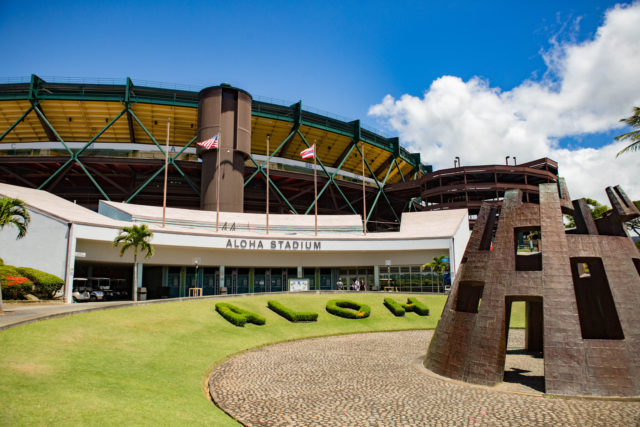
If there are huge, never-ending problems like an overcrowded prison, a dangerously out-of-date stadium or the construction of a rail system, we think we need the private sector to solve them.
Public-private partnerships have become the fairy dust of Hawaii politics, policymakers’ ritualized incantations. There is little evidence that they work in this state — this is all wishful thinking.
As for rail, prisons and the stadium, there have been no actual public-private proposals to consider, just some hopeful entreaties that with the help of, for instance, private developers, we can make things work.
Gov. David Ige is big on such partnerships, but his attempt to use Kaiser Permanente’s takeover of Maui’s state-run hospitals as a model public-private partnership took so long with so many complications that this process can’t be a model for anything.
So this uncritical privatization chorus becomes a version of the old Joe Hill union song with the line, “there’ll be pie in the sky by and by.” Which is just another version of the standard governmental response here to complaints about bad public services.
The state of disrepair of Hawaii’s public facilities nurtures a can’t-do spirit that drives our civic and political life. Think of our low voter turnout, the diminishing interest in running for Honolulu’s neighborhood boards or the hard time your organizations have getting volunteers.
Look, it’s not as if the government at all levels haven’t given us good reason to give up on it. But the fact is we still need it.
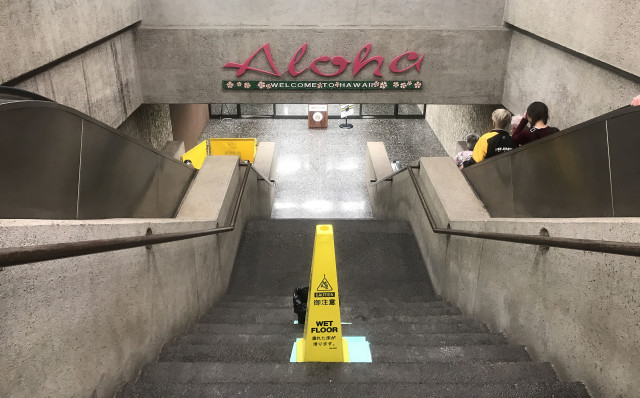
Keep that in mind the next time you wade through the gusher in front of your Palolo home or swivel around those mysterious, ubiquitous orange cones at the airport.

