

The Ocean Belongs To All Of Us
We are seeing promising advances in protecting this vital resource throughout Hawaii.
Last week we celebrated World Oceans Day against a backdrop of monumental challenges, from the U.S. backing out of the Paris Climate Agreement, to the highest-ever (410 ppm) carbon dioxide reading at the Mauna Loa Observatory.
Despite this bad news, I feel inspired by people who are taking action and making a positive difference for our environment.
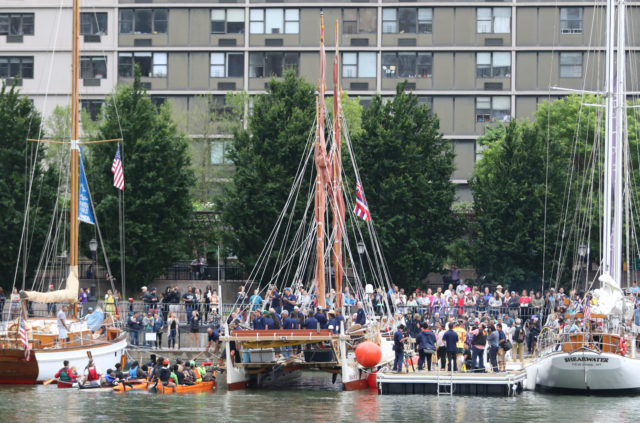
At The Nature Conservancy, we have been honored and humbled to participate in one source of inspiration: the Hōkūleʻa’s Mālama Honua voyage, which celebrates its homecoming this weekend. Signing and supporting the intentions of the Promise to the Pae ʻĀina o Hawaiʻi – a commitment to make demonstrable progress in Hawaii during the three-year voyage – was a natural extension of our ongoing work to restore health and abundance to Hawaii’s forests and oceans.
Both the voyage and the promise answer the question “what can I do as just one person, one family or one community?” The answer is clear – join together, start now to rediscover a deep knowledge of place, and make choices that restore connection and care. In the last three years, we’ve seen remarkable positive changes, demonstrating that a lot can happen in a short time; this gives me hope.
There is a groundswell of community-led collaboration and engagement for ocean health, fish abundance, and clean water across Hawaii. Although some efforts have been in process for decades, the Mālama Honua voyage and the Promise to the Pae ʻĀina o Hawaiʻi reinvigorated 20-year-long community efforts and inspired new people to join. As a result, Hawaii now has our first Community-Based Subsistence Fishing Area (CBSFA) rules in Hāʻena, Kauai and our first community-driven 10-year marine reserve at Kaʻūpūlehu on Hawaii island.
Community leaders also formalized and extended the Maui Nui Makai Network, bringing people together to learn about marine science and policy, share culture, and collaborate to improve Hawaii’s coastal resources. In Hāna, local communities implemented a voluntary three-year ʻopihi rest area, and monitoring showed increasing populations after just the first year.
Communities on Hawaii island are crafting their own peer learning networks focused on oceans and fish ponds, Kai Kuleana and Hui Loko, to share knowledge and support one another in their efforts to mālama. These communities are also joining dozens more to learn best practices to restore coral reef fisheries and develop conservation plans rooted in science and culture.
The Nature Conservancy’s role is to provide technical, scientific and training support to help communities care for coastal and marine life and restore abundance. For example, on Maui we are training volunteers from Hui O Ka Wai Ola, a citizens’ science group, to learn about water quality, collect samples that show where sediment and pollution could smother coral reefs, and guide better decision making.
On Hawaii island, volunteers conduct fish surveys at Kīholo Fish Pond to measure which, and how many, fish are returning as the area is restored. Our work restoring upland native forests increases water quality and supply, while installing erosion control measures reduces sediment. And community partners are planting rain gardens near the shoreline to capture run-off.
Understanding what’s going wrong is important too. Over the last two years, vast areas of coral reefs in West Hawaii bleached in the warmest waters ever recorded here. We documented this event and are beginning to understand why some reefs are better than others at resisting or recovering from stressful events like bleaching.
This is an urgent matter, as it’s shaping up to be another hot summer with hot air, hot ocean water, intense hurricanes, and moderate to severe drought. We can retreat to air conditioned rooms, but our coral reefs can’t escape the warming waters and acidification of our oceans; some will suffer and die. Identifying the most resilient, or healthiest, reefs will help determine which ones have the best shot at surviving and what kinds of active management will encourage healing, recovery and longterm viability.
Nature functions in reciprocity and we are boosting it with quality scientific information, engaged communities and good policy. As an island state, we cannot wait to take action to protect our coral reefs and fisheries, which are valued at $34 billion and contribute $360 million annually to our economy. Their cultural and lifestyle values are immeasurable.
I applaud Gov. David Ige, Senator J. Kalani English and the Legislature’s leadership in making Hawaii the first state to statutorily commit to the Paris Climate Agreement. It expresses the kind of servant guardianship being practiced across Hawaii and by our brothers and sisters across the Pacific.
The ocean belongs to all of us, and the most effective, sustainable conservation is driven by the bottom-up local community engagement we’re seeing across Hawaii nei. Together, we can extend the Promise to the Pae ʻĀina o Hawaiʻi into the future, and keep making a positive difference for our environment and our communities, here in Hawaii and around the globe.
 GET IN-DEPTH
REPORTING ON HAWAII’S BIGGEST ISSUES
Community Voices aims to encourage broad discussion on many topics of community interest. It’s kind of a cross between Letters to the Editor and op-eds. This is your space to talk about important issues or interesting people who are making a difference in our world. Column lengths should be no more than 800 words and we need a current photo of the author and a bio. We welcome video commentary and other multimedia formats. Send to news@civilbeat.org. The opinions and information expressed in Community Voices are solely those of the authors and not Civil Beat.
