It’s Good To See Young People On The March
They need to start early because engagement in public policy is a long journey.
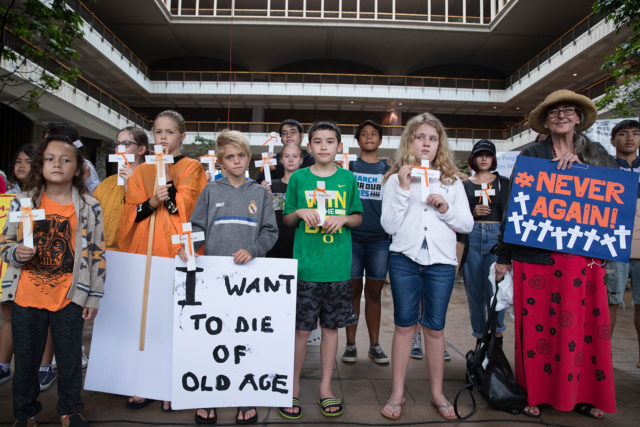
The young people involved in the school safety march in Washington, D.C., have faced some pretty harsh blowback, including some condescending talk from pundits who in my view aren’t much more mature in policy terms than the students who they are criticizing.
I see some immaturity in things like the #MeToo Movement or #BlackLivesMatter, but do you know what my conclusion is?
I’m happy that younger folks have figured out that the government can affect their lives and that they should be engaged. At their age, all I wanted to do was make green money. The truth is that engagement in public policy is a journey and there are a number of reasons why.
First, it takes time for ideas to take hold. Here in Hawaii, the Legislature has passed a bill on assisted suicide in limited cases. This idea goes back decades, but it was only a few years ago that The Economist magazine endorsed the policy idea.
When I was in law school, one Dr. Kervorkian got prosecuted for murder for this activity. It can be annoying to watch the slowness with which a legislative body embraces change. By the time they do, the “new” idea is usually an “old” idea. But if we remember that a key job of a legislative body is “prudence” and that part of the function of any government is to provide stability and continuity, then we might get less upset at our politicians.
Second, this is a complex world in which outcomes have multiple causes. In statistics, they use “regression analysis” or “multifactorial analysis.” Which partly means that tracing a line between causes and effects can be difficult and complex, but it also means that policy novices sometimes are like the proverbial man who touches the leg of the elephant but can’t see the rest of the animal.
Example: we have a live debate in Hawaii about the minimum wage and I have heard some folks complain that other states handle it better. But other states don’t have a health insurance mandate for employers called the Prepaid Health Care Act either.
Studies have suggested that one reason that Hawaii wages tend to be lower than those on the mainland is because we have such rich workplace benefits, including health insurance, which is very expensive. If a private employer is paying 90 percent of their employees’ health insurance and someone starts agitating for a higher minimum wage, what is a business owner to think?
These issues are connected, so a public policy advocate must also connect the dots. Public policy novices will have a harder time doing so. Don’t worry, be patient, they’ll learn.
Third, it is a very big world and to become fluent in public policy you almost have to know the whole world. Can I be an effective advocate for the homeless if I don’t understand land use and zoning policy? And can I understand land use and zoning policy if I don’t understand environmental policy?
And can I understand environmental policy if I don’t understand business and industry? And can I understand any of these, unless I understand economics?
Figuring Out The World
You see, the problem is not that we’re not smart or that we don’t care, it’s that it takes a long time to figure our world out to the degree needed to do public policy properly, and most people are blind busy just doing their jobs and having a family life.
By the way, part of the reason that Hawaii has a big homelessness problem is because it’s warm here and we live on small islands and we must have land use controls because tourism depends on a nice environment.
Restricted supply means higher prices and costs, as demand rises. And by the way, land values are relatively high in places like Nevada, Utah and Arizona because the federal government owns a significant part of the land and locals can’t build houses there. Does the federal government own any land in Hawaii? I think they do.
Public policy is very fun and sometimes you can actually make a difference.
All of that having been said, public policy is very fun and sometimes you can actually make a difference if you are both persistent and patient enough. But you must do your homework, for your own sake, and the sake of everyone else.
And here are two rules of thumb that I personally follow.
One, I don’t complain unless I have a solution to offer. That forces me to do my homework.
Two, I don’t usually go public as a first step. I usually go behind the scenes and offer the Establishment an idea and let them handle it.
Why? Because as Harry Truman said, you can get a lot more done if you don’t try to take credit for it. And because even when you have experience in public policy, there are always things that you don’t know, but which are obvious to leadership.
Now, I don’t think that any of us believe any longer of our Establishment that “father knows best,” but I don’t assume that they are acting in bad faith. As it says in the Bible — forgive them, Father, for they know not what they do.
True of government, true of public policy advocates.
Thoughts on this or any other story? Write a Letter to the Editor. Send to news@civilbeat.org and put Letter in the subject line. 200 words max. You need to use your name and city and include a contact phone for verification purposes. And you can still comment on stories on our Facebook page.
 GET IN-DEPTH
REPORTING ON HAWAII’S BIGGEST ISSUES
GET IN-DEPTH
REPORTING ON HAWAII’S BIGGEST ISSUES
Community Voices aims to encourage broad discussion on many topics of community interest. It’s kind of a cross between Letters to the Editor and op-eds. This is your space to talk about important issues or interesting people who are making a difference in our world. Column lengths should be no more than 800 words and we need a current photo of the author and a bio. We welcome video commentary and other multimedia formats. Send to news@civilbeat.org. The opinions and information expressed in Community Voices are solely those of the authors and not Civil Beat.