

Honolulu’s Vanishing Crosswalks: Why The City Is Taking Them Out
The city has removed 34 crosswalks since September 2016, despite protests from some neighborhood groups.
Crosswalks are disappearing on streets across Oahu, a move the city says will improve pedestrian safety.
But some residents argue the lack of crosswalks will just encourage people to take bigger risks crossing busy streets.
The city has removed 34 crosswalks since September 2016, when the Honolulu traffic engineers finished the Complete Streets Design Manual. The manual guides infrastructure changes that make streets safer for bikes, public transportation users and pedestrians.
The Honolulu City Council passed a Complete Streets policy in 2012, ushering in streetscape changes that include adding curb extensions known as “bulb outs” in Chinatown and bike lanes on the city’s major arteries.
Oahu residents have had a hard time adjusting. Some doubt the city’s assertion that removing crosswalks makes conditions safer for pedestrians and other residents feel officials have ignored community input.
The city plans to remove seven crosswalks along South King Street, a heavily trafficked five-lane road that runs through urban Honolulu. The crosswalks in question are all at intersections that don’t have traffic lights.
Pedestrians can still legally cross at these unmarked intersections. But for safety reasons, the city wants to encourage them to walk one or two blocks to an intersection with a pedestrian crossing signal, Department of Transportation Services Deputy Director Jon Nouchi said in an email.
The city removed a crosswalk on Kapiolani Boulevard at the intersection of Pumehana Street near McCully Shopping Center. But McCully-Moiliili Neighborhood Board Chair Timothy Streitz said people still scramble across the boulevard.
“It’s not realistic to expect pedestrians to walk hundreds of feet down to the nearest signalized crossing,” Streitz said. “I’ve seen a couple of close calls.”
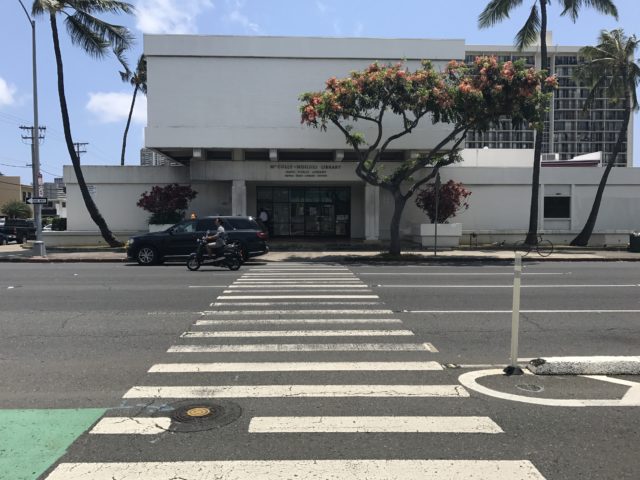
Streitz is particularly concerned about a crosswalk at the intersection of King Street and Poha Lane just in front of the McCully-Moiliili Public Library and a bus stop. It takes about two and a half minutes to walk to the nearest signalized crosswalks at Isenberg Street or McCully Street.
The neighborhood board passed a resolution in 2015 requesting the city add a pedestrian-activated signal at the intersection. Three years later, the crosswalk at that intersection is on the city’s list for removal.
Honolulu is required to follow federal guidelines to determine if it can add traffic signals, Nouchi said. If Federal Highway Administration criteria isn’t met at a particular crosswalk, the city removes the crosswalks rather than adding more safety features.
Streitz invited a city traffic engineer to the board’s meeting next month to discuss the city’s plans. The meeting is scheduled for 6:30 p.m., June 7 at Washington Middle School.
Since the city removed four crosswalks along Makakilo Drive, Kim Katjang of the Makakilo/Kapolei/Honokai Hale Neighborhood Board has made it her mission to get them repainted. She and five other Makakilo residents are known as the “crosswalks moms.”
“This is my job right now, to get these crosswalks back,” she said. “I feel like I’m working on my dissertation for my Ph.D.”
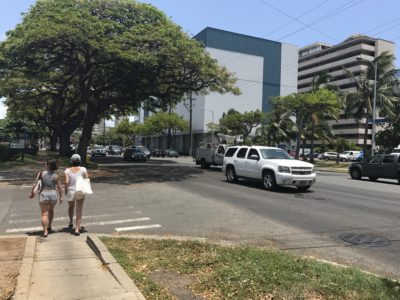
The city’s Department of Transportation Services has held a series of public meetings to gather community feedback on its Complete Streets plans. The department is scheduled to host a Complete Streets meeting at 6:30 p.m. Tuesday in the Maemae Elementary School cafeteria to discuss plans for the Nuuanu and Liliha area.
“The public is not always going to get what they necessarily want because you have to look at it holistically. But we try to accommodate as best as possible the wishes and concerns that the community has,” said Andrew Pereira, a spokesman for Mayor Kirk Caldwell.
“It’s definitely not done willy-nilly, there’s a lot of thought and process that does go into it.”

