A Talk With The Hawaiʻi Hotel Alliance About An Uncertain Time For Tourism
Hotel and lodging owners and operators say an increased visitor tax is not the right way to support climate mitigation efforts.
March 17, 2025 · 27 min read

About the Authors



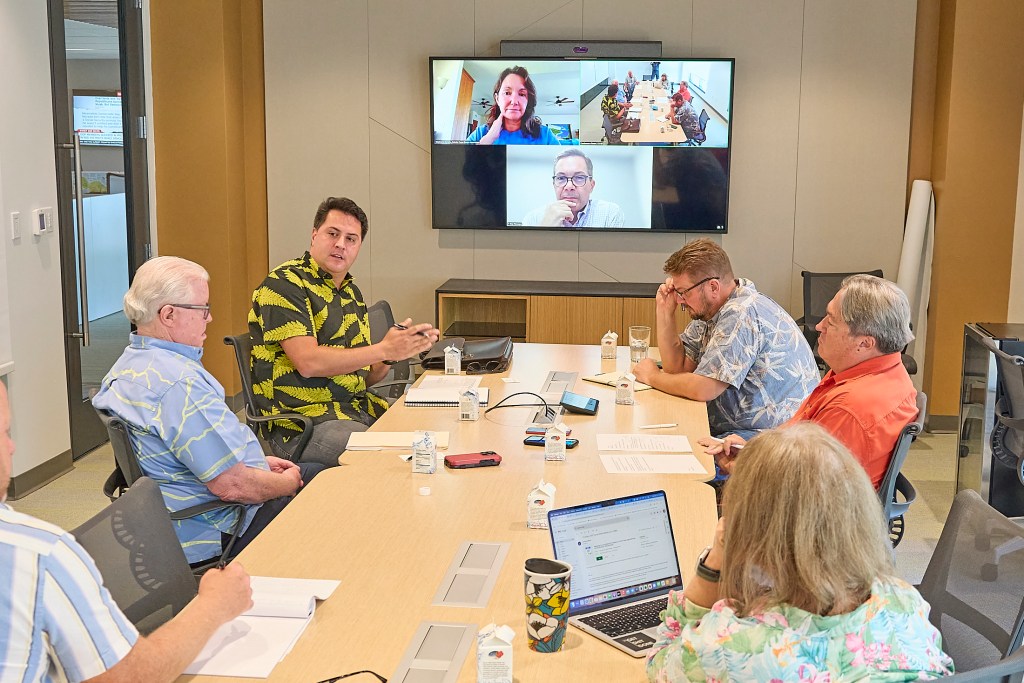
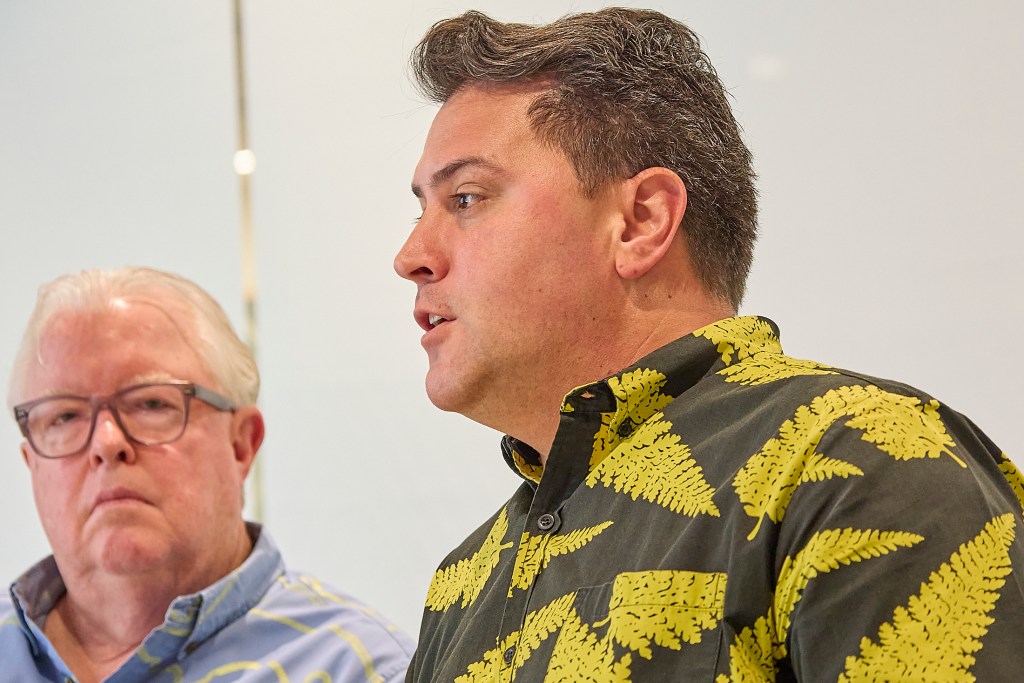
Editor’s note: Civil Beat reporters and editors met Tuesday with leaders of the Hawaiʻi Hotel Alliance, whose members and partner sponsors own and operate more than 29,000 rooms across the state.
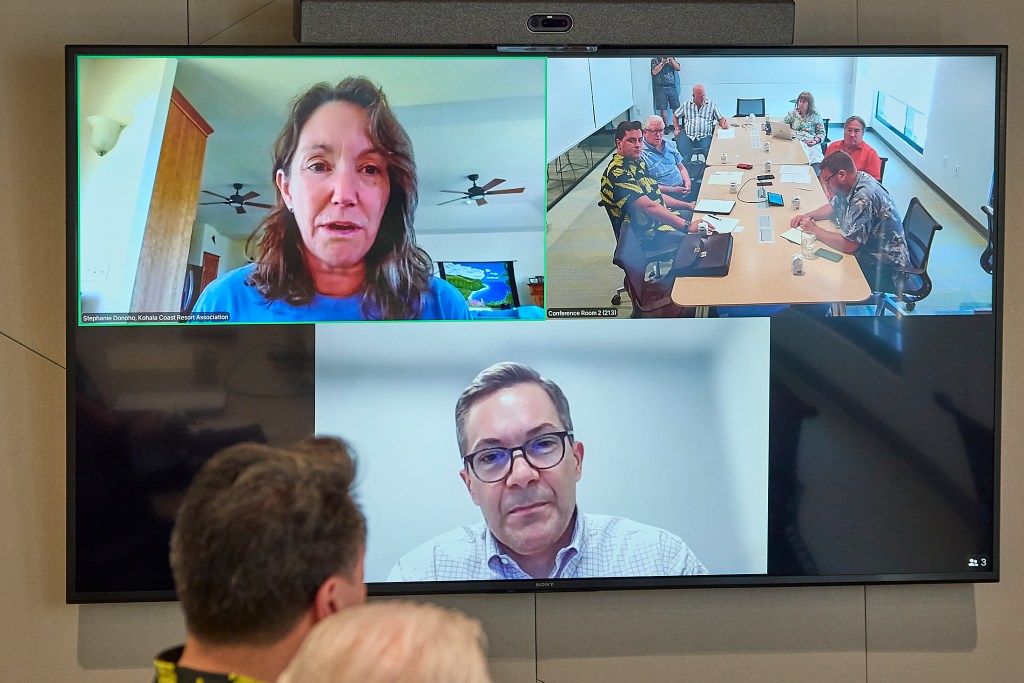
On hand were Jerry Gibson, the alliance president and general manager of the Waikīkī Beach Marriott Resort and Spa; Kekoa McClellan, chief advocate for the alliance and a consultant for Outrigger and Host Hotels; Stephanie Donoho, executive director for the Kohala Coast Resort Association; and Troy Flanagan, executive vice president for state and local affairs for the American Hotel and Lodging Association.
The interview was edited for length and clarity and with an eye toward future reporting. Gibson began by describing the current Hawaiʻi tourism landscape.
Gibson: There’s some gold nuggets out there that we’re really appreciative of. The governor, through the Department of Business, Economic Development and Tourism, gave us $6.3 million to help market and help the situation in Maui a little bit. You know, “As goes Maui, as goes the state.” So those are really important dollars.
When you turn on the TV, you’re going to be hearing about Hawaiʻi, and you’re going to be hearing about Maui. That just came up, and that is an additive $6.3 million to our fund. Very, very important. We hope that will help with people that want to stay in hotels and stay with our properties.
As you know, the west side of Maui has been not doing as well since the fires and (hotel occupancy has) been between 45% and 55%. The south side is about 10 points off, about in the 70s or 72%, so as things get better, that’s going to be great for the industry.
As the Legislature goes, they start out with approximately 3,200 different items on their legislative slate. We’re past halfway on some of those. Some have gone by the wayside, which are good. We still have a few out there that are concerning. An increase to the transient accommodations tax is certainly concerning. House Bill 504 is out there.
We are looking at markets, and I will tell you, the government business, for reasons we all can can agree on, is down 55% now. There is government business on the outer islands, but it’s more on Oʻahu. That’s very important, because to many of the hotels that is a base piece of business — that’s government and government contracts. Credit cards have been canceled. We are still getting about 45%, but that’s government contractors, etc. So that is a real big concern. That’s thousands of rooms that are base business.
“Everybody’s asking about Japanese business, and when is that going to return? I’ve been doing this long enough to tell you that it’s not going to return.”
Jerry Gibson, Hawaiʻi Hotel Alliance
Canada is way down again, for obvious reasons. Right now that’s usually 7% to 8% of our business, and that is cut in about half for those that still choose to come. Maui is a big recipient of Canadian business, so it’s really important to us that we maintain Japan. You know, everybody’s asking about Japanese business, and when is that going to return? I’ve been doing this long enough to tell you that it’s not going to return. A half a generation is gone already. So when we see a 4% to 5% increase a year, that is my belief as to what it will be in the future. We think we can increase that number, but when we see numbers out there — 15%, 20% —that’s fantasy. It’s a currency issue. It’s a generational issue. And I don’t see that coming back in droves again, as much as we wanted to.
We still have a wishy-washy market. That matters for people to travel or not to travel. The L.A. fires and where they were, that’s our breadbasket. There’s no doubt about it, that’s the Maui, Kauaʻi, Gold Coast business. That’s where we’re in a bit of trouble there. It’s just not going to come right now, for obvious reasons.
When you say government business and travel from Canada are down and “things that we can all agree on for obvious reasons,” you are referring to the Trump administration and Elon Musk, correct?
Gibson: Yeah, I’m saying exactly what’s happening in the business right now. What we’re seeing as a short trend right now. Could it keep going? Of course, it could.
Donoho: I would like to add one thing, and that is something that we don’t talk a lot about. It’s all of the hotels’ buy-in in other sectors. We are a major buyer for agriculture, a major buyer for construction, but we’re finding that with some of these tax issues, there’s a real inequity in collections, and we see that on the Kohala Coast, because we do an economic and community impact report every couple years. We track how much we pay in TAT (Transient Accommodations Tax) and general excise taxes to the counties and the state, and on the county level we can see that we’re the ones paying the majority of the freight. Hawaiʻi County last year had $24 million as their TAT. The Kohala Coast hotels and timeshares paid $17 million of that.
And yet, (data collection aggregator) Granicus said we have 8,700 short-term vacation rentals on our island. As a comparison, I have less than 4,000 hotels and timeshare units. So we’re seeing that there’s a strong inequity in collections at both the county and the state of what is currently due. And so when we look at these TAT increases, we’re really concerned that it’s going back to the same payers. It changes our business model, because they know we’re large corporate payers and we will pay it. But not everyone is helping toward all these issues for marketing that Jerry said, so that’s the primary concern that I have.
Granicus actually has a strong reputation in Hawaiʻi, because it’s worked with Kauaʻi County and the City and County of Honolulu to track vacation rentals. What they were doing initially was making certain that there was registration enforcement. Are these legal? Are they registered? What we’ve been talking with them about in Hawaiʻi County is the tax collections. If those 8,700 units that were rented for an average of $347 a night at 68% occupancy paid their fair share of taxes, they owed Hawaiʻi County $22 million.
“The hotel industry has not recovered from Covid, and I’m not just talking about visitor arrivals, I’m talking about the net negative loss that the hotel industry experienced as a result.”
Kekoa McClellan, Hawaiʻi Hotel Alliance and Outrigger and Host Hotels
And that TAT at the county level has been in effect for the last three years. You’ve got taxes that need to be collected from a bunch of players in this marketplace that aren’t being collected currently.
So we’ve got an inequitable playing field between hotels and timeshares and those legally paying for all of their bills, and the short-term rental market where there has been sporadic enforcement of what’s currently required.
Senate Bill 1395 taps the interest on the rainy day fund for climate change mitigation. Senate Bill 1396 increases the TAT for climate change. It also would support tourism. You mentioned House Bill 504. It’s a $20 increase to the TAT and somehow it factors into a points or miles or loyalty program.
The governor has argued we need at least $500 million a year to mitigate against what few people doubt is a reality, rising sea levels, stronger storms and so forth. His Climate Advisory Team made recommendations. Can you comment on the argument that we need the money to help take care of our environment, because if we don’t, that’s going to impact overall business?
McClellan: The realities that we are facing as advocates for Hawaiʻi’s hotel and lodging industry are nothing short of stark, and when we take a step back and think holistically around what needs to be done, there is no shortage of support for measures and efforts to manage and deal with and address climate mitigation. There was no shortage of support for reinvesting in our wahi pana (sacred sites). There was no shortage of support for engaging directly in curating safe spaces for kamaʻāina and malihini alike to engage and visit and to enjoy. And when you look at the hotel and lodging industry, legitimate establishments, that investment has been happening for generations.
I’ll give you an example: In Waikīkī and in Kāʻanapali, it is the hotel owners and operators who are actively engaged in both funding and supporting beach renourishment and replenishment programs, and this ensures public access to public spaces for public uses that we as locals tremendously enjoy and embrace. And it’s the industry that for generations has advocated for and supported and led on these climate mitigation efforts.

When we look at the subject measures, let’s take HB 504. There are mechanical things that simply do not make sense. We’ll start with a $20 fee on points programs. Points programs are redeemed and TAT is paid. And so the way the fee is structured, it is a $20 tax on ratepayers who are already paying the TAT when your points are redeemed by the operator.
The hotel owner is paid whatever the formula is for the rate based on that night, and for the number of people that are staying there on the occupancy level, hotel rates vary from when you book them to when you stay. So whatever that rate is, the hotel receives that rate in terms of a cash payment, and the TAT is paid on that. So what this $20 fee would effectively do is it would create a second tax on folks who are using their points to come to Hawaiʻi.
Now look at the macroeconomic factors. Just yesterday, the three largest airlines in the United States said they are forecasting a lower rate of travel than they had previously forecast. Southwest, United and American Airlines, I believe, all adjusted their projections for the year. Southwest went on to say, we’re also going to charge a fee for your bags. No longer will you get two free bags. And why does that matter? Well, because Hawaiʻi is a no-drive market. If you’re coming here, you’re flying here. So what are we doing at a macroeconomic level? We are creating further barriers to entry.
“There’s a strong inequity in collections at both the county and the state of what is currently due. And so when we look at these TAT increases, we’re really concerned that it’s going back to the same payers.”
Stephanie Donoho, Kohala Coast Resort Association
We are forgetting that as things get more expensive — and they are — and as local families make the difficult decision that their vacation this year will not be on the continent or will not be out of the United States, it will be in the islands — those staycations are already taxed at nearly 19% when you add in the GET (General Excise Tax) that the state charges, and the 3% surcharge that the counties have applied to it, and the 4-plus percent — depending on what county you’re in — GET that you’re paying.
We are asking more than 200,000 kamaʻāina nights booked every year to pay an additional 1%, and when everything is more expensive, that is not an insignificant ask of local people. It also means that whenever local government officials are traveling from Honolulu to Kauaʻi to do work, or from Kauaʻi to Honolulu for medical care and treatment, or from Molokaʻi to Honolulu for their dialysis treatment, that they will be paying more money that they simply do not have. This is a tax on us as much as it is a tax on the visitors that are coming to Honolulu.
The hotel industry has not recovered from Covid, and I’m not just talking about visitor arrivals, I’m talking about the net negative loss that the hotel industry experienced as a result. Hawaiʻi was the hardest-hit market, because we are a no-drive market. When people started to travel again, they had to make a decision to get on a plane and sit in a tube with strangers for five to 11 hours, and they just weren’t doing that after we started to reopen.
To be clear, you’re still opposing any increase to the TAT for climate mitigation. Is that correct?
Gibson: That is correct. We don’t oppose climate mitigation at all. We think that it should be able to go on a bill, and if you want to take it out of existing TAT, have at it, because we got $1.1 billion that we contribute every year with the TAT taken out of that. But to make an additional 1 point or 1.75 in what we believe is a regressive tax … people are going to say, “No, I’m not coming here.” That’s a lot of money when they don’t come, OK?
I do want to clarify on the other bill as well — the rainy day fund and using the interest. Where do you guys stand on that for climate mitigation?
Gibson: We are absolutely not opposed.
McClellan: And speaking of the Climate Advisory Team, they didn’t only say go after the TAT. They offered other solutions, like a barrel tax, and it would make sense that if we actually meant what we were saying about climate mitigation, that we would place the tax squarely where it belongs. And so we would absolutely support that, but you’re looking at increasing a tax on an industry that has not recovered from Covid, that is already the highest tax in the world, and that will hurt revenues.
So, not recovered from Covid. Highest tax in the world. Japan down. Canada down. U.S. economy, stock market down …
McClellan: More importantly, we have some of the highest carrying costs for a hotel operation anywhere in the world.
What do you mean by that?
McClellan: Well, property debt service.
Donoho: Can I add to that? It’s in all capacities, the highest carrying costs, because we have the highest labor with all the union negotiation contracts that have gone through. We’re trying to give our people the highest living wage that we can.
Profitability at the hotel sector is down. It’s down in the last decade, and that’s why you see so much conversion to other types of units. On the Kohala Coast, we have fewer hotel rooms. We’ve been converting to timeshare because it’s a different ownership model. We have the highest food cost. Everybody feels the cost of eggs and milk and bread in their own personal budgets. But when people come on vacation, they still expect a really good breakfast when they wake up in the morning. So all of those costs are higher.
We are trying to support our local agriculture. When you talk about everything from fertilizer to labor costs, then it costs more. We have the capacity to pass on those costs to visitors, but all of those costs create an inflection point. HMSA and Kaiser have higher premiums than ever, and we pay full family medical for an entire family.
June and through the end of August are the best months for tourism. Then we have the shoulder season, then the holidays. We have spring break coming up. That’s pretty good, right? March is pretty good — or not?
Gibson: It’s not. We’re not showing the numbers that we normally have. Are we going to get a bump? Yes. Is it like we normally get? No, and that’s every island, and it’s just not showing up with the market the way it is now, with the countries we talked about. Most of our business, our big breadbasket, is California. I call it the Country of California — 42.6% of our market to Hawaiʻi is from California. Think of the problems there, think of what’s going on. What are people thinking? Would we travel?
McClellan: I mean, when you lost 10% of the value in your 401(k) in three weeks, and you’re making a travel decision for spring break — we cannot afford to travel. I think Troy can do a good job giving us some macro level stuff.
Flanagan: I think the biggest theme — and this is not to dodge a concise answer — but there’s so much uncertainty with the economy generally, but with our industry and how executive actions coming out of the White House and a lot of other global things that are impacting our industry. We’re still figuring it out.
I mean, from day to day, hour to hour, we’re ramping up and then pulling off potential tariffs on our friends and allies, and that has a real impact. Just earlier today we convened a meeting here with some different hotel executives and we were joined by my counterpart from the hotel association of Canada, and they were talking about some of the sentiment around Canadians not wanting to go to the United States. And as a native Floridan, just think of how many Canadians winter in Florida.
“I think the biggest theme is there’s so much uncertainty with the economy generally and how executive actions coming out of the White House and a lot of other global things that are impacting our industry. We’re still figuring it out.”
Troy Flanagan, American Hotel and Lodging Association
But it’s even more than that. There are certain provinces, particularly British Columbia, that by government mandate are asking retailers to remove American products from their restaurants and bars. So California wine, Kentucky bourbon, all of that, it’s being removed from shelves. So there are real world implications.
And of course the supply chain for hotels and the fixtures, furniture and equipment in hotels is a cross-border challenge for us that we’re already hearing from our members. That’s just the near-term uncertainty, and I don’t think we have any expectation that that’s going to be alleviated. Some of us almost compared the uncertainty at the moment to some of the early days of the pandemic, where there were just challenges that you just weren’t expecting, whether it was closures or adapting to new science.
Some of the things that are not new, that our industry has been facing for years now, is enough access to workers, particularly foreign workers, a pipeline of legal foreign workers. That is a challenge that has not gone away.
Where are we with union contracts? I don’t believe there’s currently a strike or one pending with Local 5 or the ILWU (International Longshore and Warehouse Union).
Gibson: That’s correct. There’s no pending action. In fact, we have signed a new collective bargaining agreement with Local 5. There are some ILWU contracts that will be up soon, and there’s also some Local 5 that are still out there that they’re working on right now. They’re negotiating as we speak.
McClellan: And those negotiations resulted in record wages two years ago. And of course these salary trends work across the market space. A dishwasher is now making $33 an hour — full medical, vacation, crew meal. Thirty-three dollars an hour is a living wage in Hawaiʻi for a job that isn’t meant to be a forever job. It can be, if you want it, but it gets you in the door at a fantastic organization with mobility, across the brand, across the state, or anywhere in the world.

And as we look at conversations around how we’re going to solve and meet the needs of climate change, the industry has been doing this actively. We’ve also been supporting our schools, our police, our fire, our ambulance, as the largest taxpayers from a real property perspective in all four counties. A TAT increase is going to hurt the industry, and they haven’t recovered yet.
When we talk about what is the industry doing to meet our environmental standards, well, we start by educating our people on the importance of coming from a Hawaiian sense of space and place, because we’re not just saying we should invest in our beaches. We’re saying we should invest in the thought process of our employees as it relates to their kuleana to Hawaiʻi. So we’re doing that in spades.
What is the role of the Hawaiʻi Tourism Authority these days? A major shift happened in the last few years regarding its funding. It had a dedicated, I think, $70, $80 million a year. And then they had to shift to actually having to rationalize getting their money every year to compete with other organizations. How strong is that organization these days in terms of marketing, not just marketing the state of Hawaiʻi but also managing the destination?
Donoho: Prior to working for the Kohala Coast Resort Association, I was the tourism specialist for Hawaiʻi island in the Office of Economic Development. Each island’s tourism strategic plan was created by community organizations that HTA convened. So when I came on board as the tourism specialist, I had this mandate: Here is our island’s tourism strategic plan, and it was created by a group of people. HTA serves that purpose. They’re a convening organization that brings together groups of people across the islands, working in the industry.
That is the power that I see with HTA. But I don’t see them as this stand-alone organization. They’re only as good as the people that they bring together from all of the islands to do the work, because it’s an industry that’s much larger than any single body. Tourism encompasses so much.
And so I see the challenges that HTA has been put through over the last few years with the Legislature. I mean, I watch those hearings, I read those audits. I am very well aware of it, but I also see the money that’s getting invested in small community projects that probably wouldn’t happen. I think what we have to realize is that the Hawaiʻi Tourism Authority touches so much within the industry and those people on the ground doing the work in their communities.
The main counter argument against HTA is that we don’t need it, that Hawaiʻi shouldn’t have to market itself, because our brand is so well known as compared to Costa Rica or Florida. And related to that, why don’t the hotels and the airlines do that? I know that you market as well, but why does Hawaiʻi have to do that? Because that is a tax source that goes to support HTA that could go elsewhere in the state.
Donoho: I’d like to answer that, if you don’t mind, just because I lived in a destination that removed its tourism office prior to moving here. I lived in Colorado, where the Colorado Tourism Office was completely eliminated and each entity within the state was then marketing itself. I lived in Clear Creek County, which is directly on the I-70 corridor between Denver Metro Convention & Visitors Bureau and ski country, USA.
When you don’t have a collective marketing of the entire destination, looking at all of the small communities, the only messaging that gets into the marketplace is what the individual entities that are advertising want to get out there. So in the Colorado example, my four historic gold and silver mining towns that had less than 10,000 people, but had four 14,000-foot peaks and a railway and all kinds of stuff, we got lost. We had no money. We had to pass our own tourism tax, and my biggest hotel was a Super 8. It didn’t make any sense at all.
So that framework of who we are as a destination — you say, “Everybody knows Hawaiʻi” — I would disagree.
Gibson: We have to be out there, and we have to be in the game. I use the Coca-Cola example — why are they on TV every time you turn it on? There’s a reason we know Coca-Cola, but we forget. Well, Hawaiʻi has to be out there too. It’s not automatic by any means.
We have a real severe disadvantage here. We need a dedicated source of money. Every year we spend half our time fighting to get money, and it could be productive. And yes, HTA and the Hawaiʻi Visitors and Convention Bureau are a little duplicative because they’re both contract-oriented. HVCB is one of the best visitor and convention bureaus, I think, in the United States. They do a very, very good job of what they do, but they need the money to do it too.
We really need a dedicated source, probably $150 to $200 million to market Hawaiʻi every year properly and do everything that we need to do. It’s nowhere near that amount of money. So we’re not competitive with the Caribbean, Florida, Mexico. California, they market pretty well themselves. So we are at a severe disadvantage. We’ve got to find a way to get some kind of dedicated source that makes sense.
Troy, how does Florida market Florida?
Flanagan: I think it may best be described as a multi-pronged approach. There is a Visit Florida entity, which is a quasi-government entity. It does have dedicated funding. I’d be lying if I said it didn’t get political sometimes. But the data shows that the money invested more than makes up ROI. I think importantly you also have destination entities with their own marketing and funding for several of the areas of Florida — Fort Lauderdale, Miami, the Panhandle, all do their own spending as well.
What is the average hotel room cost in Hawaiʻi? Is it up to $300 now?
Gibson: It’s about $313.
OK. So where are we with the ongoing battle between hotel rooms and short-term rentals?
Gibson: That is definitely ongoing. We have some of the best laws in the land, and we have worked on that — eight, nine years — together, on these laws. What we don’t have is enforcement. We have very poor enforcement, all the way around the horn, and we are working on that hard as Stephanie mentioned with Granicus. They can tell you how many nights someone spent there, they can tell you the average rate that they spent. It is incredible.
You know, the information we have now, we have to figure out a way to use it, because the treasure chest right now would be to fix the legal-illegal short-term rental problem, and have them pay their share. Hotels, timeshares pay their share. This section does not pay their share whatsoever, and many, many are illegal.
Flanagan: I would agree with Jerry that Hawaiʻi does have some strong laws on the books, but that’s in comparison to some pretty weak laws around the country, and that’s not for lack of trying. There are some roadblocks — some of it’s federal laws, and I think that’s where Hawaiʻi has really put in a lot of effort to try to bring the platforms to the table and make them part of the enforcement equation.
We’re always going to be chasing more money for enforcement if we keep doing it this way, but if they aren’t held to a standard where they have to be part of the enforcement of the regulatory mechanism, and stop hiding behind federal laws and legal precedents, it’s always going to be this way.
And you’ve got four separate counties here, which can set their own rules and regulations.
McClellan: We have worked with all four counties over the last eight years to both increase fines, increase regulatory schemes, to go after illegal operators, to ensure platform accountability. And you’ll find that in all four counties in Hawaiʻi, there are laws sufficient to enforce. There needs to be some investment in that activity, and enforcement also comes with taxation. We do need to enable the Department of Taxation to go after the TAT where it is not being collected.
We believe that the governor and all four mayors want to engage heavily on this front, but in terms of where we are, it is frustrating that while hotels have not recovered, short-term rentals have not just increased in their total revenues but increased in their total numbers. It’s frustrating, and it’s not because the councils and the Legislature wanted it to happen. They’ve done the work, and now we need to work within the systems to go after the money and go after the noncompliant actors. I think that’s what the focus really needs to be.
Gibson: And make sure they’re in the legal zone. That’s a big problem, and that’s a big problem with resident sentiment.
McClellan: We know that housing is a priority for the Legislature and for Gov. Green, and that’s why he’s been so adamant about going after illegal short-term rentals. We know that if we can get these operators of illegal hotels in our communities to put homes back in the long-term rental or permanent housing pool, it will help with our housing crisis.
Donoho: On the Kohala Coast, we track property taxes as well. So the resorts along the Kohala Coast pay a third of the islands’ property taxes. We have nine districts, but three of them pay 75% of the property taxes. Short-term rentals are everywhere, but most of them are operating under a homeowner’s exemption or an agricultural land lease. So the property taxes are another part of this taxation challenge, whereas hotels and resorts are charged a property tax rate that goes into the impacts. Yet a lot of the short-term rentals are not because there’s not a standard.
There’s a University of Hawaiʻi report on declining use of short-term rentals versus hotels — that the rentals aren’t the value proposition they once were, and as they become closer in price to hotels people are saying, “I might just as well stay at a hotel” or “I’d rather stay at a hotel.” Have you seen this nationally?
Flanagan: There’s some of that trending, but it’s not going away. And the very large volume of short -term rentals that are still on the market, to the point we’ve made, are not being regulated and taxed in the same way. So even if there’s price parity, there’s still a huge difference in the burden of regulation, of taxes. And so it’s still inaccurate to say that it’s somehow leveling out. But I think people are starting to have certain expectations.
 Sign up for our FREE morning newsletter and face each day more informed.

Local reporting when you need it most
Support timely, accurate, independent journalism.
Honolulu Civil Beat is a nonprofit organization, and your donation helps us produce local reporting that serves all of Hawaii.
ContributeAbout the Authors