

Half Of Hawaiʻi Kids Can’t Swim. Little Is Being Done To Help Them
Drowning is the leading cause of death for children in the state, but efforts to address the problem have been mostly left up to community organizations with limited funding and uneven reach.
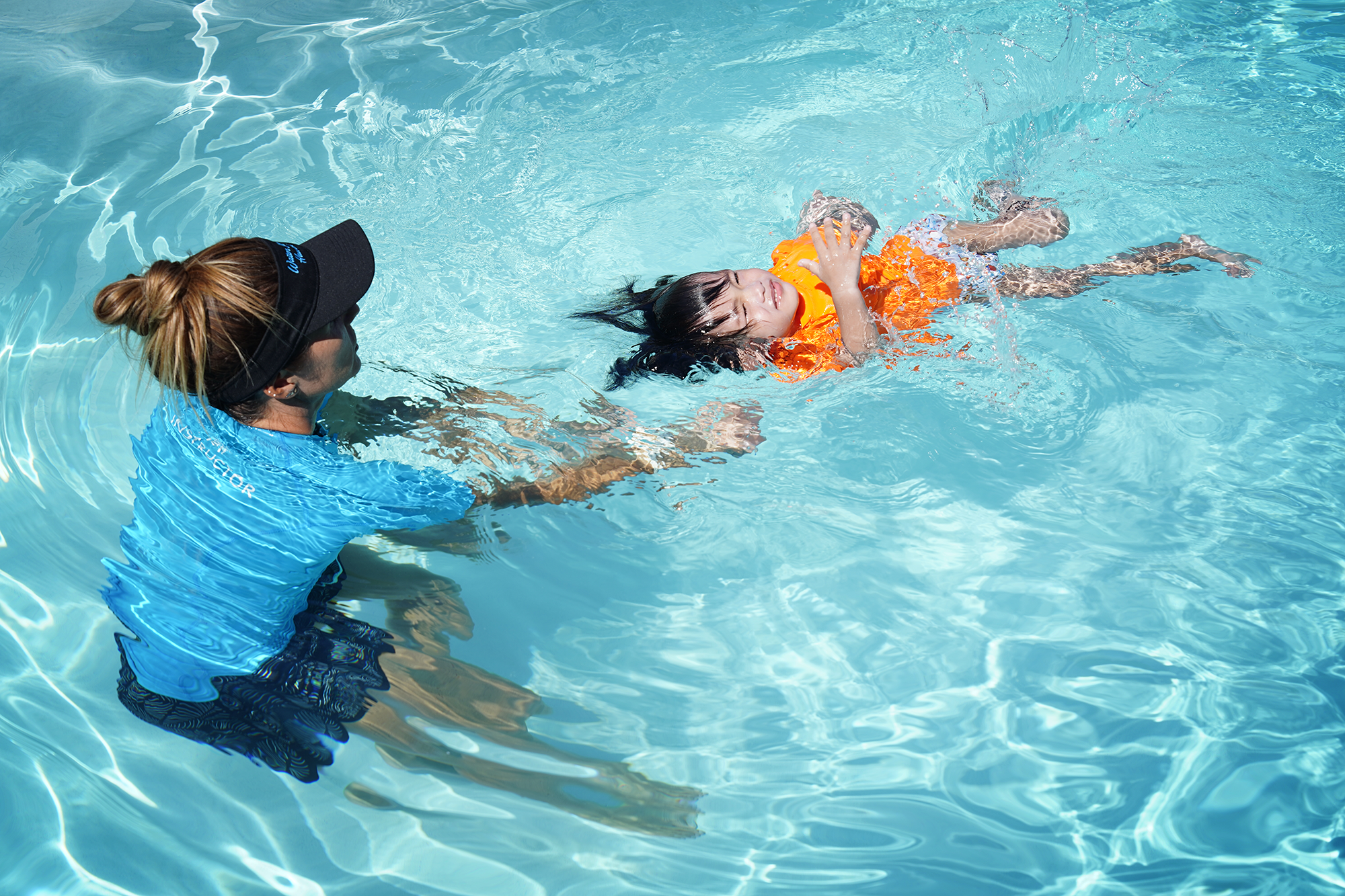
Jianni Romualdo did not want to get into the water. Teary-eyed, the 3-year-old approached the edge of the pool and reluctantly climbed in with his instructor, who tried to distract him by pushing a plastic submarine toy in the water.
“Is it floating?” the instructor, Audrey Harrer, asked him. “Can I see you float?”
Romualdo turned on his back and floated before flipping onto his stomach and swimming a short distance into Harrer’s arms. The exercise lasted only a few seconds, but Romualdo was demonstrating the basic skills he’d need to keep from drowning in the pool or ocean.
Romualdo’s mother says the six weeks that it took for him to learn those skills were a big time commitment for her family, but she knows how important it is. Her mother’s brother drowned in a pool on Maui when he was young and she wants to prepare her son for the dangers of growing up in an island state.
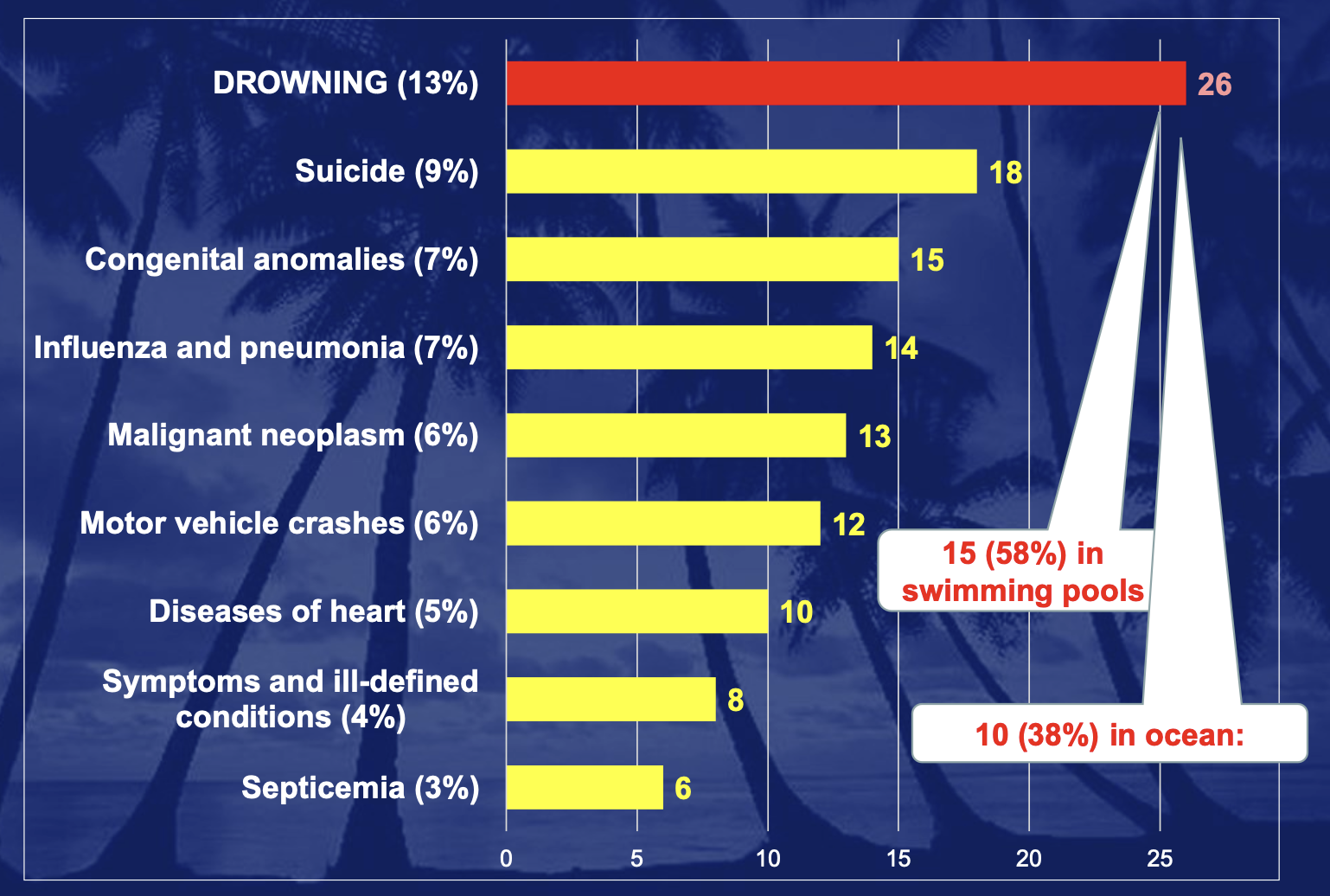
Roughly half of kids in Hawaiʻi — a state famed for its 1,000 miles of shoreline and year-round access to ocean recreation — don’t know how to swim, according to the latest available data. The state has the second-highest rate of resident drownings in the nation, and drowning is now the leading cause of death for Hawaiʻi kids age 1 to 15.

Swimming classes can be life-saving, said Harrer, the executive director of Water Safety Hawaiʻi, which focuses on drowning prevention for children. But lessons can be expensive and time-consuming for families, and most kids go without basic water skills.
Despite the alarming statistics, there have been few coordinated efforts to address the problem in recent decades — and little consensus about who should be leading the charge in Hawaiʻi.
Elementary schools currently are required to address water safety in at least one grade level, but the lessons can be brief and don’t include any real-world practice.
Lawmakers are currently considering a bill that would require the Hawaiʻi Department of Education to create a pilot program teaching kids water safety skills in local pools, but there’s been little buy-in from the department. The proposal is the latest in a series of failed efforts to provide swimming lessons in public schools statewide.
The education department declined interview requests for this story, as did the Department of Health, which develops the state’s injury prevention plans.
Hawaiʻi needs a central source of leadership to coordinate efforts between nonprofits and schools across the state, said Sarah Fairchild, executive director of the Outrigger Duke Kahanamoku Foundation. While the education department is best positioned to take on this responsibility, she added, lawmakers and other state leaders also need to push for more change.
“We’re just not reaching all the kids,” she said.
Uneven Access To Life-Saving Lessons
In a brightly colored activity book, a cartoon lifeguard and a pack of smiling sea animals survey the ocean.
“When in doubt, don’t go out!” the lifeguard instructs the animals. Next to him, a small orange graphic spells out the acronym KAI: know your limits, ask a lifeguard and identify the hazards.
The activity book, developed by the water safety nonprofit Nā Kama Kai, has been distributed to DOE elementary schools for the past four years. All schools are required to review the books, along with an instructional video, with at least one grade level to raise water safety awareness in the classroom.

The lessons are filling an important role of providing culturally relevant safety training to students, but they can only do so much if kids aren’t able to apply their knowledge in the water.
Hawaiʻi has world-renowned oceans and beaches, but being able to swim is shockingly a privilege for kids growing up in an island state, said Duane DeSoto, founder and CEO of Nā Kama Kai. While children read about water safety in class and frequently visit the beach with their friends, he added, working parents don’t always have time to teach their kids how to swim.
“At the end of the day, we’re not actually giving our children what we’re trying to sell to the world,” he said.
Even when children can learn how to swim from family members or friends, researchers say formal water safety lessons are necessary to ensure kids have strong survival skills, such as knowing how to tread water or identify rip currents at the beach.
But access to those lessons is unequal. In low-income schools, less than 20% of second graders could float, swim or tread water in a 2019 study from the Hawaiʻi Aquatics Academy, compared to nearly half of their peers at other schools. There are no public pools on Oʻahu’s Westside, further limiting access for families.
Native Hawaiian and Pacific Islander children are three times more likely to die from drowning than peers of other ethnicities, according to the Department of Health.
While the City and County of Honolulu offers free swimming lessons for children, spots quickly fill up.

The state came close to offering swimming lessons to all students in the early 1980s, when the now-defunct nonprofit Sea Trek introduced a “drownproofing” initiative in DOE schools that taught fourth graders basic survival skills in nearby pools. In the program’s second year, it served nearly 10,000 students across the state, said Ralph Goto, who worked for Sea Trek before serving as administrator of Honolulu’s Ocean Safety and Lifeguard Services Division for over three decades.
“That was really the only organized, concerted statewide effort that I remember,” Goto said.
The nonprofit faced challenges covering the program’s expenses, Goto said, but may have ultimately failed because of limited buy-in from education leaders at the time. The lessons ended in 1986 when the Board of Education stopped requesting state dollars for the initiative, citing the need to focus on teaching kids math and reading, according to a 1987 article from the Honolulu Star-Bulletin.
Three decades later, the nonprofit Hawaiʻi Aquatics Academy appeared to be gaining traction in similar efforts to provide free water safety lessons to students by pairing schools with nearby pools and swimming instructors. In 2023, the nonprofit projected that it would reach 2,500 students in 35 elementary schools across the state.
Before the pandemic, the aquatics academy estimated that if it had the funds to expand statewide, it could offer lessons for as low as $100 per student. The academy received some state funding through grants in its final years, but operating costs became too much for the nonprofit and it closed in 2023.

The false starts have come at a cost to the state, said Dan Worden, who served as a training coordinator for the academy and is now working with DOE on a similar, but smaller, water safety program.
The new initiative will take place in three Oʻahu schools this spring and will teach students basic water safety skills in Palama Settlement’s pool for eight weeks using a similar program that was developed under the aquatics academy. But the cost breaks down to $500 per child, a significant jump from the academy’s previous estimate of spending $100 per student to provide water safety lessons statewide.
Inflation accounts for some of these rising costs, Worden said, but it also takes a lot of money to create a program from scratch.
Education Department Doesn’t Want To Lead Effort
Despite a lack of significant funding and state leadership on drowning prevention, nonprofits such as the Alex & Duke De Rego Foundation on the Big Island have continued to partner with schools to offer limited water safety education.
Shirley De Rego, president of the foundation, plans to partner with about seven middle schools this year, but hopes to expand her reach to eventually serve all of the Big Island. Nonprofits like her own also need more funding to expand their programs across more schools, De Rego said. She estimates it costs $35,000 to run the foundation’s middle school program, which currently runs on grants and community donations.
It’s difficult to scale up these partnerships to the statewide level without a central source of authority, Fairchild said.
In Seattle, the mayor’s office successfully coordinated the work of community organizations and the city in the Swim Seattle initiative, which provides free swimming lessons to low-income children through public pools and local YMCAs. Leadership from the mayor was key in elevating the issue of drowning prevention at a larger scale, said Chezik Tsunoda, founder of the Seattle-based nonprofit No More Under, which advocates for water safety lessons and legislation.

Fairchild believes DOE should take the lead in facilitating similar partnerships in Hawaiʻi, although she also knows it’s a big ask from a department that already has so many other responsibilities.
“There needs to be a deeper solution,” she said.
A first-of-its-kind water safety plan released by advocates earlier this year also emphasizes the need for statewide leadership in educating kids about the dangers of drowning. The plan suggests that DOE require schools with on-campus pools to offer basic swimming classes and integrate lifeguard training into high school classes.
But DOE so far has been reluctant to take on the responsibility of bringing kids to the water.
In 2023, lawmakers considered a proposal that would have appropriated $1 million to the DOE to partner with nonprofits that could offer water safety classes in elementary schools. While it received strong support from families and drowning prevention advocates, Superintendent Keith Hayashi said the bill would place an “undue burden” on the department in his written testimony.
While the department recognizes the importance of water safety, schools have limited time to dedicate to physical education and health, Hayashi said. The Legislature would also need to provide sustained funding to cover the costs of hiring lifeguards and swim instructors and transporting kids to pools when they’re not walking distance from campus, Hayashi added. Only eight Hawaiʻi schools have pools on campus, none of them on Maui.
Pools aren’t the only way to provide water instruction, although bringing kids to the ocean is a more challenging venture, DeSoto said. Nā Kama Kai is currently working on a pilot that would partner with Westside schools and teach fourth graders the basics of water safety at the beach, although it would need special insurance to take kids in the ocean to practice swimming.

Lawmakers are now discussing a bill that would create a similar program to what was proposed in 2023, albeit on a smaller scale.
House Bill 1234 would require the department to partner with a community organization to provide water safety lessons for an elementary school within walking distance of a local pool. The pilot would receive two years of funding before the department would assess the program and report back to the Legislature.
Lawmakers have not yet decided how much money they would appropriate for the pilot.
If successful, water safety advocates are hopeful the pilot would lead to sustained funding from the Legislature that would allow more nonprofits to partner with more schools. But the department once again pushed back in its testimony, saying the proposed pilot is too similar to the program with Palama Settlement that it’s launching this spring.
While the initiative with Palama Settlement is a great opportunity, Worden said, it doesn’t seem like a pilot. The $100,000 sustaining the program this spring comes from one-time funding, he added, and he isn’t aware of any plans to continue the initiative next year.
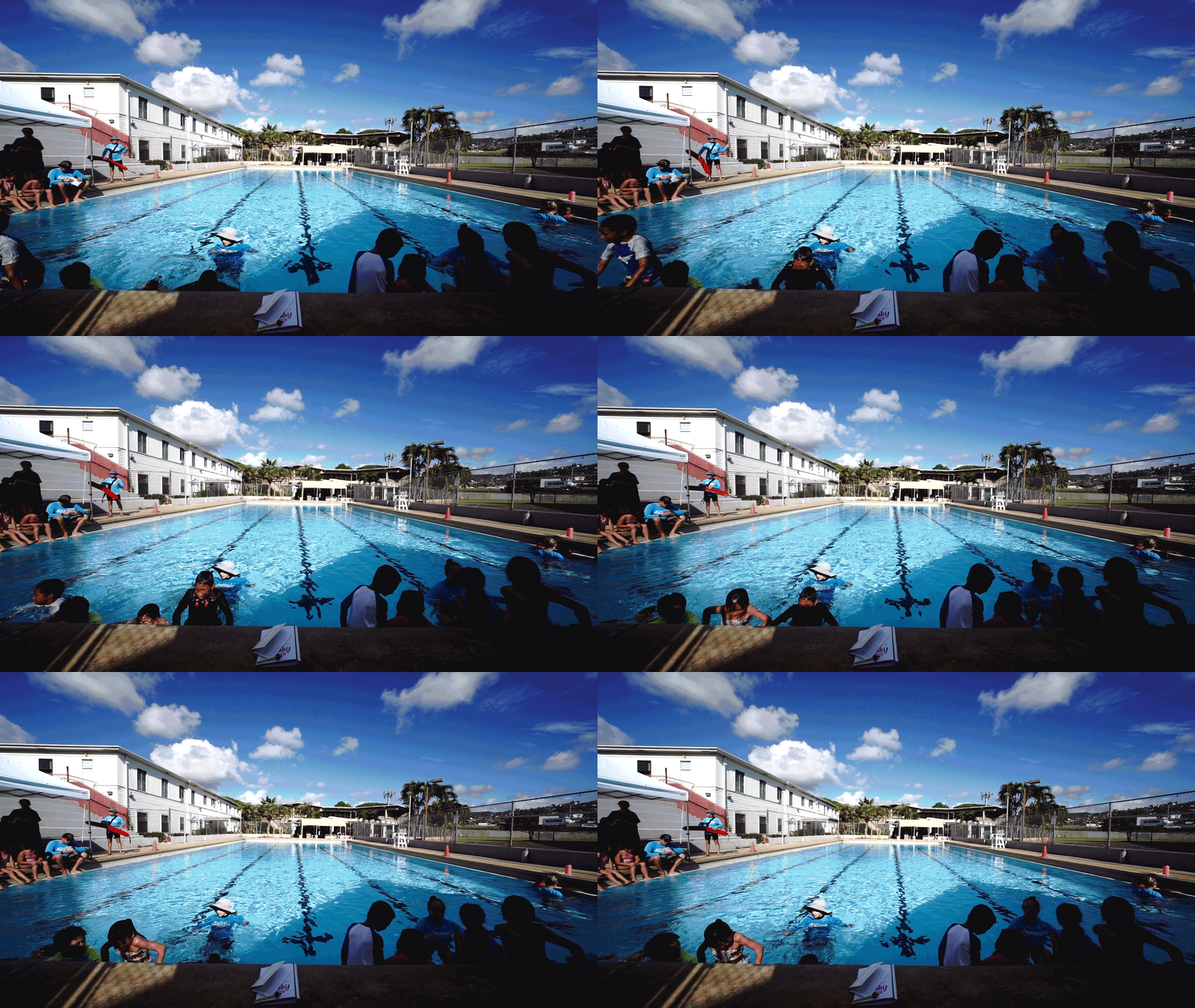
At Likelike Elementary, principal Kelly Bart said he’s grateful for any opportunity to get his students in a pool. The school previously worked with Hawaiʻi Aquatics Academy before the Covid-19 pandemic and will partner with Palama Settlement this spring for more water safety lessons.
Many of his students have never been to the beach, Bart added, and don’t know how to swim, even though Palama Settlement’s pool is walking distance from Likelike’s campus.
Still, he said, a statewide law requiring schools to offer water safety lessons in a pool or the ocean would be difficult to execute.
Alissa Magrum, interim executive director of the National Drowning Prevention Alliance, said a top-down approach is sometimes what’s needed to create sustainable change.
“Unfortunately, people need that legislative mandate to get it done,” Magrum said.
Civil Beat’s education reporting is supported by a grant from Chamberlin Family Philanthropy and its community health coverage is supported by the Atherton Family Foundation, Swayne Family Fund of Hawai‘i Community Foundation, the Cooke Foundation and Papa Ola Lōkahi.
