

Hawaiʻi Braces For Cuts That Could Strip Medicaid From Tens Of Thousands
Community health clinics offer a window into how the state might be impacted by hundreds of millions of dollars in cuts expected in the coming years.
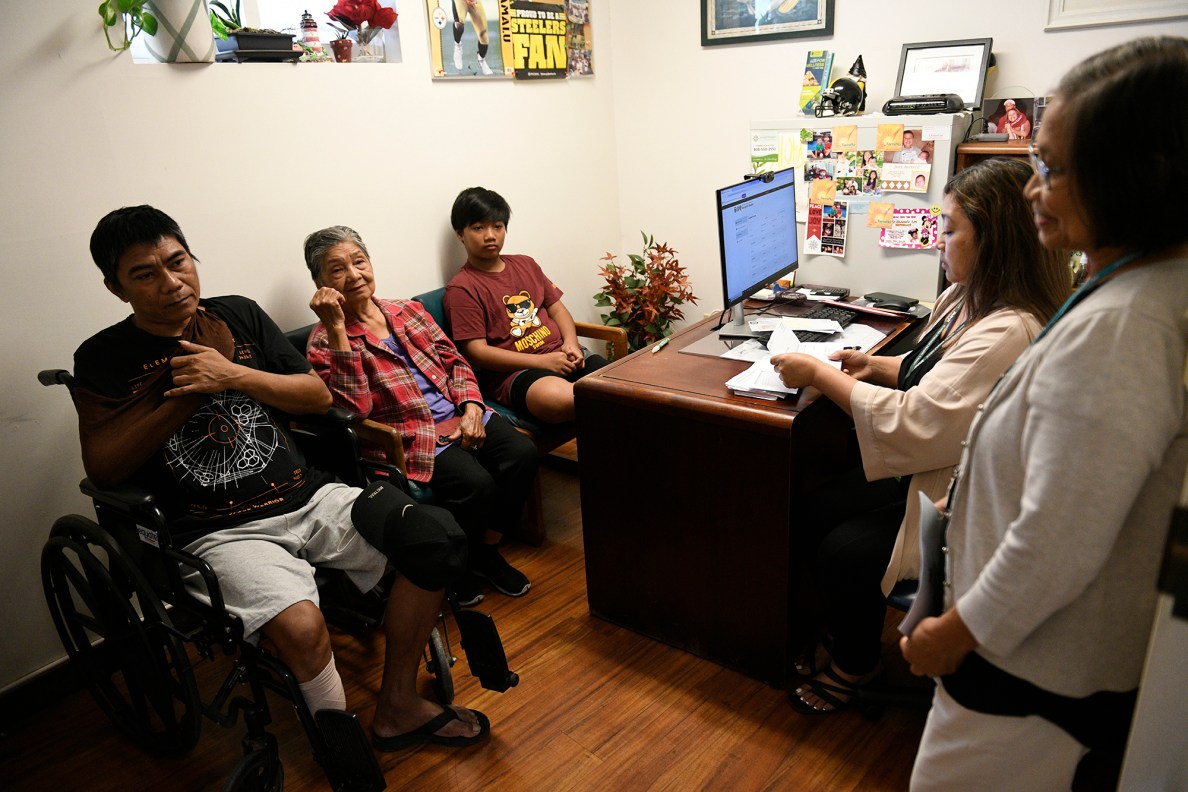
Donald Calano, his mother and son beside him, sat in his wheelchair in the cramped eligibility office at the Kalihi-Pālama Health Center’s clinic on North King Street. On the desk before them was a pile of paperwork to enroll him in Medicaid.
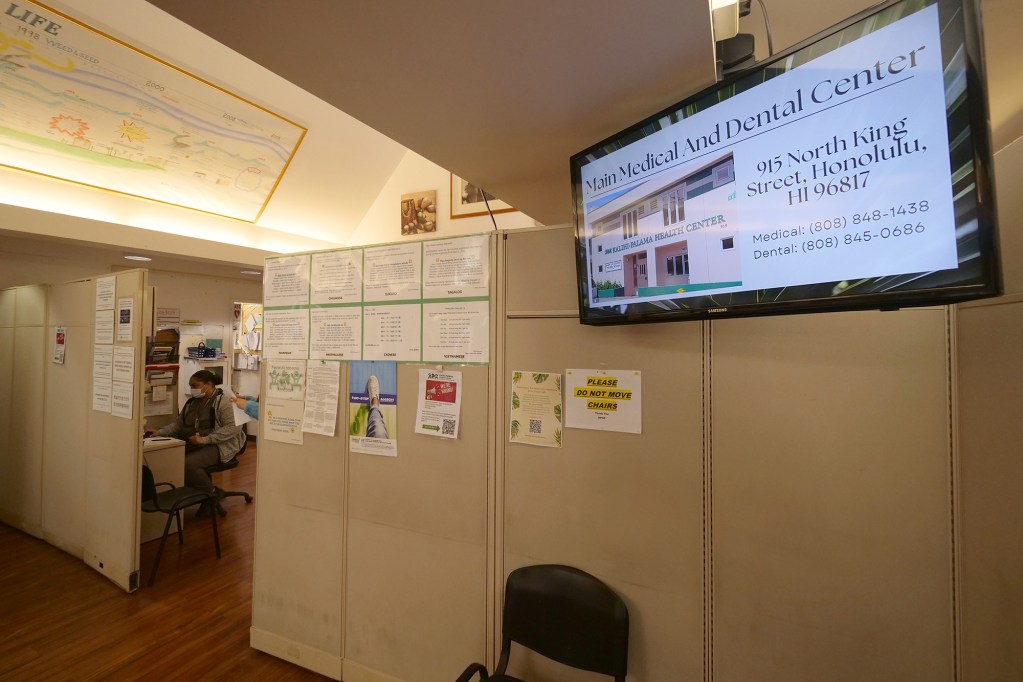
They had been among the first patients in the Honolulu waiting room, with a portrait of Queen Emma, a long mural illustrating the center’s 50-year history, and a television playing health care messages in languages ranging from Vietnamese to Tagalog.
Calano was in pain, with a leg injury, but he had no insurance and likely wouldn’t for another month.
The federal Medicaid program provides health care coverage to just over 400,000 Hawaiʻi residents with low incomes and limited resources. But dramatic changes are in store, compliments of the domestic policy bill – the One Big Beautiful Bill Act – that President Donald Trump signed into law July 4.
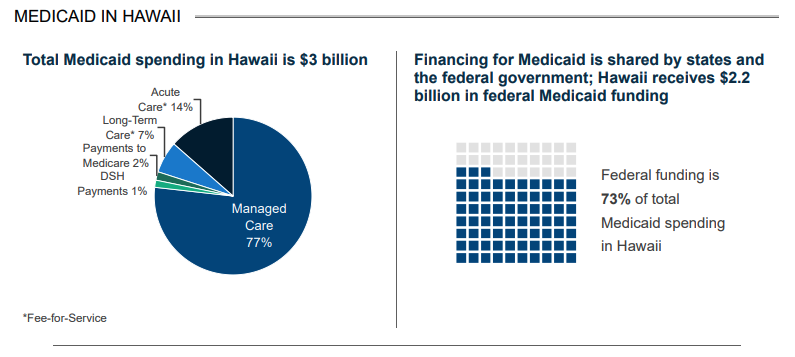
The law aims to reduce Medicaid spending by $1 trillion over a decade. Federal funds are about three quarters of the $3 billion Hawaiʻi spends on Medicaid each year, so the cuts are certain to have a major impact on the state, though it’s far from clear yet exactly what that will look like and — because of delays written into the bill — when.
“This is a major crisis in the making. Probably the top priority for the state to address after the Maui wildfires,” Ruben Juarez, a University of Hawaiʻi health economics professor, said in an email. “This is not a marginal policy change. This is among the largest single reductions in federal health support the state has ever faced.”
Calano, 50, a recent immigrant from the Phillippines, had no inkling of those developments. His leg – amputated below the knee last year after a motorcycle accident – was aching. He needed medical attention and had given the staff at the health center’s main North King Street clinic a battery of required details about his income, household size, assets and disability to qualify for the federal insurance program.
“This is a major crisis in the making.”
Ruben Juarez
Without that assistance, he said, speaking through a clinic interpreter during his clinic visit on Tuesday, he would have to “go around looking and asking for help.”
Marian Bernardino, the community health worker supervisor helping Calano with his application, stuffed the paperwork into two envelopes.
“I will submit all of this for you,” she said, adding that it might take up to a month for him to hear back from Med-QUEST, the state agency that administers the Medicaid program.
New Work, Enrollment Requirements
Bernardino felt good about Calano’s chances for approval, but the future of health coverage is uncertain for him and other Medicaid recipients under the new law, which among other changes requires people to renew their eligibility twice a year instead of once, and forces many to work.
The nonpartisan Congressional Budget Office in June estimated that up to 12 million out of the 71 million Medicaid enrollees nationwide — 12% — could lose their coverage as a result of the new law.
“Maybe 40,000 to 60,000 people will lose their Medicaid in Hawaiʻi,” said Emmanuel Kintu, CEO and executive director of Kalihi-Pālama Health Center, which has six primary care clinics around Honolulu. Two thirds of the organization’s 20,000 patients are covered by Medicaid.
“Those are vague projections, but based on the global projections that were given, you can say it’s going to be about that for Hawaiʻi,” Kintu said.
An analysis by the health policy research organization KFF concluded the bill’s provisions – intended to achieve about $1 trillion in cost savings over 10 years – would slash Hawaiʻi’s federal Medicaid funding by up to to $5 billion over a decade.
The state would have to fill that hole with its own money — perhaps through new taxes — or by cutting benefits and beneficiaries, or some combination of those measures, Juarez said.
“Unless the state acts decisively to cushion the blow,” he said, “we will see a meaningful reversal of the gains Hawaiʻi has made in health coverage and health equity over the past decade.”

Among those gains: just 3% of the state’s population is without health insurance today, the second best rate in the country.
That could easily climb to 10% if the state doesn’t intervene, said Jack Lewin, administrator of the state Health Planning and Development Agency and special advisor to Gov. Josh Green on health care innovation.
“It’s a real, distinct possibility,” Lewin said. “That would be scary. We would take action and turn that around if we started heading in that direction.”
Lobbying for a share of a $50 billion fund set aside in the new law for rural health providers will be a key step to shoring up Hawaiʻi’s Medicaid program, Lewin said. Another step might involve developing a short-term temporary insurance plan to help cover people no longer eligible.
‘Their Broken Bodies’
“Some of us have been here before,” Kintu said.
“Before” was from 2009 to 2020 when the state began to limit access to Medicaid for most migrants from Palau, the Marshall Islands and the Federated States of Micronesia, and eventually, in 2015, stripped it away entirely.
Hawaiʻi had covered those residents itself since 1996, when then-President Bill Clinton and Congress revoked Medicaid access for migrants from the three Pacific Island nations. In 2020, Congress reinstated it and began footing the bill again.
That era holds lessons about what happens when people lose access to medical care and what might happen for people who lose their Medicaid under the new law.
“A good number of these folk are going to suffer more,” Kintu said. “The ones who have conditions that are not really that bad are going to worsen because they say, ‘Okay, I’ll manage.’ In the meantime the condition is worsening.”
“And when they finally seek primary care in the hospitals and free clinics, the emergency rooms, they will be in really worse shape.”

In the end, Kintu added, “It is going to cost the state and the community a lot more to take care of those folks.”
Pacific Islanders are the Kalihi-Pālama Health Center’s single largest group of patients, nearly a third of its patients last year. Many receive care at its two clinics on North King Street in Kalihi.
At the newest of the two, on the corner of Pua Lane in a four-story building with a cheerful green tiled facade, Teko Gabriel got emotional.
She is a Micronesia native who has been an interpreter and community health worker with the health center since 2006.
Studies have found that Micronesians are hospitalized more frequently and suffer among the poorest health outcomes of any group in Hawaiʻi. Gabriel said that doesn’t bode well for those who lose coverage.
“I am so worried about my people,” she said. “I know my own Micronesian patients cannot afford to pay without insurance — and then with their broken bodies, with all their multiple health issues, what can we do to help them?”
The clinics offer a sliding fee scale for patients who are uninsured, but that may not be enough for many Micronesians, who have the state’s highest poverty rate.
“They are very afraid they might not be able to see a doctor because they cannot pay,” Gabriel said.
‘That Would Be Really Devastating’
Inside an examination room down the hall at the Pua Lane clinic, Jasmine Alviarez sat with her son Gabriel talking with Hue Nettrour, an eligibility worker.
Alviarez, 29, said she needed to see a doctor for a check up and showed Nettrour her phone; it displayed an image of her I-94 form, establishing that she had entered the United States lawfully from Venezuela.
Alviarez, a native of Venezuela, faces additional obstacles to Medicaid enrollment because immigrants who are not U.S. citizens already contend with tighter eligibility rules.
Undocumented immigrants do not qualify for Medicaid at all. States have been able to provide it at their own cost, as California has done but is now pulling back from; Hawaiʻi does so only in the case of life or limb threatening emergencies.
“You need to print this out and bring it back to me,” Nettrour told Alviarez about the I-94, suggesting that she could do that at a nearby 7-Eleven or library.

Nettour said she would try to enroll Alviarez in the same plan her son has, the UnitedHealthcare Community Plan, which is an insurance company that offers Medicaid policies.
The new law includes a provision that could add to Alviarez’s problems because, as a housekeeper, she might have difficulty providing proof of employment.
Work requirements will apply to most able-bodied adults ages 19 to 64 with incomes up to 138% of the federal poverty level, or roughly $49,000. That group – 130,000 people on Medicaid fit that category in Hawaiʻi – will have to prove that they work 80 hours a month, or participate in volunteer service or education activities, or be disenrolled.
“Those individuals will likely see the largest impacts of the new law,” said Judy Mohr Petersen, Med-QUEST Division Director.
Some 64% of all Hawaiʻi Medicaid recipients are already employed full or part time, another KFF study found.
“I don’t want it to be as many as happened in other states.”
Judy Mohr Petersen, Med-QUEST Division Director
The experience of states which have tried adding work requirements, like Arkansas, shows that even employed Medicaid recipients often get pushed off the rolls, Petersen said. Combining that with the new law’s requirement that recipients prove their eligibility twice a year instead of once, she said, means more people will lose coverage.
“What we know is that whenever you increase the paperwork or increase the number of times that people have to enroll, it creates an administrative burden and that increases the likelihood that people will drop off, even though they may still be eligible,” she said.
“I don’t want it to be as many as happened in other states,” she added. “That would be really devastating for our community and our families.”
Petersen is trying to tamp down fears of immediate impacts. She noted that the work requirements do not take effect until next year. It’s also possible the state might be able to obtain a waiver until December 2028, giving recipients and officials more time to plan and prepare.
“If you put in the possibility of an extension to 2028, that picture begins to look a little bit different,” Kintu said. “It says to us that if you get busy now, you might be able to cushion the impact of this.”
‘We Depend On Healthy Parents’
What happens to patients who lose insurance coverage is predictable, medical providers said. They get less or no primary care, see specialists even less, go without medication and miss out on important lab tests.
“A lot of people, they just don’t come in, even on a sliding scale, and then they end up with abscessed teeth and they end up having to go to the hospital sometimes,” said Keith Larsen, dental director at Kalihi-Pālama Health Center.
With insurance, he said, “we could see them and, just for an example, catch them before they abscess and prevent a lot of hardship.”
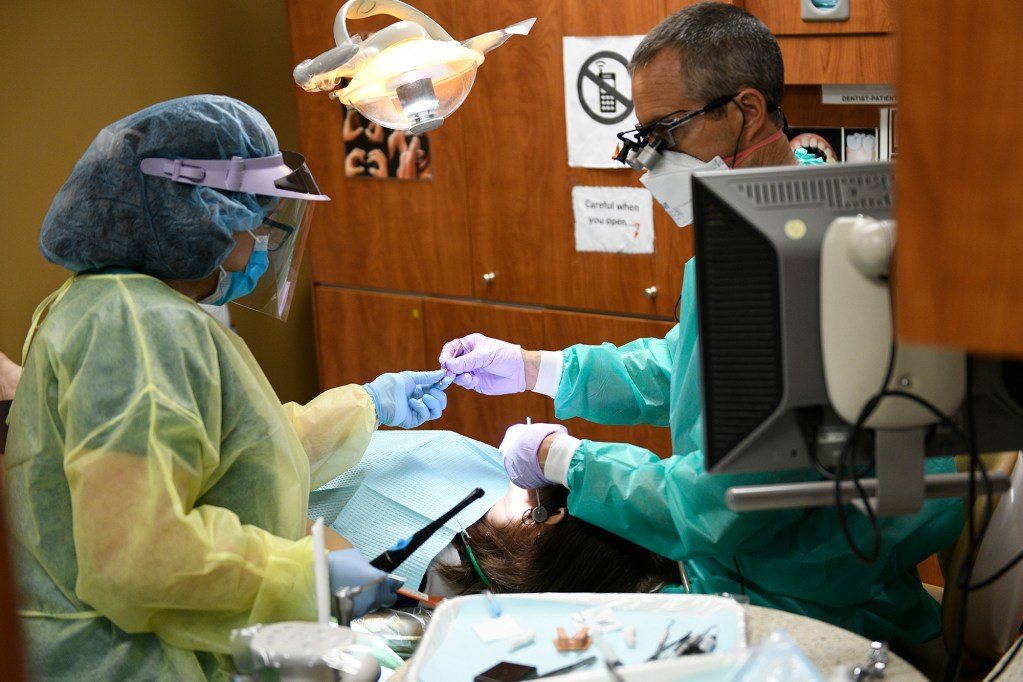
Patients also lose out on the opportunities proper care can provide.
“We’ve had patients with tears coming down their face after they get a set of dentures so they can go on with their lives and get a job and things like that,” he said.
Looking at the new law’s Medicaid provisions, the brunt of the cuts will fall on “primarily low-income women and parents and will affect the stability of households and hence children,” said Françoise Culley-Trotman, CEO of nonprofit AlohaCare, the state’s second largest Medicaid insurer.
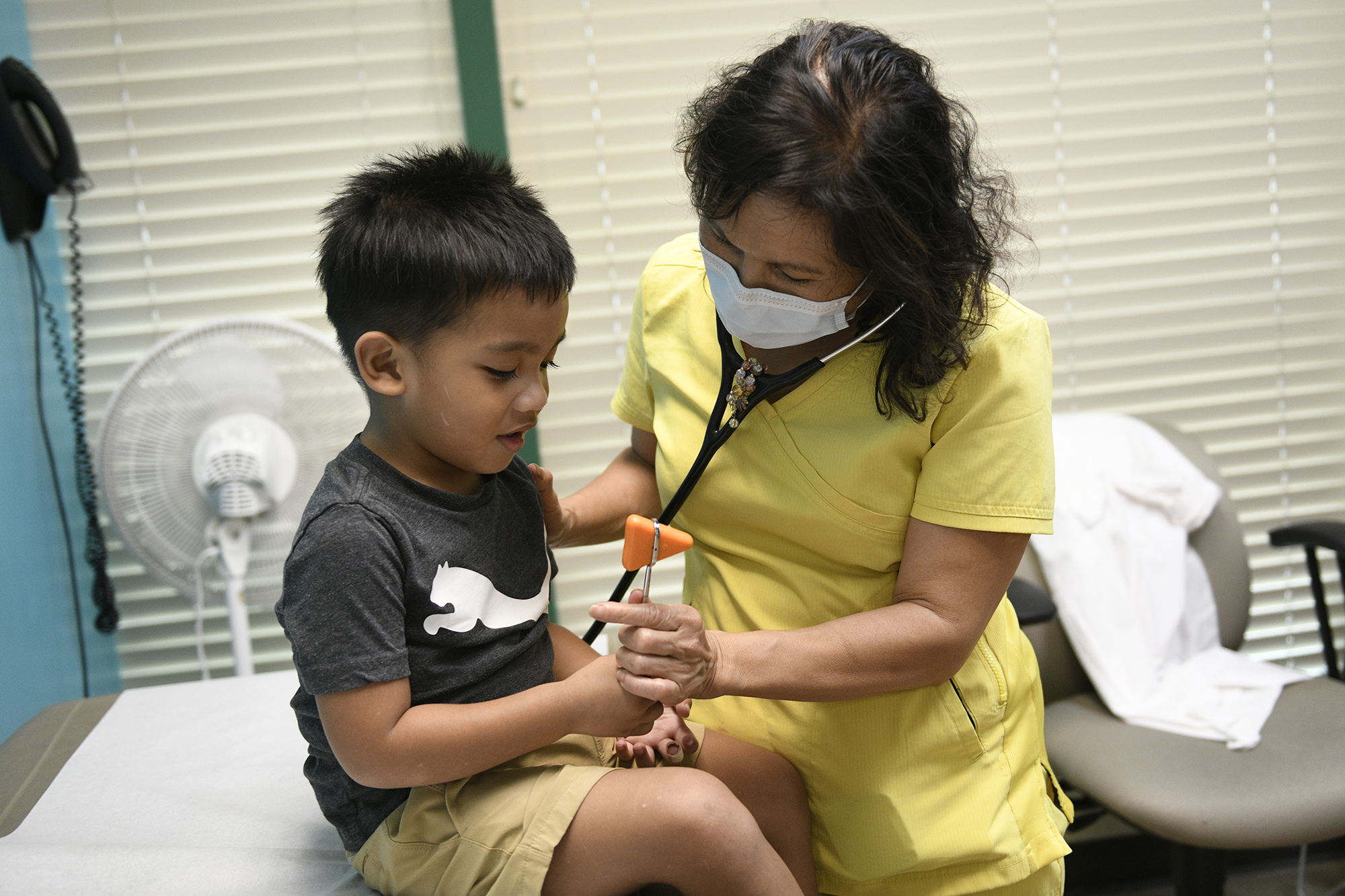
At the Kalihi-Pālama Health Center’s downtown clinic on Tuesday afternoon, Yone Bellu helped his grandson Yonzu Bellu get up on the examination table. The 3-year-old, who had been crying a few minutes before, giggled as Blandi Mamaclay, a nurse practitioner, gave him a reflex hammer and used a stethoscope to check his breathing.
The boy lives with his Marshalese grandmother and two aunts in Honolulu. He was just getting a check up on Tuesday, but also receives speech therapy at the clinic.
Regardless of whether they lose coverage under the new law, children are likely to experience poorer health outcomes if their parents are dropped from Medicaid, said Michael Walter, a Kalihi-Pālama Health Center pediatrician and its assistant medical director.
“The kid’s health and wellness comes from the family, and most health care decisions and care takes place in the home. So we depend on healthy parents,” Walter said.
As 5 p.m. closing time approached, the waiting room at the health center’s main clinic on North King Street was as full as it had been when the day started. By then, another 14 patients had come through to file their paperwork to enroll in Medicaid or renew their eligibility.
An older man finished his visit at a receptionist’s window. “Gracias. Que Dios te bendiga,” he said. Thank you, God bless you.
Civil Beat’s reporting on economic inequality is supported by the Hawaiʻi Community Foundation as part of its work to build equity for all through the CHANGE Framework; and by the Cooke Foundation.
Civil Beat’s community health coverage is supported in part by the Atherton Family Foundation.
