


Editor’s Note: Here in the middle of the Pacific Ocean, signs that climate change has arrived are all around us. We see it in our disappearing beaches, the flooding of our homes, the ever-looming menace of wildfire. For us, climate change is more than a threat on the horizon and far bigger than an inconvenience. And we share this truth with our island neighbors across the Pacific, the region known as Oceania that stretches from Hawaiʻi to New Zealand. In this ongoing series, we tell the stories of people living on the front lines of climate change.
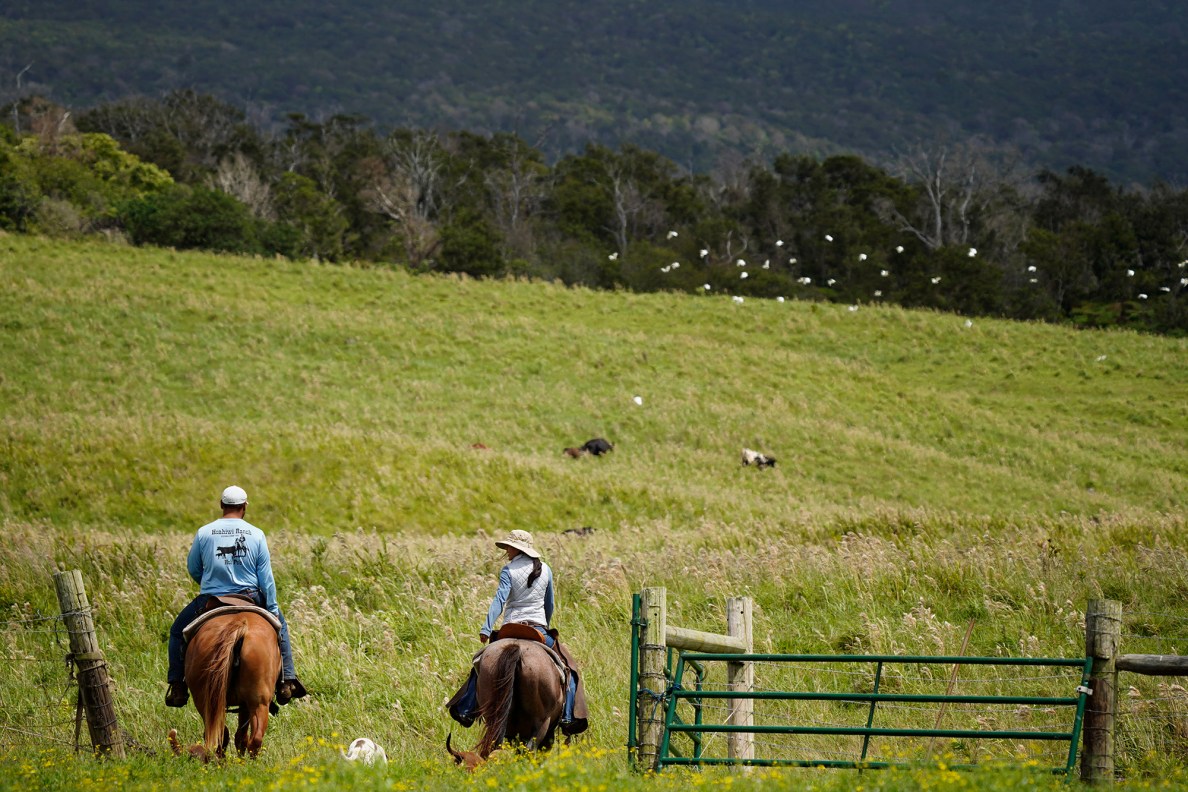
The Kuahiwi Ranch paniolo whistle and holler over high winds, urging the herd of cattle across arid pastures flecked with lava rock.
“Get ‘em up, get ‘em up, get ‘em up,” one yells as they near the corral.
It’s a dusty caper and, for seven of these Big Island steers, this is the end of the road.
Bulging chest, thick torso and a fat rump are among the traits the cowpokes look for as they choose the best candidates for slaughter. Thanks to current climate-driven conditions, however, the land is producing fewer of them.
The only meaningful rainfall for months in the Kaʻū region at the southernmost tip of Hawaiʻi County was a May shower that brought less than an inch — moisture quickly wicked away by the district’s strong southeasterly winds.
“It’s been a struggle,” says the rancher, Guy Galimba. “It’s hard to make grass-fed animals without grass.”
With summer fully underway, it’s only going to get worse.

Extreme drought was declared for Kaʻū in May. Ranchers brace themselves for that possibility every year but this one hit hard since it followed the second-driest wet season in three decades. A dehydrated landscape not only increases the risk of wildfire and kills off native flora and fauna, it impedes progress in Hawaiʻi’s crusade to shrink its reliance on offshore food.
The state’s beef and cattle industry grew to take the place of plantations as one of the strongest agricultural industries, with ranches now covering nearly a fifth of the state and supplying about 9 million pounds of beef to the local market each year.
Now, on Kuahiwi Ranch, the pasture cannot sustain the herds of the past. Galimba has dropped from 1,300 head to about 800. In May, he sold 120 steers to mainland buyers — herding upward of 70,000 pounds of future beef into the belly of a Boeing 747.
That leaves him hoping for the unthinkable: a summer hurricane that would bring a deluge along with destruction.
“I want a bad year,” he says. “I hate to put it that way but it’s just the facts.”
‘It’s a Compounding Problem’
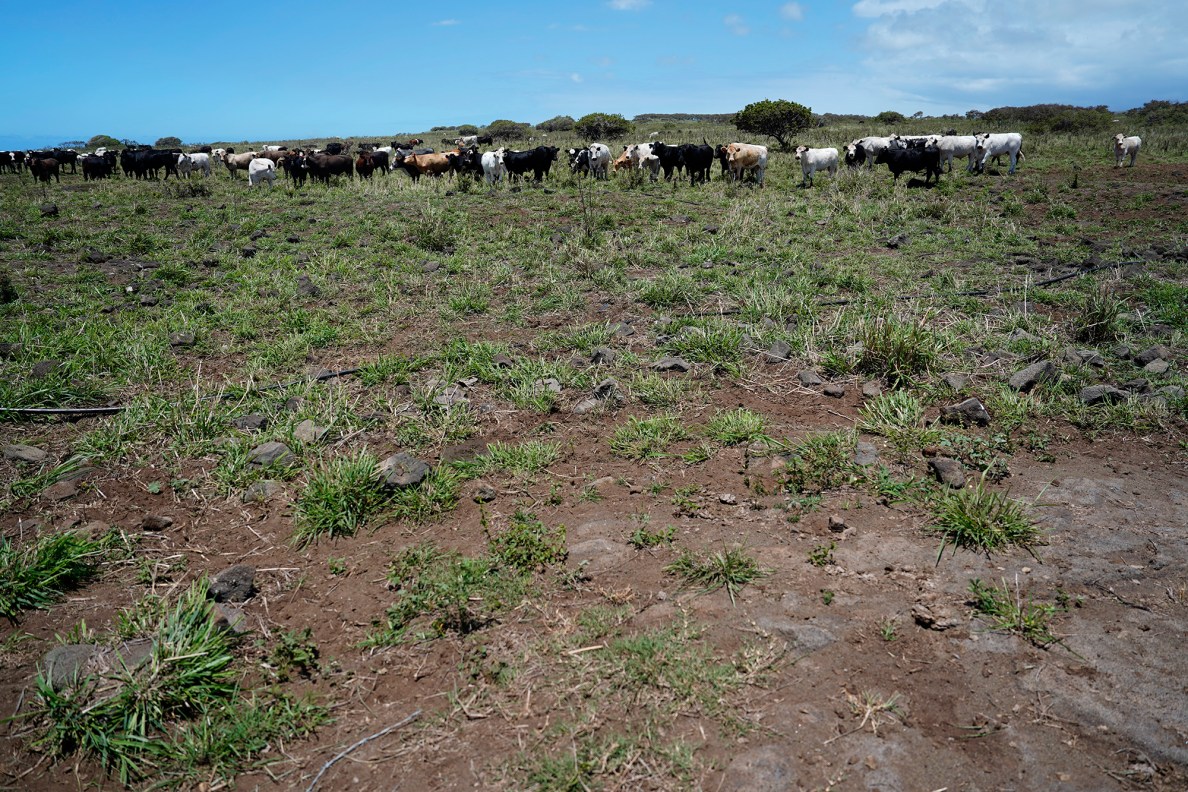
As the main road into the town of Nāʻālehu cuts through Kuahiwi Ranch’s 10,000 acres it traces a line between verdant green and camel tan.
The division is a microcosm of Hawaiʻi, where mountains guide persistent northeasterly trade winds and block swaths of the islands from rain, while the islands’ diverse ecosystems attract and retain water in different ways. That’s why the ranch’s upland or mauka acres are greener than its dry and windswept coastal land.
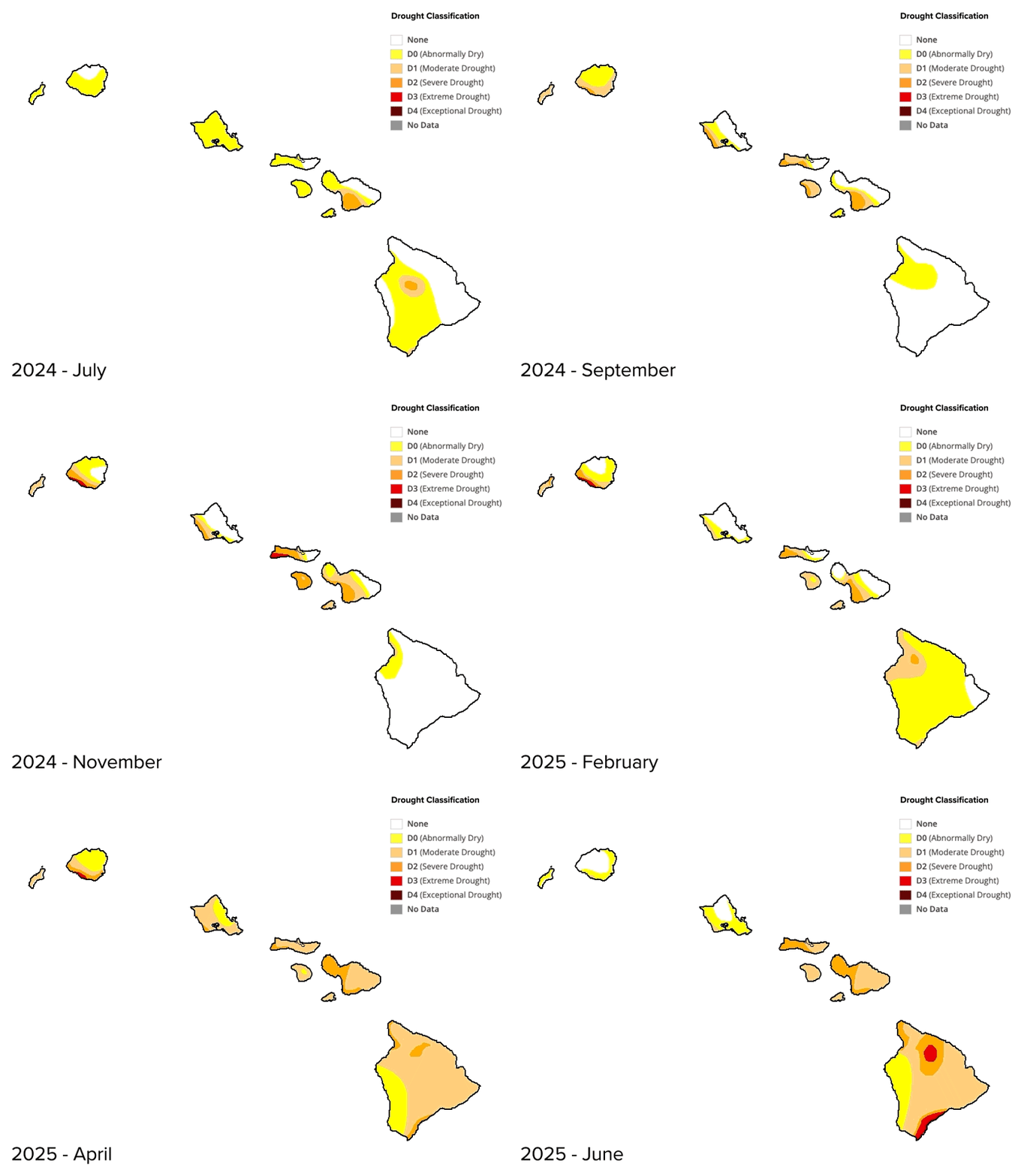
According to the U.S. Drought Monitor, Kaʻū is one of the two driest districts in Hawaiʻi County, along with a portion of land on the northern slopes of Mauna Kea, where ranchers are also struggling.
The climate is undeniably changing, although researchers can’t yet say for sure whether global climate change is the main culprit.
Much of the state’s long-term weather forecasting has focused on the El Niño Southern Oscillation, with years designated as El Niño or La Niña. During El Niño years, winters are typically dry; La Niña brings relief.
Now that’s changing. A La Niña cycle was officially declared in December. Yet rain has barely fallen on Kuahiwi Ranch, on much of the Big Island or on Lānaʻi, Molokai and Maui.
While Oʻahu and Kauaʻi have suffered less, with even leeward areas getting more rain than usual, offering hope, a growing body of research shows the La Niña seasons have been getting drier and longer for decades.
Scientists do generally agree that the Earth’s temperatures are on the rise, with 2024 the hottest year on record. But there’s no consensus yet on whether that is affecting rainfall or the El Niño system. University of Hawaiʻi drought researcher Ryan Longman says that is because it’s part of a broader network of climate phenomena, making a single cause harder to identify.
El Niño is the big one, but there’s also the Pacific Decadal and Madden-Julian Oscillations. Then, Longman says, there’s the Pacific Meridional Mode. Each operates on its own time schedule, influencing one another.
“It’s complex to say the least,” Longman says. “And it’s dynamic.”
Now researchers are trying to take a broader view, accounting for all the systems and their influence on rainfall. The days of relying solely on El Niño are over, according to Hawaiʻi State Climatologist Pao-Shin Chu.
“Like climate change itself, these climate modes are expected to change as well,” Chu says. “We cannot assume that we have a stationary climate.”
Ranchers, who oversee about 750,000 acres of diverse landscapes across the islands, have come to understand that they cannot bank on weather forecasts to inform their plans. In the upper reaches of the Big Island last year, they trucked water onto their land to deal with severe and extreme drought conditions — conditions that have improved there in recent months.
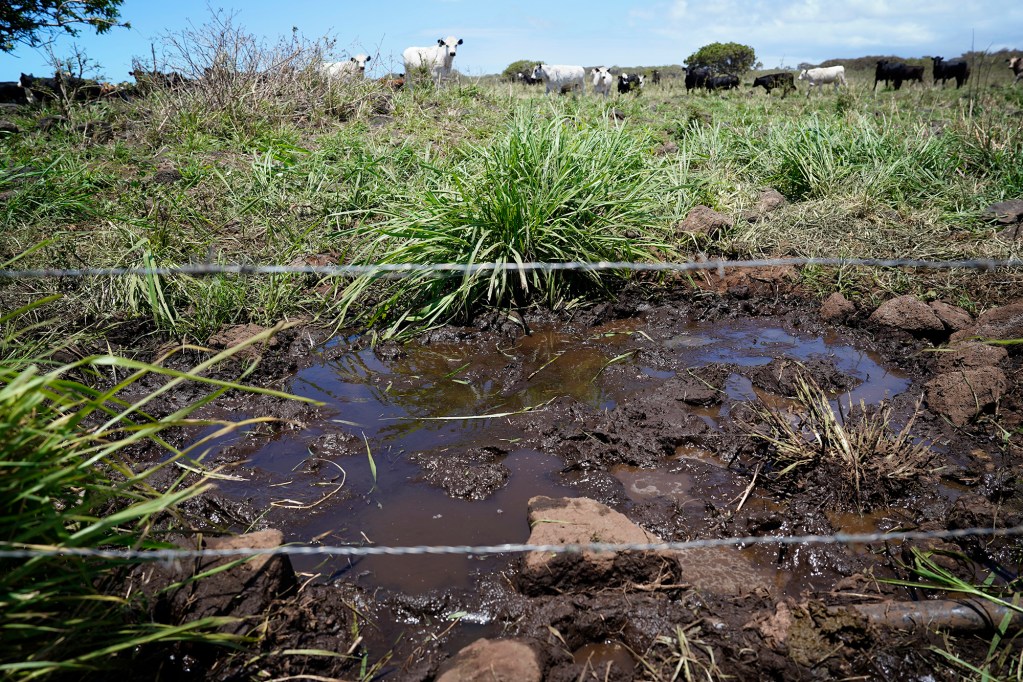
Yet wetter parts of the island, like the northern Hāmākua Coast, are dry this year. Rancher Jason Moniz has already taken 100 cattle out of his herd on KK Ranch. If the drought continues through the summer, he may need to bring it down another 200 — to about 500. Like Galimba, he’s wishing for a summer miracle.
“I’m wishing for tropical depressions and storms. Everybody worries about those, and I’m hoping for a direct hit,” Moniz says. “Maybe two, three days, a good soaking, would get us through the dry season.”
Galimba has observed his district’s unique weather patterns for 32 years, ever since he and his father started the ranch. Rain should come in September or October. Now it shows up closer to November or December. And this year there wasn’t any rain after that at all.

So he doesn’t get his hopes up when the nightly news predicts an incoming storm.
“Don’t believe too much of what the news says,” he says. “Every time they say it’ll rain, they’re looking at Honolulu, where most of the rain comes from the north. For us, we need rain coming from the east and the south to hit us.”
Centuries Of Ranching Evolution
On that main road dividing Nāʻālehu and Kuahiwi Ranch sits the ranch’s store, where a steady stream of local residents stop to buy local beef, lamb, eggs and feed for their animals.
In a barebones office space next door, Galimba sits with his 21-year-old daughter Kealia, who works in the office and out in the pasture. They sell hay but they’ve run out; customers bought it all to replace the pasture grass that isn’t growing.
Those customers are predominantly from smaller operations, with animals like horses or goats, because large-scale cattle “ranchers can’t really afford” to supplement with other feed, like hay or molasses, Galimba says. “You can’t feed on a consistent basis or you’ll be bankrupt.”
Cattle have grazed the Big Island for 232 years, since British Naval Capt. George Vancouver gifted King Kamehameha six cows and one bull. Kamehameha protected the cattle to increase their numbers, prohibiting anyone from killing the animals, which led to tens of thousands of wild and domesticated cattle roaming the island within decades.
King Kamehameha III lifted his father’s prohibition when the wild population became too unwieldy, inviting Mexican vaqueros to train locals how to work with cattle. That gave rise to the term and tradition of paniolo, an adaptation of the Spanish term vaquero, and Hawaiʻi’s ranching industry.


Three generations of paniolo have worked on Kuahiwi Ranch, and Guy Galimba is hopeful his daughter (top) and son will eventually take over. (Kevin Fujii/Civil Beat/2025)
The industry evolved to where Hawaiʻi produced almost all of its own beef, partly thanks to feed lots where ranchers finished cattle for the local market. By the early 1990s, national and global market forces forced shipping prices up, making grain unaffordable and eventually shuttering the state’s feedlots.
The islands’ paniolo adapted by embracing a cow-calf model for ranching, which focuses on breeding cows and shipping their weaned calves to the mainland, where they are sold and finished on feedlots.
Hawaiʻi’s strong reliance on grass today makes it different from much of the rest of the country where a majority of the cattle are finished in feedlots, where animals are fed on grain, widely considered a more efficient way to fatten up cattle.
Hawaiʻi cows produced 59,000 calves last year, according to the U.S. Department of Agriculture. But a growing contingent of ranchers are trying to keep cattle in the islands from birth to plate in response to a renewed demand for locally grown food.
The state is partly driving that demand with mandates for its agencies to buy local. The Department of Education, for one, is supposed to spend 30% of its food budget on local ingredients within a few years. Last year, the agency spent $2.5 million on ground beef.
In light of these goals, the managing director of Hawaiʻi Cattlemen’s Council points out that ranchers still need the escape valve of being able to ship cattle to the mainland to be fattened up, which keeps them in business for better times.
“When the feed and forage returns, then there’s still an operation to be able to raise that beef for local finishing,” Nicole Galase says.
The U.S. is currently facing its worst cattle shortage since the 1950s, which has driven up the price of cattle, creating a second incentive for ranchers to send their cattle off the islands.

“Everybody’s just dumping their wean-offs and shipping them to the mainland,” Galimba says. “So your grass-fed market is also shrinking. It’s partly because of drought, then part of it is you can make almost the same or more, sending your wean-offs.”
The climate conditions favor sending calves to the mainland as well: Dry pasture provides less nutrition for pregnant and lactating cows.
Even if it does not make the best business sense, Galimba and his family take pride in keeping at least some of their cattle on the ranch and seeing it on grocery store shelves, or at their own store. He also fears that with less visibility in Hawaiʻi, demand will drop, forcing them back into a more export-focused operation.
Two of Galimba’s children, Keālia and her 27-year-old brother, Grant, have the same attitude.
“It fills you with so much pride when you walk into the store and see it’s from your place,” Grant Galimba says. “It’s not just a sell-out to somebody else who’s manufacturing and packaging under their brand. You get the full experience of the farm-to-table thing.”
Irrigation Helps — At A Cost

Once the cattle drive is complete and the seven slaughter-bound cattle are loaded onto a trailer, it’s time for another roundup. The paniolo load their horses onto another trailer and drive north, to Kuahiwi’s uphill pastures.
The crew crosses the main road of Nāʻālehu, into the hills and northeast along an old cane haul road, one of the district’s many reminders of the more-than 100 years of plantation agriculture that once underpinned community life.
They unload and mount their horses at the Airstrip Corral, named after the nearby runway constructed by the plantation, then drive the animals south into a stockade. It’s a chorus of paniolo whistling, dogs barking and cattle lowing, as the ranch’s bulls are separated ahead of breeding season.
From this windswept corral you can see at least 10 miles east to where the ocean crashes white against the black volcanic coastline as it snakes past Punaluʻu and Kamehame Beach. That vista provides its own weather report.
“It cuts across here in the afternoon, you’ll see it,” Guy says of the rain. “It’ll hit Pāhala, come across and stay right above Punaluʻu.”
In these upland pastures, rain is far more common than along the coast thanks to forest that attracts and holds the moisture. Irrigation from reservoirs feeds the land, too. Galimba’s more-than 1 million gallons of reservoir capacity has helped him survive the hard times — although even it has almost run dry a couple of times.

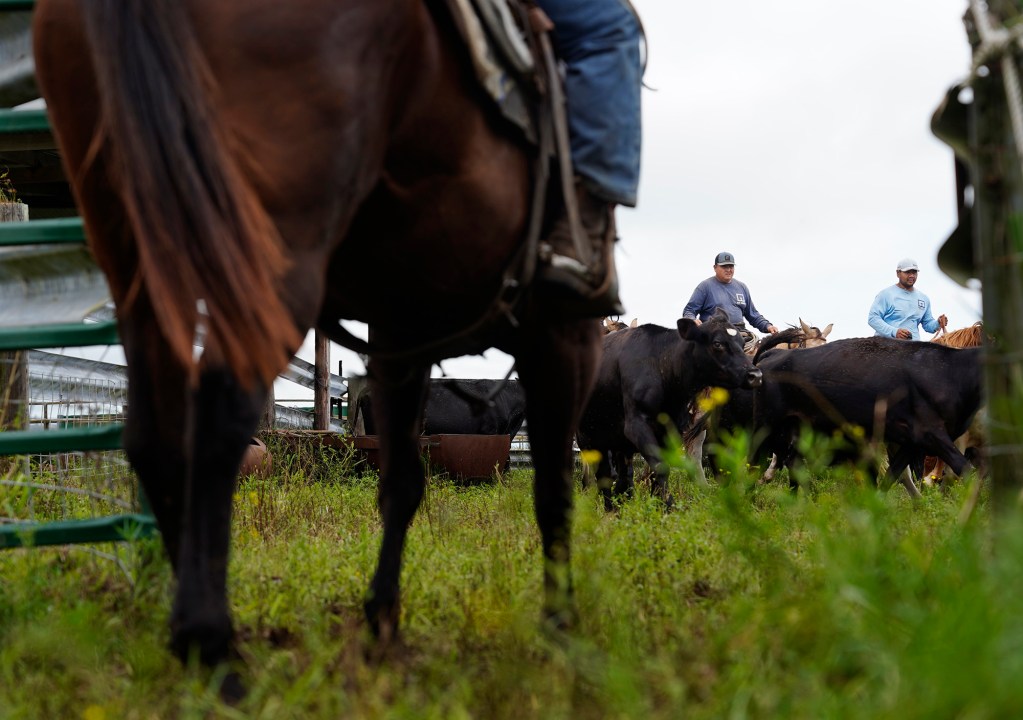

Building water infrastructure is expensive, a stopgap measure that can also be prohibitively costly. With droughts lasting longer and getting more intense, they may become more attractive investments.
The district of Kaʻū has faced 17 droughts since 1920, the longest lasting more than seven years. Lani Petrie, who runs the neighboring Kapāpala Ranch, has witnessed many of them. “Summers can be brutal,” she says.
The last extreme droughts to hit Kaʻū came in 2010 and in 2012, two of the five droughts there that University of Hawaiʻi research has deemed extreme in its 104-year assessment of the state’s drought history. Since then, Petrie has found the weather “abnormally wet.”
According to the data, Petrie is correct. The past few years have been wetter, bucking an almost century-long trend of less rainfall across the district, according to data from the Pacific Drought Knowledge Exchange, an initiative of think tank East-West Center.
The exchange has developed a tool that helps forecast regional climate outlooks based on more than a century of meteorological data. For Kaʻū, the news is not good: Annual rainfall is projected to drop by up to 26% by the end of the century while temperatures rise by up to 6%.
For Petrie, who is the Hawaiʻi Cattlemen’s Council president, droughts have side effects as she expands and contracts the business on her 35,000-acre ranch to cope with the conditions. It’s far harder to build a herd back up after drought, she says, because Hawaiʻi ranchers typically can’t purchase replacement cattle — they have to breed them.

“In the mainland, you can go to another region where they weren’t in drought and buy replacement heifers,” Petrie says. “They put them in a truck and ship them, right? One day (and) they’re down at your ranch in Texas. We can’t do that here.”
Petrie has been on the ranch for 48 years, with every dollar in profit immediately invested in water infrastructure, including a $1 million water reservoir.
“With our catchment system right now, half an inch of rain is 100,000 gallons of water,” she says. “As ranchers and farmers, we built these kinds of things into our equations.”
Yet she is not yet convinced the climate is changing for the worse in her district. In fact, she’s skeptical of the link between what is happening on the Big Island and climate change.
“I think the world’s been moving in directions for millions of years and we’re not going to see — in a couple of decades — a big change,” Petrie says. “The sky is not falling in.”
Fighting Through It
Grant and Kealia Galimba sit together in the ranch office, having spent the previous day driving to and from the slaughterhouse in Paʻauilo, where they dropped off the seven cattle to be processed for the local market.
The five-hour round trip, like the horseback cattle drive to separate the bulls two days earlier, is one of their many weekly tasks. It’s hard work, they say, but also rewarding. They are unusual in an otherwise aging profession. Almost one-third of Hawaiʻi’s food producers are over the age of 65.
“Being farmers or ranchers, it’s like a dying breed,” Grant Galimba says. “There’s not much of us left, who are actually into this stuff. Everybody wants a comfy lifestyle, A/C. But the hard work really pays off.”
Both have lived their entire lives on the ranch, witnessing the rising temperatures and longer dry spells. They have come to learn the power of contingencies, that “having a back-up plan for your back-up plans” is always in the ranch’s best interest, Grant Galimba says.
Whether they believe there’s a link to climate change, neither can say, but nor do they question whether the ranch will survive. And while the cards appear stacked against them, they want to carry on what their father has built.
“Even,” Kealia Galimba says, “if you just have to fight through it.”
“Hawai‘i Grown” is funded in part by grants from the Stupski Foundation, Ulupono Fund at the Hawai‘i Community Foundation and the Frost Family Foundation. Civil Beat’s coverage of climate change and the environment is supported by The Healy Foundation, the Marisla Fund of the Hawai‘i Community Foundation and the Frost Family Foundation, and on Hawaiʻi island by a grant from the Dorrance Family Foundation.
