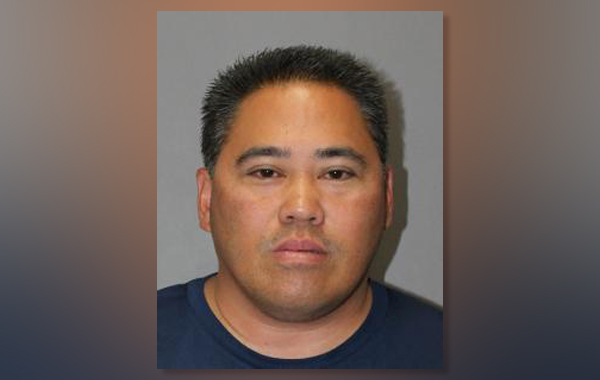
During his 29 years with the Honolulu Police Department, Darren Cachola was repeatedly accused of violently assaulting women, fired after a video surfaced of him hitting his girlfriend in a restaurant and sued for his role supervising DUI checkpoints where sober drivers were arrested.
Though his well-publicized bad behavior repeatedly tarnished the police department, Cachola always managed to walk away unscathed, regaining his job and clocking in enough overtime hours in his final years on the force to retire on Aug. 1 with a pension that could approach what the chief earns.
As a final goodbye to policing, Cachola distributed a flyer inviting family and friends to a retirement party on Aug. 22. It reads “The man, the myth, the legend” and contains a photo of a protester holding a sign with Cachola’s face next to the faces of Derek Chauvin, the Minneapolis police officer convicted of killing George Floyd in 2020, and George Zimmerman, the Florida neighborhood watch volunteer who shot and killed Trayvon Martin in 2012.
For those who have followed his long and troubled career, the flyer is disturbing but unsurprising.
“It doesn’t surprise me in the least that he revels in a comparison to a violent felon,” said Loretta Sheehan, who was chair of the Honolulu Police Commission when Cachola was charged with domestic violence assault, a crime for which charges were eventually dropped.
“HPD wonders why they can’t recruit new officers, why the job of being a police officer suddenly doesn’t seem that attractive,” Sheehan said. “Well, they don’t really have to look very far, do they?”


Even though Cachola is off the force now, his behavior will have lasting consequences for the department — and taxpayers.
The administrative sergeant is being sued by the ACLU for his actions supervising DUI checkpoints where attorneys say more than 100 sober drivers were arrested for driving under the influence. Staffing at the checkpoints was paid as overtime through a grant, which incentivized the officers to work the checkpoints and make more arrests.
Cachola raked in major amounts of overtime in his final three years on the force. During his last year as an officer, he claimed more than 2,300 hours of overtime, the equivalent of working roughly 45 extra hours a week, every single week.
This also means he more than doubled his salary in his final year of work, vastly boosting his pension. Retirement payments for most government workers are based on the average of their highest three years of earnings. For those hired before 2012, the average includes overtime.
Taxpayers could be on the hook for more than $200,000 a year for the rest of Cachola’s retirement. By comparison, former Chief Joe Logan earned $231,648 and Mayor Rick Blangiardi earns $209,856.
Reached by phone, Cachola declined to comment for this story.
Interim Police Chief Rade Vanic said the department opened an inquiry into Cachola’s overtime usage shortly before his retirement.
While Vanic said working that many hours of overtime does happen, it is extremely rare. The sheer number of hours raises questions for the department, he said, including what Cachola was doing during those hours, who approved his overtime and whether or not supervisors checked first to see if anyone else was available.
Troubling History
Cachola was first accused of domestic violence in 2002 when the mother of one of his children filed a temporary restraining order against him, alleging that he choked her, kicked her, bit her and forced her to have sex.
In 2014, Cachola became the focal point of frustrations for the department when video surfaced of him chasing and striking his then-girlfriend inside Kuni Restaurant and Catering in Waipahu. He was drunk and refused to leave the restaurant when asked.
Lawmakers and then-Mayor Kirk Caldwell expressed anger over the video as well as the department’s handling of the issue. Responding officers didn’t arrest Cachola or write a report about the incident. They drove him home because he was too drunk to drive.
A Timeline of Darren Cochola’s History with HPD
Scroll →
Mid-’90s
Darren Cachola joins HPD.
June 2002
The mother of one of Cachola’s children files a temporary restraining order against him, alleging that he had been violent toward her, including choking, kicking and biting her and forcing sex. A judge grants her restraining order and Cachola is served on June 21. It was dissolved on July 2 due to insufficient evidence.
June 2009
Cachola and the mother of one of his children file restraining orders against each other, but both parties agree to withdraw their respective orders.
September 2014
Cachola is captured on surveillance video at a restaurant in Waipahu repeatedly punching his then-girlfriend. HPD temporarily removes Cachola’s police powers after a citizen turns in a video. Then-Mayor Kirk Caldwell calls for “extreme action.”
October 2014
HPD releases the video and 911 calls of the incident. Ten officers are under investigation for how they responded to the fight.
December 2014
Cachola is served with an HPD Internal Complaint alleging, among other things, that he was “involved in a physical altercation while off-duty.”
Nov. 20, 2015
Then-Chief Louis Kealoha signs a letter firing Cachola from HPD.
April 2017
Around 3 a.m., Cachola comes home intoxicated to the house where he lived with his then-wife Kerri Kiana Cachola, their two children and his parents. He allegedly began strangling his wife, according to a lawsuit she later filed. She called the police, and Darren Cachola was given a 48-hour no-contact order signed by one of the responding officers.
February 2018
An arbitrator reduced Cachola’s discharge to a suspension and ordered he be reinstated at HPD with back pay and lost overtime benefits.
April 2019
Cachola goes to the house of his ex-wife Kerri Kiana Gouveia, who changed her last name after they divorced, at around midnight smelling of alcohol and allegedly pushes her. Cachola is subsequently arrested and charged with abusing her in the presence of a minor. He is later released on a $1,500 bail.
Aug. 12, 2019
Cachola’s ex-wife files for a restraining order against him, and it’s granted. It is later dissolved on Aug. 26.
Dec. 5, 2019
The abuse charges filed against Cachola are dismissed after his ex-wife stops cooperating with prosecutors.
Scroll right to read more →
Louis Kealoha, who was police chief at the time, opened an investigation into Cachola and the responding officers amid intense media coverage and criticism over how the department had handled other instances of officers accused of domestic violence.
Despite the scrutiny, Kealoha said there wasn’t enough evidence to charge Cachola and sent the case to then-Honolulu Prosecuting Attorney Keith Kaneshiro. Kaneshiro’s office convened a grand jury, but grand jurors declined to indict Cachola in October 2014.
Kealoha fired Cachola in November 2015 after the completion of an internal investigation, but he was reinstated in February 2018 when an arbitrator reduced his discharge to a suspension. He received full back pay, including lost overtime and benefits.
Civil Beat sued to get the arbitration records, which became public in 2020. In his decision, the arbitrator said HPD failed to properly investigate and the department treated Cachola unfairly compared to other officers accused of domestic violence.
The arbitrator described the fight between Cachola and his girlfriend as a “playful sparring match” and said Cachola was fired for bringing “shame, embarrassment, and unnecessary attention” to the department.
Even before he was reinstated, Cachola was accused of domestic abuse once again. His wife called 911 on April 23, 2017, to say that Cachola had strangled her in front of their children.
His wife, Kerri Kiana Gouveia, from whom he was divorced in 2018, filed a lawsuit against Cachola and HPD over the incident. In the lawsuit, Gouveia said responding officers did not arrest Cachola and persuaded her not to press charges.
In 2019, Cachola was charged with abusing Gouveia, but those charges were later dismissed after she would not cooperate with the prosecution.
Gouveia’s lawsuit, however, resulted in a $320,000 settlement from the city.
Cachola’s behavior sparked calls for reform from lawmakers, including that an independent committee not affiliated with the police department be formed to investigate allegations of misconduct and provide oversight.
‘Not Something That The Department Condones’
Cachola managed to stay out of the news for several years before resurfacing as a defendant in the lawsuit the ACLU filed in May over what it says were 127 arrests of drivers for DUI who were later found to have no alcohol in their systems.
The drivers arrested were deprived of their rights and suffered harm, including emotional distress, embarrassment and fear of future interactions with police, according to the lawsuit.
Cachola was one of the officers supervising a DUI checkpoint in Waipiʻo on the night of Nov. 7, 2023. The main plaintiff in the lawsuit, Ammon Fepuleai, was the first car to drive through the checkpoint that night and was arrested for driving under the influence of marijuana and/or prescription medication. He lost his license, but it was later reinstated by the Administrative Driver’s License Revocation Office.
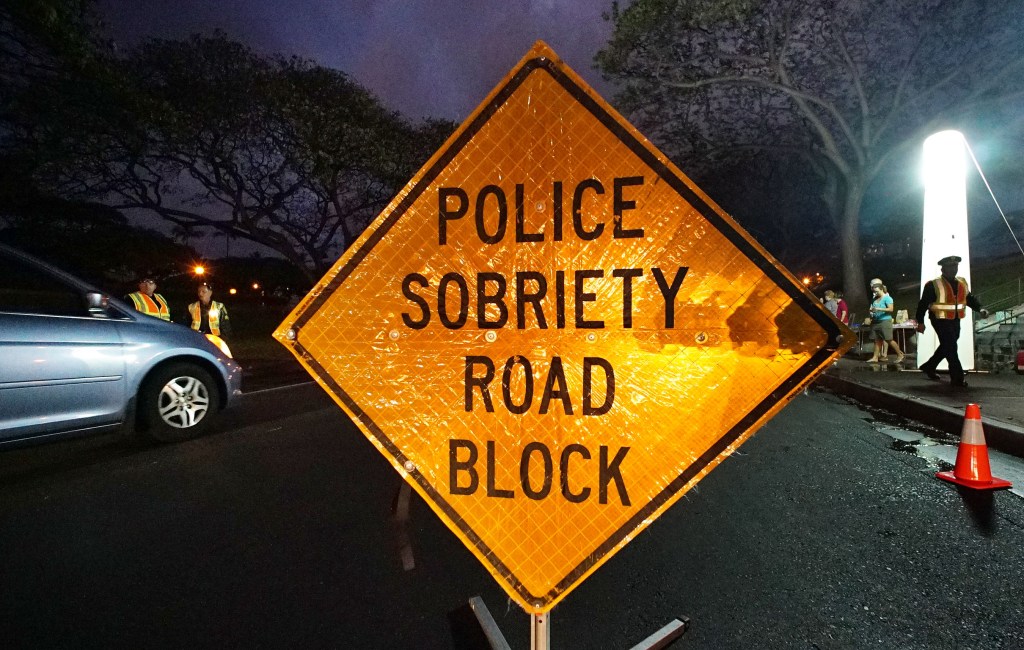
The lawsuit says officers running the checkpoints had a “one and done” policy under which they could shut down a checkpoint after making a single arrest and head home, but still be paid for their full shift.
One woman was arrested for a DUI after she was pulled over for not having her headlights on and a burned-out taillight. An 18-year-old was pulled over and arrested for a DUI after his truck skidded in the rain. Both blew a 0.000 on breathalyzer tests they were given at the police station.
The lawsuit does not say how many checkpoints Cachola helped supervise, nor how many people he arrested.
HPD received about $1.2 million in federal grants in 2025 to conduct impaired driving enforcement, including publicized sobriety checkpoints, according to a Hawaiʻi Department of Transportation grant application. Records show Cachola’s overtime increased dramatically in recent years. Data obtained by Civil Beat show Cachola claimed no overtime in 2020, 2021 or 2022.
In 2023 he claimed just over 1,420 hours. The following year he logged nearly 1,460 hours. And in 2025, the year before his retirement, he logged 2,375.
Vanic said a handful of other officers have also logged close to that amount of overtime, although he said he did not know exactly how many.
Despite the law passed in 2012 precluding overtime earned from employee pensions, workers hired before 2012 are still able to claim the extra hours for their retirement pay. A Civil Beat investigation in 2021 revealed pension spiking among longstanding employees was continuing, especially within HPD.
A Civil Beat review of overtime data in 2020 found that two dozen officers were doubling their salaries with overtime. The highest overtime user logged 2,485 hours between July 28, 2019 and June 27, 2020.
Vanic said the fact that Cachola increased his hours dramatically before retiring is a “red flag” that he may have been trying to spike his pension.
“That’s not something that the department condones,” he said. “It hurts the taxpayers, it hurts the city, so that’s something that we frown upon.”
A report by the Honolulu city auditor in 2022 found the overtime system at HPD vulnerable to fraud and abuse. It also raised questions about the toll working excessive overtime would take on officers. One officer worked 17 hours a day for two weeks straight in 2019, according to the audit.
The auditor’s recommendations included that HPD standardize its overtime policies, find alternatives to its paper timecard system, reevaluate its minimum staffing percentages, consider officer wellbeing in its policymaking, use technology to account for overtime allocation and find ways to increase recruitment.
HPD overtime use is eligible for a follow-up audit this year, but is not on the auditor’s work plan, according to Jordan Alonzo, administrative officer with the city auditor’s office. It may be taken up next year.
Vanic said while the department has made changes to make its overtime system more accountable, it is working on improvements, such as rolling out an allotment system that will prioritize offering future shifts to officers who’ve worked less overtime.
“We’ve got to keep making sure that we put systems in place,” he said. “We need to make sure that, ‘Hey, was there some wrongdoing that went on?’ And if there was, we need to address it.”