On a recent Wednesday morning, more than a dozen seventh-grade students waded into the Waiʻoli River on Kauaʻi’s north shore, their bright yellow shirts standing out against the murky water.
Kneeling in the sand, two girls carefully collected river water in glass vials, while fellow students lifted up long white nets filled with plankton and collected small organisms in petri dishes.
At most schools, a visit to the river might be a one-time field trip, but it’s a weekly occurrence for students at Namahana, Hawaiʻi’s newest charter school. Students, many of whom visit the nearby beach park with their families on the weekends, are collecting data to learn about issues that affect their daily lives, like how heavy rainfall changes the water quality of the river.
“I love how they incorporate nature,” seventh grader Cora Cagle said, adding that she feels a strong sense of community at Namahana from its small class sizes and staff.
This year marks the 30th anniversary of the opening of Hawaiʻi’s first charter school. At the start of Hawai‘i’s charter movement in the 1990s, many parents were eager for a new approach to public education and felt the one-district state system failed to meet the needs of individual communities — particularly those on the neighbor islands.
Charter schools, which receive public funding but operate independently from the state education department, pledged a departure from standardized exams and a shift toward hands-on learning and creativity.

Three decades later, the desire for more community-rooted programs has led to a network of 40 schools across the state, including Namahana. But have these schools lived up to their promise?
Charter schools as a whole have not led to an increase in student achievement, with less than half of charter students proficient in English last year and nearly a third proficient in math — lower than the statewide average. But many principals say charters excel in other areas of education that aren’t measured by standardized tests, including family engagement and innovation.
Parents are voting with their feet: at a time of shrinking enrollment statewide, charter schools have continued to grow.
Despite high demand from families, charters’ broader impact on the public school system has yet to be seen. Charters were originally intended to pilot new curriculum and education models for other schools, but there’s been limited partnerships between charter schools and traditional Department of Education schools to promote innovation statewide.
“There was this sense that the charters are going to be in competition, and that was unfortunate,” said Catherine Payne, former chair of the state charter school commission and education board. “I think there wasn’t the kind of communication to all schools about how the charter movement could really enrich everybody if we did it right.”
This is the first of three stories examining the 30-year history of Hawai‘i’s charter school movement and the future of public education amid shrinking enrollment and growing demand for school choice. Up next: A look at charter school governance and the challenges of keeping schools financially sound.
‘Uncharted Territory’
While Namahana welcomed its first families this fall, the school’s creation was years in the making, according to founder and school leader Kapua Chandler.
The planning process for Namahana started around 2018, Chandler said, when she surveyed families at community meetings and food pantries to see what they wanted from a new school. Families shared the importance of having their kids graduate from high school or attend college, she said, but many people also said they wanted a school that would prepare kids to serve the community.
Before Namahana opened this fall, students spent hours on the bus every day, commuting from the north shore of Kauaʻi to the nearest middle and high schools in Kapaʻa. Dating back to the 1990s, families petitioned state education leaders for a local school but had no success.
“We were desperately hoping it was going to come to fruition, because it was just such a perfect scenario,” said Nick Cagle, whose daughter Cora is part of Namahana’s first seventh-grade class. Without Namahana, he said, his daughter likely would have attended a private school in Līhuʻe, over an hour away from the family’s home in Princeville.
The community needs that drove Namahana’s opening this fall were the same ones that launched the charter movement 30 years ago.

Charter schools weren’t a matter of choice but necessity for neighbor-island communities who felt that state leadership wasn’t responding to their needs, said Gene Zarro, who helped found Kīhei Charter School on Maui.
The campus, which opened in 2001, was built to accommodate Kīhei’s rapid growth and prepare students for careers in STEM, said Zarro, who still serves on the school’s governing board. DOE later developed its own plans for a high school in Kīhei, but the campus didn’t open until 2023.
Even on Oʻahu, families wanted more say in how their local schools were run.
In 1995, Waiʻalae School in Kaimukī opened as Hawaiʻi’s first charter school. The campus started as a traditional elementary school under the state education department but transitioned to a conversion charter after the passage of Hawaiʻi’s 1994 charter school law.
“Teachers and staff and parents, for lack of a better term, felt that there was a better way to educate kids,” said Jodie Cheff, who has worked at Waiʻalae for 25 years and currently serves as an assistant head of school.
At the time of Waiʻalae’s opening, fewer than 10 other states had adopted charter school laws, raising concerns among some DOE principals that charter schools could reduce their enrollment and funding.
“Nationwide, charter schools are so new almost everything about them is up for grabs,” the Honolulu Star-Bulletin reported in 1994, pointing out that Hawaiʻi was entering “unchartered territory.”
1990s
30 Years of Charter Schools
Scroll right to read more →

1994
Hawaiʻi passes its first charter school law, allowing DOE campuses to transition to charter schools. The schools receive state funding but have the flexibility to set their own curriculum and policies.

1995
Waiʻalae School becomes the first Hawaiʻi charter school, known at the time as a student-centered school.
1999
Hawaiʻi passes its second charter school law, allowing communities to start charter schools from scratch.
2000s

2000-01
Hawaiʻi sees the creation of more than 20 charter schools, many of which are located on the Big Island and focused on Hawaiian language and culture.
2012
Lawmakers establish the Hawaiʻi State Public Charter School Commission following reports of financial mismanagement and a lack of accountability at some schools.
2015
Hālau Lokahi in Kalihi becomes the first school to face closure by the commission. School leaders raise concerns about micromanagement and overregulation from the commission.
2018
The commission closes Ka’u Learning Academy on the Big Island.
2023
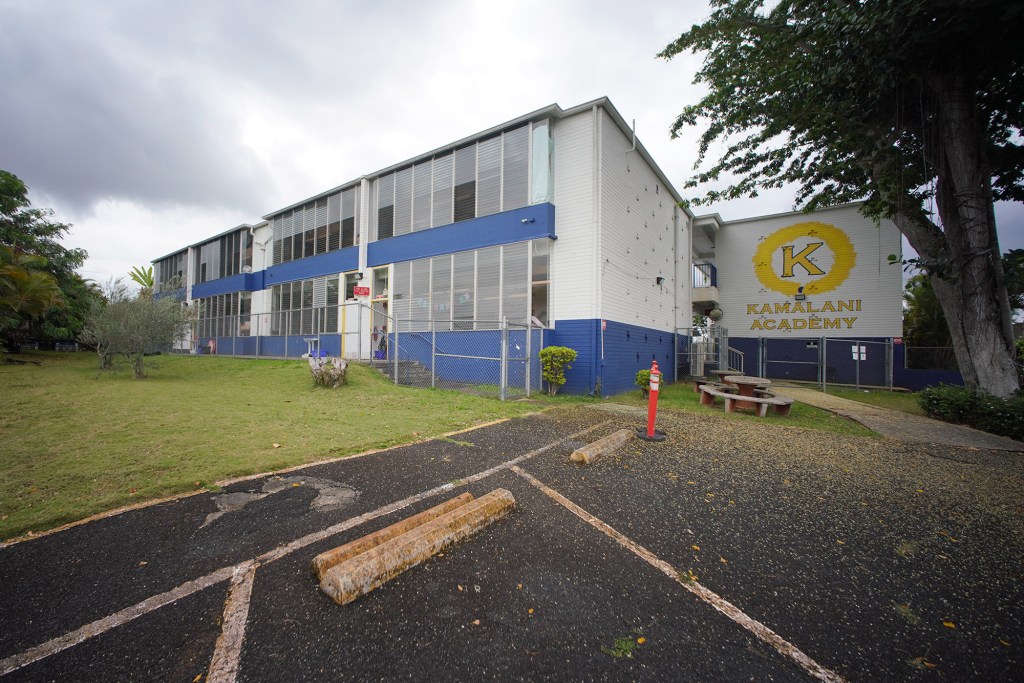
The commission votes to close Kamalani Academy in Wahiawā, but the school receives a two-year reprieve from the Board of Education.
2025
The commission permanently closes Kamalani Academy after serious financial challenges. The state’s first preschool-only charters open.
Hawaiʻi’s original charter school law only allowed for conversion schools like Waiʻalae, which transitioned from running under the education department to operating independently with their own school board. But by 1999, the law had expanded to include charter schools that were starting from scratch.
Within the first two years of the law, more than 20 new charters emerged. Half of those schools were on the Big Island, and the growth was particularly explosive among charters specializing in Native Hawaiian culture and language.
Today, more than half of the state’s 40 charter schools are focused on Hawaiian language or culture and have helped create a new standard of care for Native Hawaiian students — many of whom weren’t receiving the support they needed in traditional public schools at the start of the charter movement.
Charter school growth has since slowed as the state created more rigorous requirements for applicants, who need to submit detailed plans proving they have the academic vision and financial management skills needed to start a school. But founders say the schools that make it through the difficult application process are addressing important needs in their communities.
“The power of a charter school is to offer what isn’t being offered,” Chandler said.
Measuring Success
On a Thursday afternoon in November, second graders at Alakaʻi O Kauaʻi Charter School were leading a lesson in a room full of adults. Gathered around small tables, students walked their parents through their end-of-unit portfolios and art projects, explaining how different habitats host a variety of plants and animals.
The presentations, which happen a few times a year, encourage students to take charge of their learning while giving families the chance to see their kids’ progress and stay involved on campus, said director Paul Zina.
“There’s just this overwhelming joy,” Zina said.
Charters have the flexibility to set their own curriculum and tailor lessons to students’ interests, meaning that no two schools look the same. Kūlia Academy stocks its classrooms with virtual reality headsets and robots to teach teens about technology, while DreamHouse ʻEwa Beach has its seniors lead high school-wide gatherings to foster students’ leadership skills and confidence.

But all charter schools face the same state testing requirements, despite their unique approaches to learning.
The state has grappled with finding a uniform way to measure charters’ progress, while also giving schools the flexibility they need to innovate. Many principals say high test scores shouldn’t be the ultimate goal for their students, but state and federal funding mandates have put pressure on schools to perform well on annual assessments.
Wai‘alae dropped standardized testing when it converted to a charter school, but has re-adopted more traditional student assessments over time in response to state requirements. It’s a constant balancing act to comply with testing mandates, Cheff said, while still staying true to the school’s mission of innovative, hands-on learning.
Now in its 30th year as a charter school, Waiʻalae is going back to the basics and redoubling its efforts to make school more collaborative and engaging for students, said Head of School Kawika Chun. Fourth graders are starting a campaign to possibly change the school’s mascot after learning about Waiʻalae’s history and native birds, Chun said, and the school is integrating subjects like social studies and science into more field studies and projects.
“What we believed 30 years ago is still strong,” Chun said. “How do we bring that to the forefront?”
Last year, 47% of charter school students were proficient in reading on Hawaiʻi’s standardized test, compared to 53% of the state as a whole. Roughly a third of charter students were proficient in math, below the state average of 41%.
But there’s a wide variety in schools’ performances. Kūlia Academy in Kalihi set the highest test scores among middle schools last year, while other charters reported math and reading proficiency rates below 15%.

The state charter school commission has wrestled with how to hold schools academically accountable, while also recognizing that some campuses are drawing high numbers of struggling students, said Tom Hutton, who served as director of the commission from 2013 to 2016. Charter schools were created with the goal of improving the public education system, he said, which raises the question of whether schools should remain open when they’re struggling academically but still adding value to their communities.
“If you’ve created this parallel school system with no appreciable difference, there’s a lot of cost to the taxpayers,” he said.
The commission has yet to shut down a charter school solely for academic failure, and many families say high test scores shouldn’t be the end goal for charter schools.
At Hakipuʻu Academy in Kāneʻohe, roughly half of students were low-income and almost 40% received special education services last year. Students who attend Hakipuʻu are sometimes multiple grade levels behind their peers, meaning they’re unlikely to score proficient in reading and math in their first year at the school, said principal Michael Nakasato.
In the most recently available data for Hakipuʻu, 39% of students were proficient in reading and 4% were proficient in math.
Nakasato said he measures achievement in other ways, like when teens who used to skip class are consistently attending school or when students find their passion for learning through hands-on activities like digging an imu or fishing in science class.
“What is the definition of success? Is it just a test score?” Nakasato said. “It’s something else that just is immeasurable at this point.”
Scaling Up
On the measure of community engagement and family involvement, many charter schools have been a resounding success.
On Kauaʻi, Alakaʻi has a waitlist of 180 kids but only has the capacity to enroll about 240 students in grades kindergarten through eight. At Hawaiʻi Technology Academy, which operates blended and virtual programs across the state, enrollment grew by 67% over the past five years.
At Hakipuʻu, parent Danielle Chong said she was drawn to the school for its small class sizes, safe environment and the personalized attention staff members could offer her son, who graduated in 2023. Teachers were quick to call home if they had any concerns with her son’s behavior, she said, and encouraged him to pursue his passions related to music and Hawaiian culture.

“They took the child’s interest and ran with it,” Chong said, adding that her older children didn’t develop the same passion for learning while they were attending other public schools. Chong’s seventh-grade grandson also attends Hakipuʻu.
But despite the growing popularity of charter schools, they’ve had limited collaboration with the DOE.
An original goal was for charters to serve as testing grounds for new curriculum and teaching practices that could support all schools. But many principals in traditional public schools don’t think to look to charters as sources of innovation, said Kalehua Krug, director of Ka Waihona o ka Naʻauao Public Charter School in Nānākuli.
Even if principals wanted to make changes to their curriculum or student assessments, he said, it would be much harder to implement these reforms within the bureaucracy of the DOE.
Not all charter schools operate in isolation. At the University Laboratory School in Mānoa, teachers and administrators have piloted and tested curriculum around Hawaiian history and science that have later been taught in dozens of schools across the state.

Students regularly participate in research studies ranging from concussion recovery protocol to the development of new leadership classes that inform best practices in education, said Alyssa Kapaona, research and development coordinator at the Lab School.
“It’s always optional for our students to do the research project,” Kapaona said. “But the students and their families know that being a ULS student, that’s part of our culture, our history, part of our purpose and service to the community.”
Charter schools also helped redefine what Hawaiian language and cultural immersion could look like in public education, said Kū Kahakalau, founder of Kanu o ka ʻĀina on the Big Island. Before the creation of Hawaiian-focused charter schools, she said, many immersion classes in the DOE were simply taught by translating western curriculum and textbooks into the Hawaiian language.
Kanu o ka ʻĀina broke from that practice, she said, by centering their lessons around students’ culture and history and having kids learn outside in their communities. Other schools have adopted similar teaching models since, she said, pointing to the growing number of campuses embracing ʻāina-based learning.

“Until then, there was only one way that you could do education, which was Western education,” Kahakalau said. “We clearly showed that you can do Hawaiian education, and it can be rigorous and it can be successful.”
Three decades into the charter school movement, Hawaiʻi faces a rare opportunity for reform as the federal government begins dismantling the Department of Education and putting fewer regulations on states and local schools, Krug said. Moving away from the standardized tests mandated by federal law would allow schools to develop lessons and assessments that better reflect communities’ values and students’ understanding of Hawaiian history and culture, he said.
Already, he said, charter schools have successfully illustrated how more flexibility and freedom in education drives innovation.
“If we are no longer strictly beholden to the federal mandates and federal funding,” he said, “it’s almost free, in a sense, for the state to be the educational system that we’ve always wanted to be.”
Civil Beat’s education reporting is supported by a grant from Chamberlin Family Philanthropy.