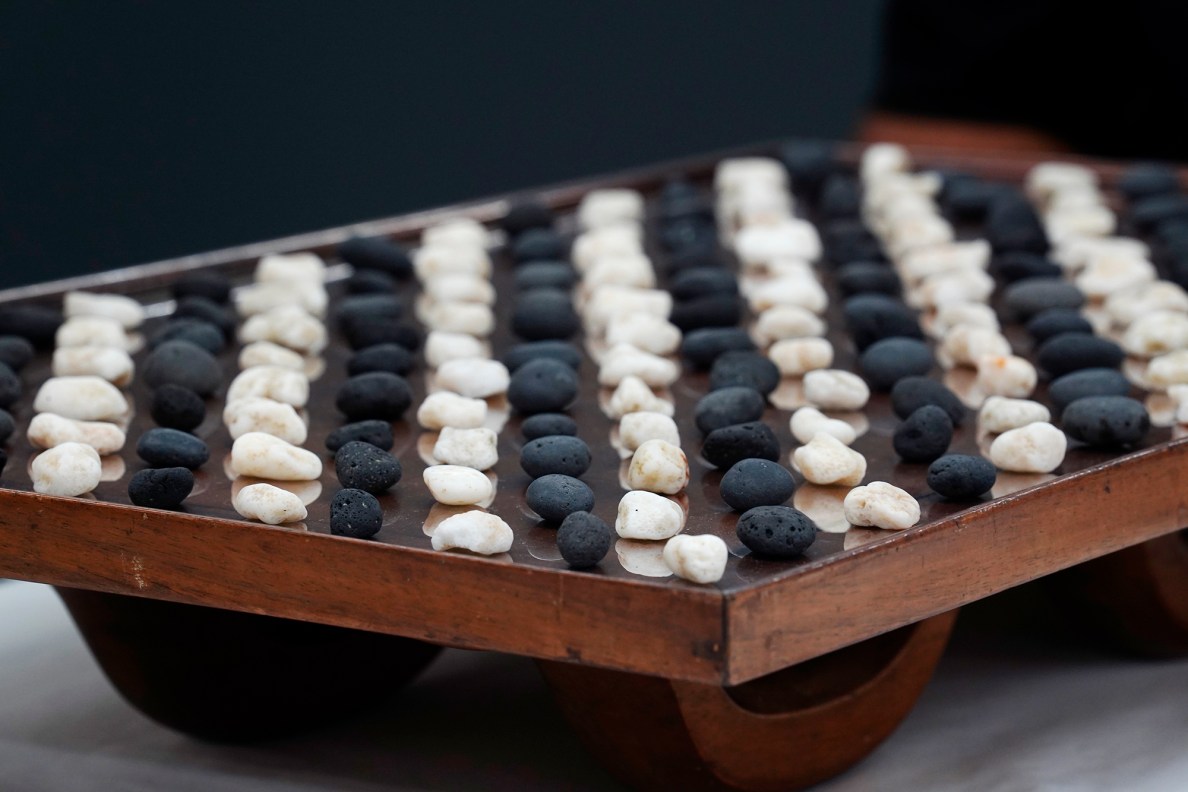
The final match of the inaugural Ka Mākou Kōnane Championship Tournament was played on the Papamū Kūpuna, one of six known remaining wooden Kōnane boards in existence.

Photo Essay: Tournament Elevates The Historic Hawaiian Board Game Kōnane

The final match of the inaugural Ka Mākou Kōnane Championship Tournament was played on the Papamū Kūpuna, one of six known remaining wooden Kōnane boards in existence.

Kōnane game pieces are placed atop the kūpuna papamu Friday, Jan. 30, 2026, at the Bishop Museum in Honolulu. The black game pieces are basalt called 'ili'ili 'ele'ele. ‘Ili'ili ke'oke'o are the white coral game pieces. (Kevin Fujii/Civil Beat/2026)
Kōnane game pieces are placed atop the Papamū Kūpuna in late January at the Bishop Museum in Honolulu. The black game pieces are basalt called ‘ili’ili ‘ele’ele. ‘Ili’ili ke’oke’o are the white coral game pieces. (Kevin Fujii/Civil Beat/2026)

Eight elite contenders from across the islands faced off in the grand Hawaiian Hall at the Bishop Museum to vie for first place in the inaugural Ka Makou Kōnane Invitational Tournament.

They had come together Friday evening from all around the islands following qualifying matches — two each from Molokaʻi, Kauaʻi, Hawaiʻi island and Oʻahu

“Kōnane is a game of pattern making and pattern recognition,” said Kapena Baptista, co-organizer of the tournament. “It tests your ability to move with and around your opponent in a manner reminiscent of lua, our Hawaiian martial arts, and hula, our traditional dance.

“It is no coincidence that many surviving terms describing Kōnane plays are identical to terms used in lua and hula.”

Kayla Kuʻualoha Fernandez, from left, Bishop Museum’s Ethnology Collections Manager, turns over the kūpuna papamu for Wallace Akua to check the base and feet Friday, Jan. 30, 2026, in Honolulu. This papamu is made of koa wood. It was donated to Bishop Museum in 1923 by Princess Elizabeth Kahanu as a part of the Kalanianaʻole-Kapiʻolani Collection. (Kevin Fujii/Civil Beat/2026)
Kayla Kuʻualoha Fernandez, left, Bishop Museum’s Ethnology Collections Manager, carefully turns over the Papamū Kūpuna so Akau Boards craftsman Wallace Akau can check the base. (Kevin Fujii/Civil Beat/2026)

The quarterfinals were played on Kōnane boards with the more common 8-by-11 game pieces setup. But the semifinals and finals were played on 12-by-15 boards to match the Papamū Kūpuna. The championship match would be played on the historic koa wood board itself.

The Papamū Kūpuna was donated to Bishop Museum in 1923 by Princess Elizabeth Kahanu as part of the Kalanianaʻole-Kapiʻolani Collection. According to the Bishop Museum’s website about the tournament, it is one of only six around the world, three of which are in the museum’s own collection, one at ʻIolani Palace, one at Hawaiʻi Volcanoes National Park, and another, it notes, “in a private collection in France.”
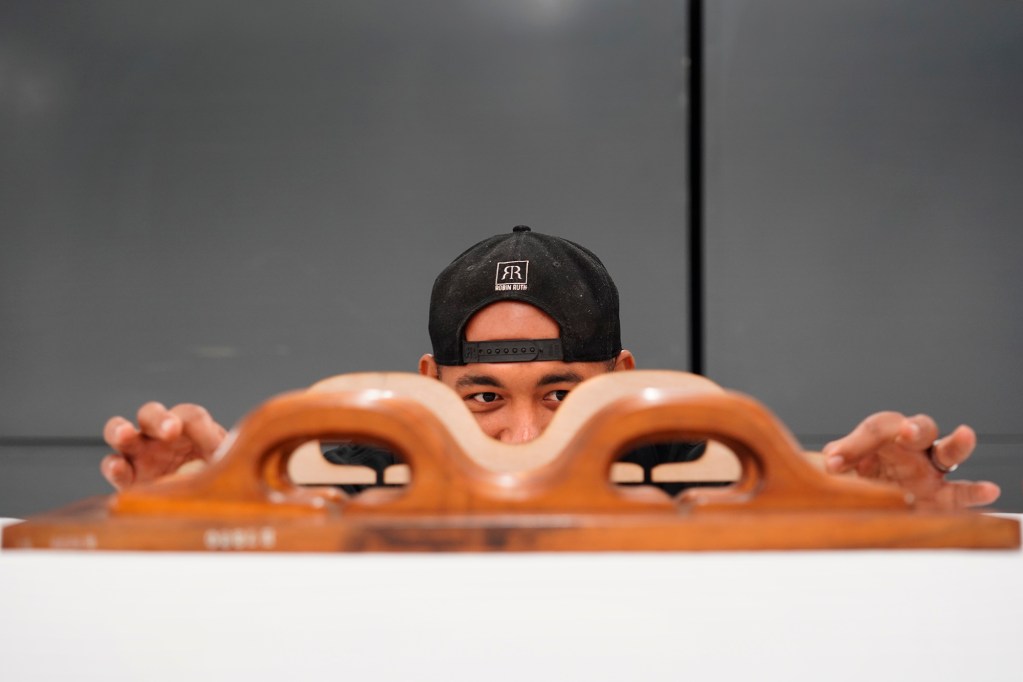
Akua Boards craftsman Wallace Akua eyes final measurements of the kūpuna papamu’s base Friday, Jan. 30, 2026, at the Bishop Museum in Honolulu. This papamu is made of koa wood. It was donated to Bishop Museum in 1923 by Princess Elizabeth Kahanu as a part of the Kalanianaʻole-Kapiʻolani Collection. (Kevin Fujii/Civil Beat/2026)
Wallace Akau compares his final measurements of the Papamū Kūpuna’s base. He is making a replica board for the winner of the inaugural Ka Mākou Kōnane Championship Tournament. “The significance of replicating this board is that we preserve the craftsmanship and artistry of the past,” Akau said. (Kevin Fujii/Civil Beat/2026)

Kōnane is a game with black and white stones — actually basalt and coral — that resembles chess and Go, albeit with fewer rules and exceptions, Baptista said. But he said its simplicity hides the depth of complexity it can offer, which can take a lifetime to fully learn.

Yuna Inoue, left of Hawaiʻi Island, plays Oʻahu’s Kapena Baptista during the semifinals of the inaugural Ka Makou Kōnane Invitational Tournament at the Bishop Museum Friday, Feb. 13, 2026, in Honolulu. (Kevin Fujii/Civil Beat/2026)
Yuna Inoue, left of Hawaiʻi island, plays Oʻahu’s Kapena Baptista during the semifinals of the inaugural Ka Makou Kōnane Invitational Tournament Friday night at the Bishop Museum in Honolulu. (Kevin Fujii/Civil Beat/2026)

Baptista called the tournament “a massive leap forward” that “brought many talented players out from isolation.”

“Since playing ‘guerilla Kōnane’ around O’ahu in 2024,” he said. “I’ve noticed that familiarity and proficiency vary greatly among our community. There are some very talented players out there, but rarely do we have the spaces to congregate and play each other.”

Kūpa‘a Ka‘imina‘auao watches the semifinal match between Kahekili Yung, left, of Oʻahu, and Kauaʻi’s Kimo Chun, right, during the inaugural Ka Makou Kōnane Invitational Tournament takes place at the Bishop Museum Friday, Feb. 13, 2026, in Honolulu. (Kevin Fujii/Civil Beat/2026)
Kūpa‘a Ka‘imina‘auao watches the semifinal match between Kahekili Yung, of Oʻahu, and Kauaʻi’s Kimo Chun. (Kevin Fujii/Civil Beat/2026)

Maile Naehu, emcee and co-organizer of the tournament, agreed: “The resurgence of Kōnane is a powerful step toward embracing who we are as Kanaka Maoli … The deeper learning, however, comes through practice, through making mistakes, adjusting and returning stronger each time.”

Yuna Inoue, of Hawaiʻi Island, focuses on a move against Oʻahu’s Kapena Baptista, left, during the semifinals of the inaugural Ka Makou Kōnane Invitational Tournament at the Bishop Museum Friday, Feb. 13, 2026, in Honolulu. (Kevin Fujii/Civil Beat/2026)
Yuna Inoue focuses on a move against Kapena Baptista, left, during the semifinals. (Kevin Fujii/Civil Beat/2026)

Kōnane, Naehu said, “is more than a game. It is a movement, a reclaiming of knowledge, identity and the discipline to step fully into our best selves.”

Akua Boards craftsman Wallace Akua, center, watches Kahekili Yung, right, of Oʻahu, make a move against Kauaʻi’s Kimo Chun, left, during the semifinals of the inaugural Ka Makou Kōnane Invitational Tournament takes place at the Bishop Museum Friday, Feb. 13, 2026, in Honolulu. (Kevin Fujii/Civil Beat/2026)
Akau Boards craftsman Wallace Akau, center, watches Kahekili Yung, right, of Oʻahu, make a move against Kauaʻi’s Kimo Chun, left, during the semifinals. (Kevin Fujii/Civil Beat/2026)

Akau Boards craftsman Wallace Akau was commissioned by the museum to make a replica board for the winner of the tournament. He says the game can “inspire younger generations to appreciate their cultural roots while developing important cognitive skills through game play.”
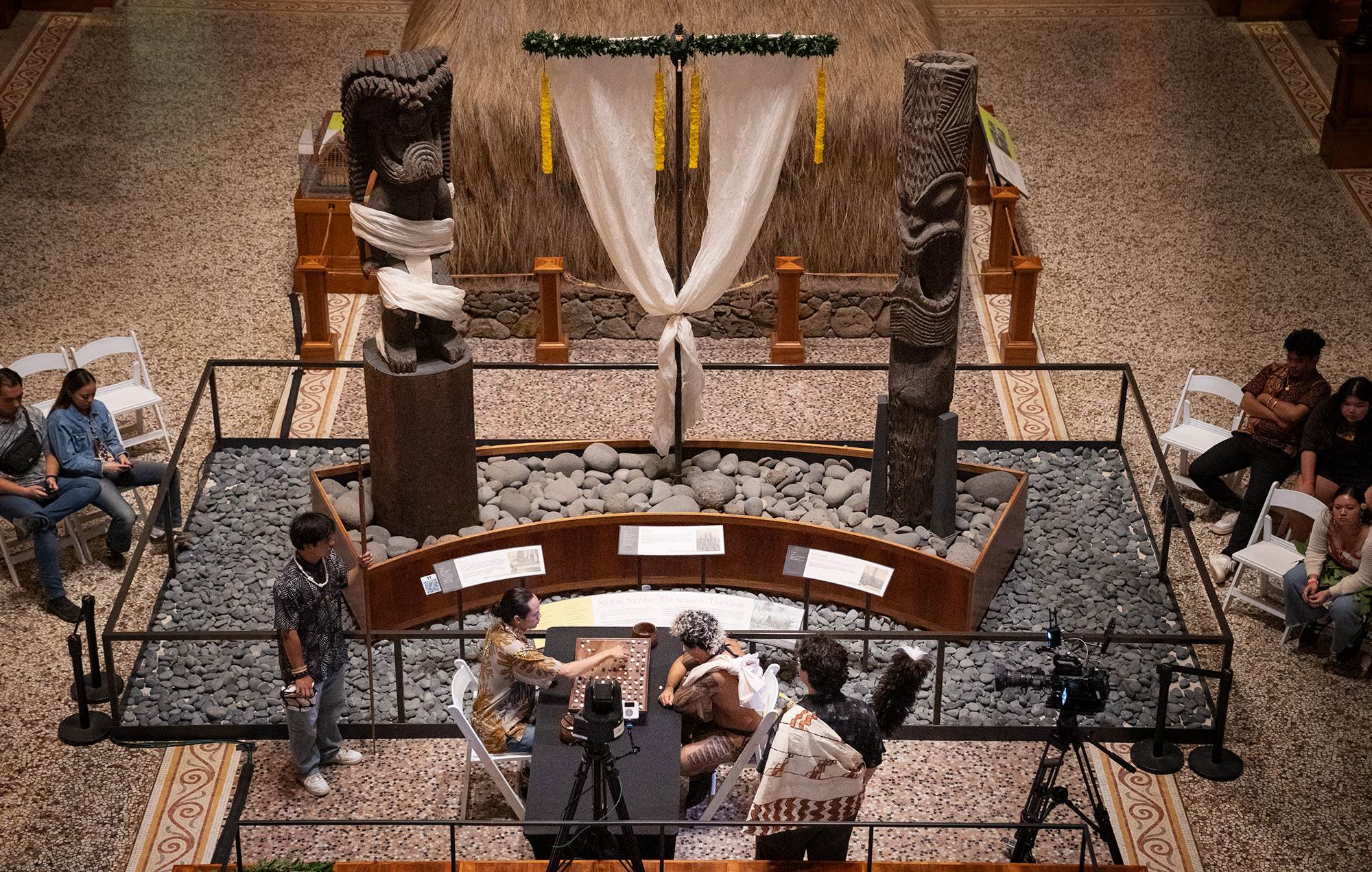
Ki‘i dressed for Makahiki watch over an all-Oʻahu championship match between Kahekili Yung, left, and Kapena Baptista during the inaugural Ka Makou Kōnane Invitational Tournament takes place at the Bishop Museum Friday, Feb. 13, 2026, in Honolulu. (Kevin Fujii/Civil Beat/2026)
Ki‘i adorned for Makahiki watch over an all-Oʻahu championship match between Kahekili Yung, left, and Kapena Baptista for the inaugural Ka Makou Kōnane Invitational Tournament championship match. (Kevin Fujii/Civil Beat/2026)

“Sometimes I close my eyes and see Kōnane stones moving in my head.”

Kapena Baptista
An all-Oʻahu championship match between Kapena Baptista, top, and Kahekili Yung, takes place during the inaugural Ka Makou Kōnane Invitational Tournament in the center of the Bishop Museum’s Hawaiʻian Hall Friday, Feb. 13, 2026, in Honolulu. (Kevin Fujii/Civil Beat/2026)
Kapena Baptista, top, and Kahekili Yung, play their championship match on the Papamū Kūpuna. Princess Elizabeth Kahanu donated this Kōnane board to the Bishop Museum in 1923 with the Kalanianaʻole-Kapiʻolani Collection. (Kevin Fujii/Civil Beat/2026)

“Our next Great Hawaiian Leader is going to be a Kōnane player,” said John Kaohelaulii, co-organizer of the tournament and founder of Hawaiiancheckers.com. “Kōnane was one of the training methods used to teach Ali’i how to manage resources for long-term sustainability.  It developed critical thinking skills, strategic planning and the ability to implement actions.”
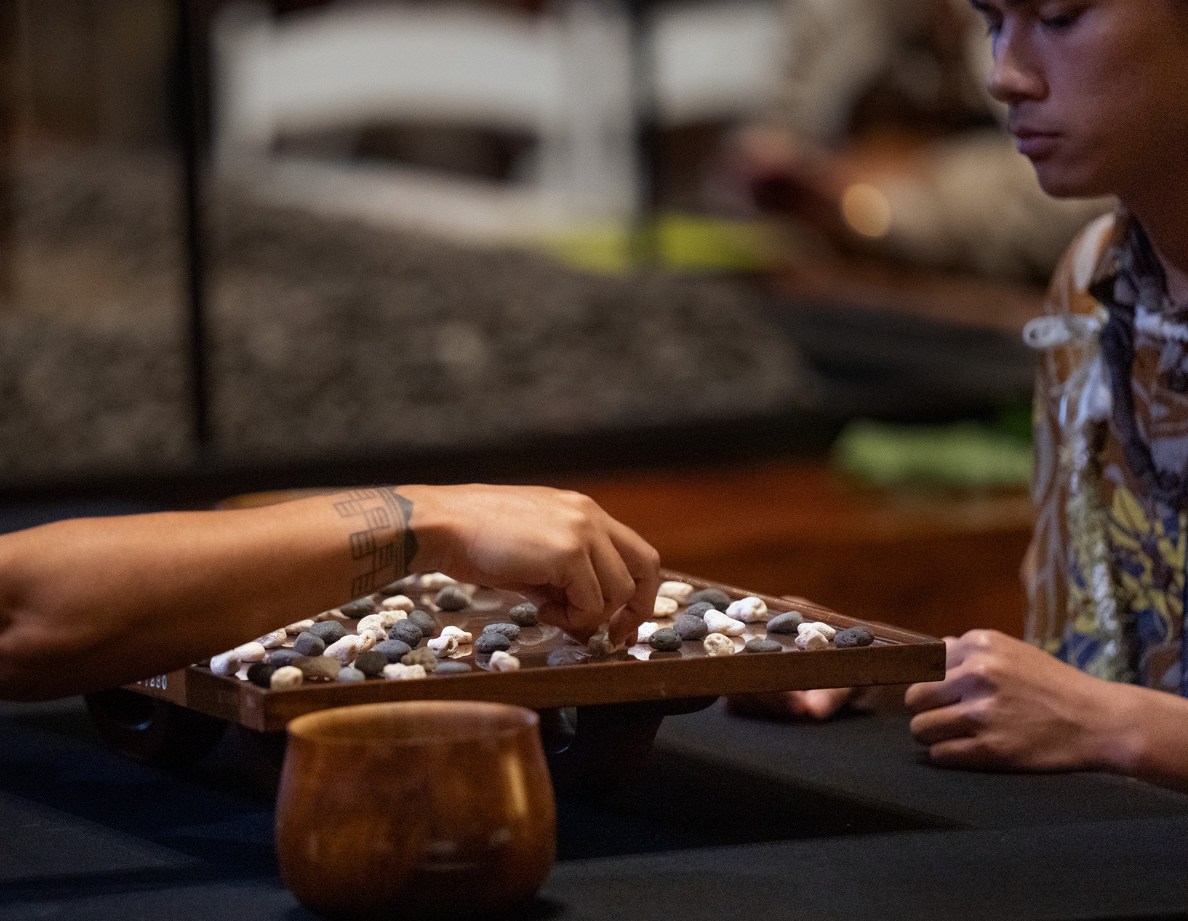
An all-Oʻahu championship match between Kapena Baptista, right, makes a move under the watchful eyes of Kahekili Yung, during the inaugural Ka Makou Kōnane Invitational Tournament in the center of the Bishop Museum’s Hawaiʻian Hall Friday, Feb. 13, 2026, in Honolulu. (Kevin Fujii/Civil Beat/2026)
Kapena Baptista, left, makes a move under the watchful eyes of Kahekili Yung on the 12-by-15-piece Kōnane board. The quarterfinals and qualifying matches were played on the more common 8-by-11-piece boards. (Kevin Fujii/Civil Beat/2026)
Kanaloa dressed for Makahiki watches over an all-Oʻahu championship match between Kapena Baptista, center, and Kahekili Yung, right, during the inaugural Ka Makou Kōnane Invitational Tournament in the center of the Bishop Museum’s Hawaiʻian Hall Friday, Feb. 13, 2026, in Honolulu. (Kevin Fujii/Civil Beat/2026)
Ki‘i watch over an all-Oʻahu championship match between Kapena Baptista, center, and Kahekili Yung, right, in the center of the Hawaiian Hall. (Kevin Fujii/Civil Beat/2026)

For Baptista, the game is a constantly unfolding lesson that could take a lifetime to fully absorb. It can also be all-consuming, he said, noting that, “Sometimes I close my eyes and see Kōnane stones moving in my head.”

Kapena Baptista, looks up to ki‘i Kanaloa while playing Kahekili Yung, right, during the championship match of the  inaugural Ka Makou Kōnane Invitational Tournament in the center of the Bishop Museum’s Hawaiʻian Hall Friday, Feb. 13, 2026, in Honolulu. (Kevin Fujii/Civil Beat/2026)
Kapena Baptista, looks up while playing Kahekili Yung during the championship match. “Did I make the right move?” Baptista later told the crowd he asked the ki‘i above his right shoulder after winning the inaugural Ka Makou Kōnane Invitational Tournament. (Kevin Fujii/Civil Beat/2026)
A crowd on the gallery lawn watches the inaugural Ka Makou Kōnane Invitational Tournament championship match between O‘ahu’s Kahekili Yung and Kapena Baptista  at the Bishop Museum Friday, Feb. 13, 2026, in Honolulu. (Kevin Fujii/Civil Beat/2026)
People on the gallery lawn watch the inaugural Ka Makou Kōnane Invitational Tournament championship match between O‘ahu’s Kahekili Yung and Kapena Baptista at the Bishop Museum Friday night in Honolulu. Experienced Kōnane players offered play-by-play commentary. (Kevin Fujii/Civil Beat/2026)

“Sometimes Kōnane can be cruel, other times, it can be triumphant.”

Kapena Baptista
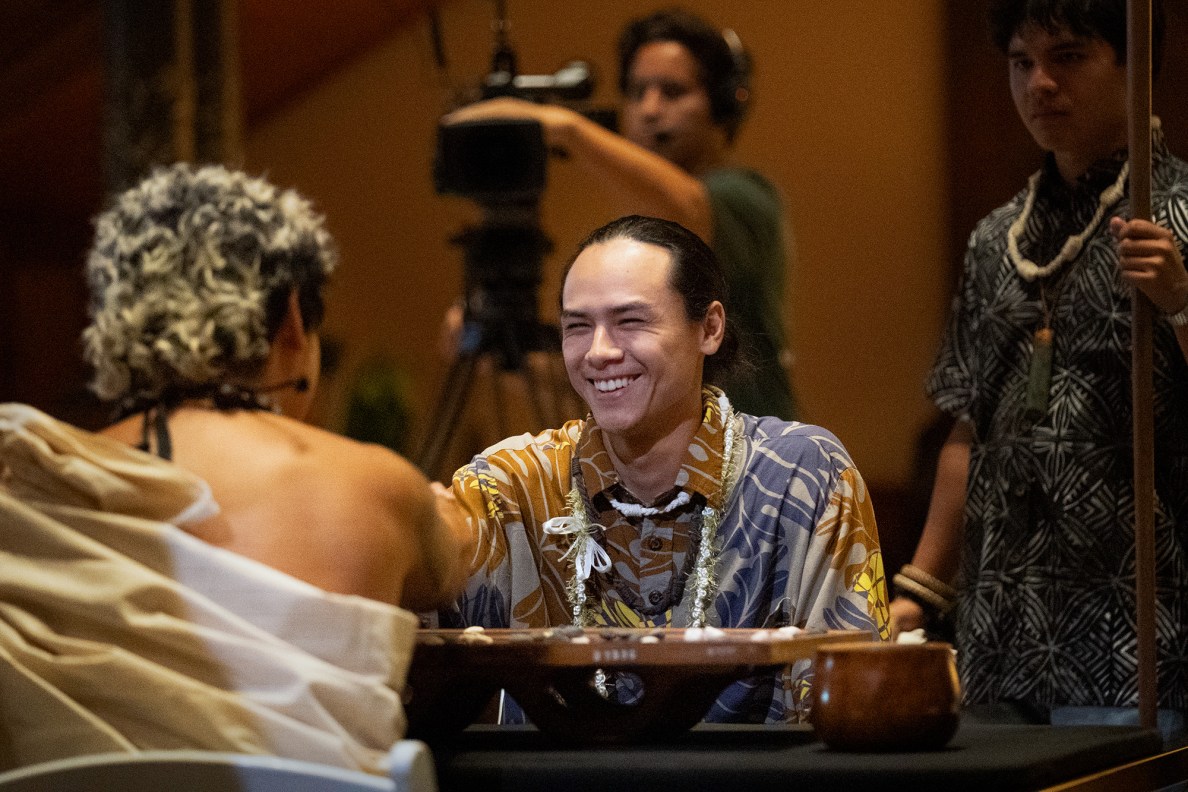
Kahekili Yung, center, congratulates Kapena Baptista, left, for defeating him to win the inaugural Ka Makou Kōnane Invitational Tournament at the Bishop Museum Friday, Feb. 13, 2026, in Honolulu. (Kevin Fujii/Civil Beat/2026)
Kahekili Yung, center, congratulates Kapena Baptista, left, for winning the inaugural Ka Makou Kōnane Invitational Tournament. (Kevin Fujii/Civil Beat/2026)

Overflow crowds saw the championship game via a wide-screen television set up on the museum lawn, where spectators watched raptly from white folding chairs as two Oʻahu competitors faced off: co-sponsor Baptista and Kahekili Yung. This game was played on an historic board, one of those in the care of the Bishop Museum Ethnology Collection, which the museum noted had “not felt stones leap across its surface in well over 100 years.”

Kūna‘e Kamahele captures the final play Kapena Baptista made against Kahekili Yung on the Kūpuna Papamū to win the inaugural Ka Makou Kōnane Invitational Tournament at the Bishop Museum Friday, Feb. 13, 2026, in Honolulu. (Kevin Fujii/Civil Beat/2026)
Kūna‘e Kamahele captures the final play Kapena Baptista made against Kahekili Yung on the Papamū Kūpuna to win the inaugural Ka Makou Kōnane Invitational Tournament. (Kevin Fujii/Civil Beat/2026)
Kapena Baptista holds the replica Papamū Kūpuna made by Wallace Akua of Akua Boards for winning the inaugural Ka Makou Kōnane Invitational Tournament at the Bishop Museum Friday, Feb. 13, 2026, in Honolulu. (Kevin Fujii/Civil Beat/2026)
Kapena Baptista holds the replica Papamū Kūpuna made by Wallace Akau of Akau Boards for winning the inaugural Ka Makou Kōnane Invitational Tournament. (Kevin Fujii/Civil Beat/2026)

Baptista went on to win the tournament he co-sponsored, taking home the replica board crafted by Akau.

“There are no ties in Kōnane; There is always a definitive winner and loser,” he said. “It teaches us that our actions have consequences, and that every choice we make compounds into a final outcome that is of our own making. Sometimes Kōnane can be cruel, other times, it can be triumphant.” 

CORRECTION: This story has been updated to correct the spelling of Wallace Akau’s last name and to properly identify the ki‘i, which are traditional Hawaiian carved images.
About the Author

What it means to support Civil Beat.

Supporting Civil Beat means you’re investing in a newsroom that can devote months to investigate corruption. It means we can cover vulnerable, overlooked communities because those stories matter. And, it means we serve you. And only you.

Donate today and help sustain the kind of journalism Hawaiʻi cannot afford to lose.