The Sunshine Blog: Lawmakers Told $35K Probe Could Take Until ... August?
Short takes, outtakes, our takes and other stuff you should know about public information, government accountability and ethical leadership in Hawai‘i.
February 8, 2026 · 11 min read

About the Author

Try wait: The Hawaiʻi attorney general’s probe of a lawmaker who accepted a paper bag containing $35,000 may not conclude until August — but before or after the Aug. 8 primary election? Who knows.
The Sunshine Blog hears House Speaker Nadine Nakamura shared that factoid with lawmakers on Jan. 30. This according to five House members in a letter sent to Nakamura on Monday. (And Nakamura is not denying it.)
That would seem to contradict AG Anne Lopez’s boss, Gov. Josh Green, who said during a recent interview on Hawaiʻi News Now that the target to finish up was spring. And it’s problematic for several reasons, some of which are laid out in a separate letter to Green from Reps. Della Au Belatti, who is running for Congress, and Republican Kanani Souza.
For one, the probe shouldn’t take that long, given that it’s already been investigated by the FBI, the lawmakers said.

If the person is still in office, they could be voting on bills, including ones about the statute of limitations for their own case. (For the record, everyone currently in the House and Senate who was around in 2022 when the cash changed hands has denied it is them.) If the facts are aired out after the legislative session ends in May, lawmakers won’t be able to take timely disciplinary action nor quickly pass laws tailored to address future cases like it.
And of course, if the lawmaker at issue is currently running for reelection, they have the luxury of campaigning and raising funds without having to address the situation, and voters will be kept in the dark as they fill out ballots.
Belatti and Souza are calling on Green to direct the AG to file a public preliminary report by Feb. 17 revealing whether the lawmaker at issue is currently serving in the Legislature or in the executive branch. He has not yet responded.
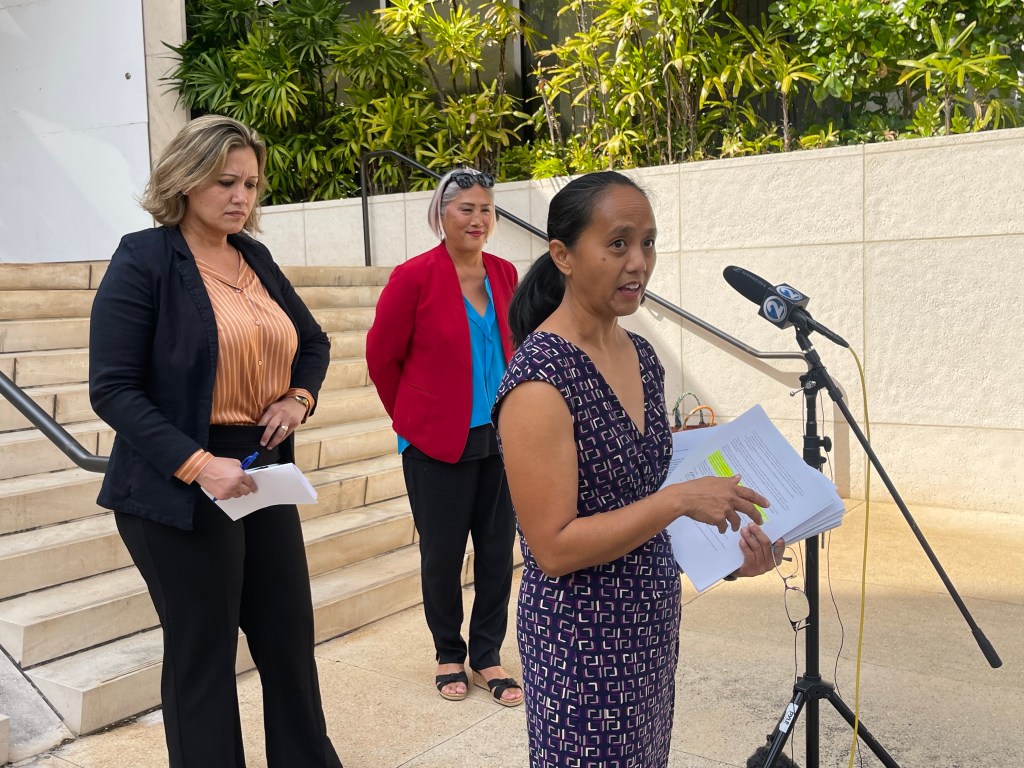
Meanwhile, Nakamura’s disclosure on the purported timing raises questions about whether Lopez’s office has shared details with other government officials about a matter she said would be kept confidential.
In announcing the probe on Jan. 7, the AG said law enforcement agencies “do not make statements on the existence of or status of its investigations.” (Emphasis added.)
So where did Nakamura hear about August? She won’t say.
In an email that didn’t answer our questions, House Majority spokeswoman Cathy Lee said the speaker “has not received any investigative details that would influence the investigation” and punted questions on timing to the AG.
The AG’s office said Lopez hasn’t spilled the beans.
“Many people have asked when the investigation is expected to be complete and are being told that the investigation is being conducted as expediently as possible,” AG spokeswoman Toni Schwartz said in an email. “The Attorney General did not communicate a specific date, or even month, for when the investigation would be completed.”
But did someone else from the AG’s office — not the AG herself — communicate an August date to anyone outside the office? Schwartz did not respond.
The letter from the five lawmakers asks Nakamura to clarify when and how she will address a petition demanding a legislative investigation into the $35,000 handoff. It’s signed by Reps. Belatti, Souza, Terez Amato, Elle Cochran, and Kim Coco Iwamoto.
Back to the future: Lawmakers are again trying to ban contractors from making donations to political candidates after a bill looking to end pay-to-play in politics was watered down by leaders in the House and Senate in the final days of the 2025 session. And then even that flawed version didn’t pass.
To recap: Hawaiʻi bans companies under contract from donating to campaigns, but a loophole in the law allows officers of those companies to continue contributing. Two years ago, the New York Times and Civil Beat found that the loophole let through $24 million from people tied to contractors.
Last year’s bill would have closed that loophole, applying the contributions ban to the immediate officers and family members of companies under contract with or given grants by the state and counties. But amendments inserted at the last minute effectively hamstrung the measure by limiting the donation prohibitions to people under contract with a specific branch of government. It would have virtually exempted lawmakers because the Legislature rarely issues the types of contracts covered under the bill.
Rep. David Tarnas introduced a version of that measure this year, House Bill 1519. It includes requirements that contractors disclose the identities of compensated officers and immediate family members to the state or county agency that issued their contract. That agency would then be required to send that list to the Campaign Spending Commission to enforce the ban.

The measure passed the Judiciary and Hawaiian Affairs Committee Tuesday, which Tarnas chairs, but only with some pretty significant amendments.
Those include suggestions from the State Procurement Office, which recommended allocating funds to agencies to implement the reporting requirements. The office also called for clear penalties to get contractors to comply with the law, including cancelling contracts.
Tarnas also took recommendations from the Campaign Spending Commission to include dependents of the key officers in the donation ban and to expand the coverage to include ballot issues. As we all know, those often draw big money from special interests lobbying for or against a measure’s passage.
But the biggest change would take county contractors out of the bill. It seems the counties complained to Tarnas that the bill created an unfunded mandate to collect information from the contracting firms about their officers.
Rep. Elle Cochran was against that change. She saw campaign corruption firsthand as a member of the Maui County Council and in no small part led to the whole bribery investigation that eventually took down two sitting lawmakers and still has the state in a tizzy over who a third potential bribed legislator might be.
In 2018, it was Cochran and her staff who tipped off federal agents to Honolulu businessman Milton Choy and his company H2O Process Systems, which won tens of millions of dollars in no-bid contracts from Maui County while also being a major donor to its mayors and council members. Once the feds were onto Choy they turned him into a confidential informant who helped them snag former Sen. J. Kalani English and former Rep. Ty Cullen. All of them were eventually convicted and sent off to prison.
Tarnas said he’d like to get the provisions on counties back into the bill at a later date.
Other states with laws regulating pay-to-play, such as Connecticut, Illinois and New Jersey, put significant investments into databases that allowed regulators to track donations from contractors.
Those states also take out the middleman and put the onus for reporting officers and immediate family members on the contractor. Companies are required to make regular filings on their officers, family members and campaign contributions.
And if they fail to file those, they can lose their contracts and the millions of dollars that come with them.
Meanwhile, the committee killed the Campaign Spending Commission’s long-debated proposal, this year in the form of House Bill 2052, which for several years has been the vehicle of hope for significant pay-to-play reform. Fortunately, it lives on as Senate Bill 2530 and is slated for a hearing in Sen. Karl Rhoads’ Judiciary Committee on Tuesday.
The Blog will be interested to see if Rhoads, who is retiring at the end of this year, acquiesces to Tarnas, with whom he works closely. Tarnas has made it clear since before session that he is more interested in his version of pay-to-play reform than the Campaign Spending Commission’s proposal.
Technical difficulties: Streaming video of public hearings at the State Capitol is so routine that the public, media and advocates find it hard to remember the bad old days pre-pandemic when The Blog and everyone else actually had to sit in hearings and talk to people in hallways to find out what was going on. So when something goes awry with that video record, people notice.
Akamai observers of the House Education Committee last week questioned why a frosty public exchange between committee Chair Justin Woodson and First Deputy Public Defender Hayley Cheng was missing from an archived YouTube video recording of a Thursday afternoon hearing on House Bill 2185.
That bill would upgrade the offense of causing bodily injury to a sports official who is carrying out his or her official duties from a Class C felony to a Class B felony, a change that would increase the potential criminal penalty from five years in prison to up to 10 years.
The bill was co-introduced by Education Committee Vice Chair Trish La Chica and 24 other House Democrats this session following a widely publicized assault on Moanalua High School’s assistant athletic director on Dec. 4.
Cheng began her testimony in opposition to the bill by explaining she was concerned with the increased criminal penalties, but Woodson interrupted.

“So, this is the Committee on Education,” he said. He explained the committee’s concern “is this good policy for education, not the legal aspect of it. We have teachers on our committee, not lawyers.”
Cheng replied that “I’ve never had a committee member or a chair or a vice chair not be open or receptive to the feedback that we have to offer, because our role, which we take very seriously, is to comment on the legality as we see it of the criminal measure before the committee.”
However, Cheng said she would defer to Woodson’s wishes if “you are not here to hear feedback on that.”
“Yes,” Woodson replied. “I’m not going to say any more or less on it.”
Cheng then began to speak about testimony she had previously submitted to the committee, and Woodson banged his gavel to call a recess.
But none of that curious and none-too-friendly exchange was available for the public to watch on Thursday or Friday morning via the hearing video posted on the House’s public YouTube channel.
People who watched that hearing in person then began to question whether the committee was deliberately editing the video or might even be violating the Sunshine Law. (In fact, the Legislature exempted itself from the Sunshine Law, so no violation there).
Among those who were concerned was Cheng’s boss, Public Defender Jon Ikenaga, who said in a written statement he checked Thursday and Friday morning to see if video of the exchange was available. It wasn’t, and Ikenaga called that “concerning.”
“The public has a right to view the hearing in its entirety and have full and complete access to proceedings,” Ikenaga wrote. “There should be no attempt to suppress any part of the hearing recording.”
“It was not until we raised this issue with other members of the Legislature that the first nine minutes of the hearing were uploaded to YouTube,” he added.
Woodson told us there was no effort to suppress the video of the exchange. He said a technical glitch early in the Thursday hearing interfered with the video feed and caused a delay in posting that portion of the recording.
Staff for Woodson said the video technicians, who work in another department, were already planning to upload the missing segment when The Blog inquired about it on Friday. Video of the exchange between Woodson and Cheng was added to the public video archive Friday afternoon, less than an hour later.
 Sign up for our FREE morning newsletter and face each day more informed.
Local reporting when you need it most
Support timely, accurate, independent journalism.
Honolulu Civil Beat is a nonprofit organization, and your donation helps us produce local reporting that serves all of Hawaii.
ContributeAbout the Author