Makana Eyre: Why Did We Stop Caring About The Ala Wai Canal?
We need to demand real and lasting change for the iconic waterway.
March 8, 2026 · 8 min read

About the Author

Twenty years ago, when I was in high school, I spent many an afternoon at the Ala Wai Canal.
Much has happened since — degrees, jobs, fatherhood, friends lost, friends made.
Still, I can picture it with vivid clarity: the canoes neatly lined up on the sloping banks, the joggers and cyclists, the steady hum from Waikīkī. And, more than anything, bubbly teenagers chatting in the afternoon sunlight, paddles in hand, waiting to get on the water.
Back then, during ILH paddling season, Matt Ching, Dylan Botelho and I would get into our creaky cars and drive from our high school in Kāhala down to Kamehameha Canoe Club, which ran PAC-5 paddling.
At the clubhouse we’d join students from other private schools around Honolulu, the ones that, like ours, didn’t have the resources or number of athletes to field their own teams.
At around 4 o’clock, we’d haul Kamehameha’s red and gold waʻa into the water. I’d sit four, Dylan two, and Matt steered.
If we were lucky, our coach, Adam Ahai, would let us paddle out to the Ala Wai Boat Harbor where the canal meets the open water. Adam was a kind man who wore a single dreadlock down his back and followed our progress on a BMX bike from the makai side of the canal.
When we reached the harbor, we would meet the expanse of ocean. To our crew of six teenagers, increasingly anxious to see something beyond the islands, being all alone on the open water felt deeply freeing.
With the distance of time, I can see how formative those afternoons were. And it leads me to this: the Ala Wai, the great punchline of Oʻahu, deserves gentler treatment.
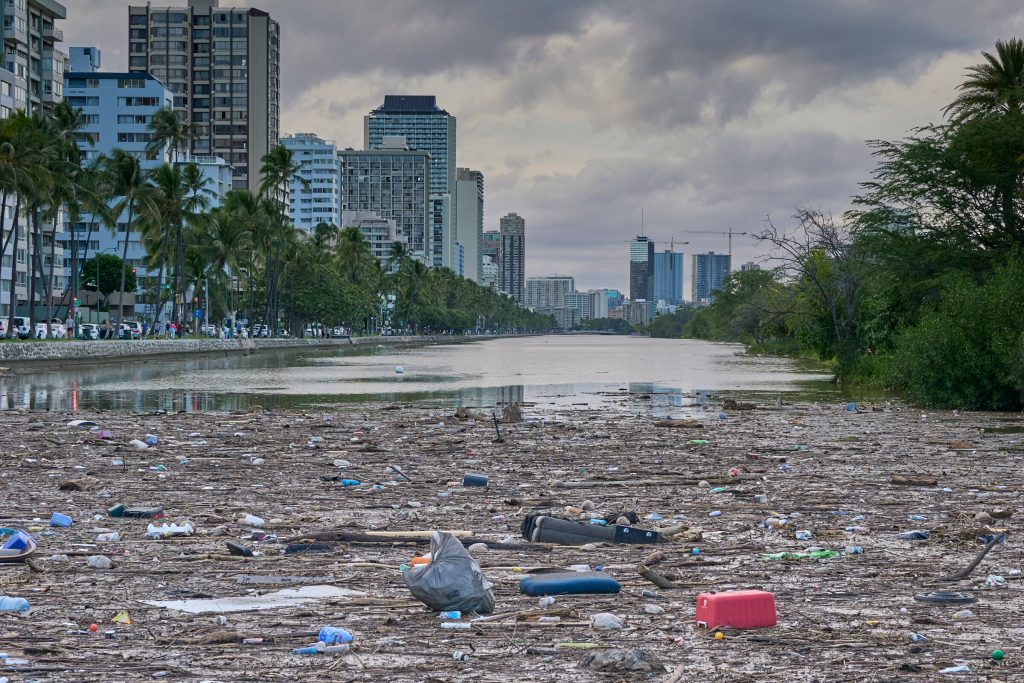
For the better part of half a century, it’s been the butt of jokes, the point of comparison for anything putrid or polluted.
Its seedy reputation makes it irresistible fodder for reporters. Recently, there’s been coverage of the proposed pedestrian bridge and the fierce opposition to it.
When did we decide it is normal for kids to train in such polluted waters?
There was a blip of optimism about genki balls, then pessimism, then a bitter PR fight. When the rains come, as they invariably will, so too do the debates over brown water, debris, levels of bacteria.
But these stories always miss what I believe the canal represents. For generations of Honolulu residents — thousands and thousands of us in all — the Ala Wai has been a defining place in our adolescence.
It was here that we honed our paddling stroke, finessed our kayaking technique. On the nearby fields, we pitched baseballs and swung for the water. We jogged and biked up and down its pathways and sidewalk.
As with any place where teens begin to tug at adulthood, our decisions were not always sound. I recall one ritual among some PAC-5 paddlers where we jumped off the McCully Bridge and swam to the docks.
Yet most of the time, it was the backdrop to innocent adolescent life. We’d sit in our cars after practice or a regatta, kindling teenage romances, passing around a single cigarette, listening to records — trying as best we could to buy a little more time before our parents called us home.
The smell, the muck, the infections — boy, did we get infections — have become one with the memories of a Honolulu upbringing.
For earlier generations, the memories were brighter — and more healthful. Anyone familiar with our capital’s history will know that for the better part of a century, the Ala Wai has been a part of our rich culture of water sports.

Before it was even built, expectations were high. Lucius E. Pinkham, then president of the Board of Health of the Territory of Hawaiʻi, submitted the original proposal in 1906.
Draining Waikīkī, he suggested, would reclaim 625 acres of land and in doing so, create a “great lagoon … a quite marvelously beautiful, unique district, a Venice in the midst of the Pacific.”
Starting in 1925, the Honolulu Star-Bulletin sponsored an annual swim, and in 1930, a water carnival was held there featuring an aquatic parade and surfboard races.
Canoe racing has been practiced on the canal for almost as long. A boathouse, opened near the McCully Bridge in 1938, made it a hub for competitive and leisure rowing alike. The Yale Olympic crew team even practiced there on its way to the 1956 Summer Olympics in Melbourne.
For decades, locals fished the Ala Wai. They built stilt chairs over the water and used long bamboo poles to drop hooks with balls of bread, wetted with spit, to entice mullet or baitfish. Children dangled circular nets off the canal wall, baited with aku head or raw bacon to lure crabs — Samoan crabs and blue pinchers.
Even my father, a child in the 1950s, fished the canal for barracuda and pāpio. Later, he went on one of his first dates there, renting a putt-putt boat at McCully Bridge and chugging romantically up and down the waterway.
Clearly, I’ve been thinking a lot about the Ala Wai as of late. Perhaps it’s because I’ve hit an age when you start to reflect on the great rotations of life.

Raising a child might also be part of it. Fatherhood, I find, causes you to ruminate on your own upbringing, perhaps in the hopes that you can recreate what was good, avoid what was bad.
The other end of life’s spectrum is another reason. Our coach, Adam Ahai, died in 2019. He was a young man. His was a weighty loss.
I learned about Adam’s death late, by chance, only this year. When I did, it drew me back to those days on the canal when my peers and I were coming of age.
It also reminded me that it didn’t end with us. A new generation of Honolulu’s adolescents are paddling, kayaking and sailing on the Ala Wai, racing at Magic Island, surfing at Kaiser’s.
This has given rise to some nagging questions: when did we stop demanding real, sustained, and lasting change for the Ala Wai? When did we decide it is normal for kids to train in such polluted waters?
I obviously have a soft spot for the canal. Still, I’d never dispute that the critics have the factual high ground.
Over the years, sewage has repeatedly flowed into the Ala Wai, most infamously in 2006, when roughly 50 million gallons were diverted into it after a main break. Not long after, a man fell into the water at the Ala Wai Boat Harbor and later died from infections he contracted.
Infections have always been a problem, from the piddling ones my friends and I got in the cuts on our feet and legs to serious cases of staph and flesh-eating bacteria. And add to that heavy metal contamination, including arsenic, lead and mercury. When did this stop mattering to us?
When I was a child, people spoke about opening the canal at Kapi’olani Park in keeping with the original plans. I’m not an engineer. I’m not an urban planner. Perhaps that is a feat too great for our time or our state’s pocketbook.
Yet I’m disturbed that, over the last three decades, we’ve come to accept piecemeal action — occasional dredging, removing of debris, the token and scientifically dubious genki balls.
In development circles, the term systemic change is in vogue these days. As far as I can tell, none of these initiatives have been transformative or lasting.
Perhaps this is just another problem that our policymakers lack the will to solve. That feels shortsighted.
After all, on most afternoons, scores of teens will get into canoes, kayaks and sailboats, launch onto the canal, and practice the great watersports we so appreciate in the islands.
They will do it even on the fetid summer days when the canal is so pilau we close our windows. For their sake alone seems reason enough for real action.
 Sign up for our FREE morning newsletter and face each day more informed.
Read this next:
Local reporting when you need it most
Support timely, accurate, independent journalism.
Honolulu Civil Beat is a nonprofit organization, and your donation helps us produce local reporting that serves all of Hawaii.
ContributeAbout the Author