Hawaiʻi Loves ‘Genki Balls’ To Clean Water. New Studies Say They Don’t Work
A new two-year research project found the balls not only were ineffective, they might make water quality worse. Supporters of the effort don’t believe it.
In the past six years, several thousand elementary school students and other volunteers have tossed over a quarter million tennis ball-sized globs of soil, molasses and rice bran into the Ala Wai Canal in a valiant effort to help clean Hawaiʻi’s most notoriously polluted urban waterway.
The goal is to get those globs, known as “genki balls,” to release special sludge-eating microbes into the Waikīkī canal’s murky depths and boost its water quality. Since the effort started, canoe paddlers and others have at times observed clearer water and more fish. They’ve even spotted the occasional monk seal and an eagle ray.
But new research from Hawaiʻi Pacific University done on Oʻahu’s Windward side casts doubt on whether the genki balls actually led to any of that improvement — or if the novel approach that inspired the community is too good to be true.

The nonprofit that organizes those cleanups, Genki Ala Wai Ball Project, is firmly pushing back against the research, saying insufficient genki material was used and its ball tosses into the Ala Wai remain effective. Yet one of the project’s leaders sold the balls used in the HPU study and recommended how the researchers should use them.
The HPU ecologists who completed the study don’t want to dampen any of the community enthusiasm. But far more rigorous study of the Ala Wai is needed, they say, to know exactly how the genki balls are impacting water quality there, if at all.
“I hope personally that from our results and our studies, the community stays involved,” said Justin Todd, a marine sciences master’s student who worked on the research. “It’s not just like, ‘Oh we shouldn’t invest in this (Ala Wai) project.’ Maybe it’s a different solution, or we work on the methods of this.”
The research team that included Todd spent 2023 collecting water quality samples from two sections of another polluted and often foul-smelling Oʻahu waterway: the canal at Hāmākua Marsh in Kailua.
Then, the team tossed genki balls in those same spots and spent 2024 taking follow-up samples at the marsh. They also analyzed over a three-month period how the genki balls performed in nine aquarium tanks filled with Hāmākua Marsh water and sediment.
The balls, according to HPU Associate Professor Olivia Nigro and Assistant Professor Carmella Vizza, did nothing to improve water quality in the marsh canal. And in the aquarium tanks, the microbes the balls were supposed to release failed to appear in any meaningful way, the researchers said, plus the water quality actually got worse.

Specifically, phosphate levels were almost 20 times higher in the tanks with the balls than in tanks without them, Vizza said, and oxygen levels in the tanks with the balls fell by about 50%.
The findings are likely to disappoint many of the 40-plus elementary schools and 100-plus community groups and businesses that’ve participated in field events to make new genki balls and toss hardened ones into the Ala Wai.
Nonetheless, Hiromichi Nago, technical consultant for the Genki Ala Wai Ball Project, says the Hāmākua results have no bearing on whether the work they’re doing at the Waikīkī canal is effective, based on how the research was done.
Nago, who’s also the president of EM Hawaii, a retailer that provides the nonprofit with the microbe-packed solution that goes into the genki balls, said the HPU ecologists did not use enough genki ball material in their tanks. It’s also normal for water quality to get worse before it gets better, he said, as the sludge gets eaten.
Nago further pointed to water quality samples taken before and after Ala Wai ball tosses that show drops in enterococci, a bacteria that often indicates fecal matter in the water, plus lower measurements of sludge and clearer water.
But Nigro, who earned her Ph.D in biology by studying the Ala Wai, pointed out that the team relied on Nago’s own recommendations for how much genki material should be used.
Further, she added, the sporadic, before-and-after water quality testing that’s been done at the Ala Wai doesn’t compare to the scientific methods her team applied at Hāmākua Marsh. The strength of the HPU study, she said, is that the team took routine, monthly measurements to get a full picture of everything that could be affecting the water.
“I think it would be great to see some studies of the controlled effectiveness of genki balls and Ala Wai,” Nigro said. “Unfortunately, from a scientist’s perspective, the fact that those don’t exist makes it really difficult to assess if that is an effective way (to clean) — and if it’s where we should be putting our effort.”
If We Do This, We Can Do Anything
The Ala Wai, a 1.5-mile canal that developers carved across Waikīkī in the 1920s to sell real estate, has long been a stark symbol of how much urban runoff is affecting Hawaiʻi’s fragile watersheds.
The move drained wetlands that had sustained taro farming for generations, converting the area into one of the state’s most daunting environmental challenges.
It now bears the brunt of storm debris from Hawaiʻi’s densest and most heavily populated watershed, in the heart of Honolulu. For decades, state officials have prohibited anyone from fishing or swimming in its waters.

In one high-profile 2006 incident, an Oʻahu man who fell in the Ala Wai died of “massive bacterial infection” following weeks of heavy rain across the state. Canoe clubs and high school teams regularly paddle up and down the canal and do their best not to huli, or flip over, into its murky waters.
When the iconic Hawaiian voyaging canoe Hōkūleʻa wrapped six years of sailing to rally for cleaner oceans in 2019, it sent a clear message by making the Ala Wai its first stop home, docking right outside the Hawaiʻi Convention Center.
“What we can tell to the young people and (to) the world is we can do anything” if the community succeeds in cleaning the Ala Wai, Hōkūleʻa Captain Nainoa Thompson told an audience at the center.
That year, the Genki Ball Ala Wai Project launched with a goal of making the canal safe for swimming and fishing within seven years by deploying 300,000 balls. Genki translates to “health” or “energy” in English.
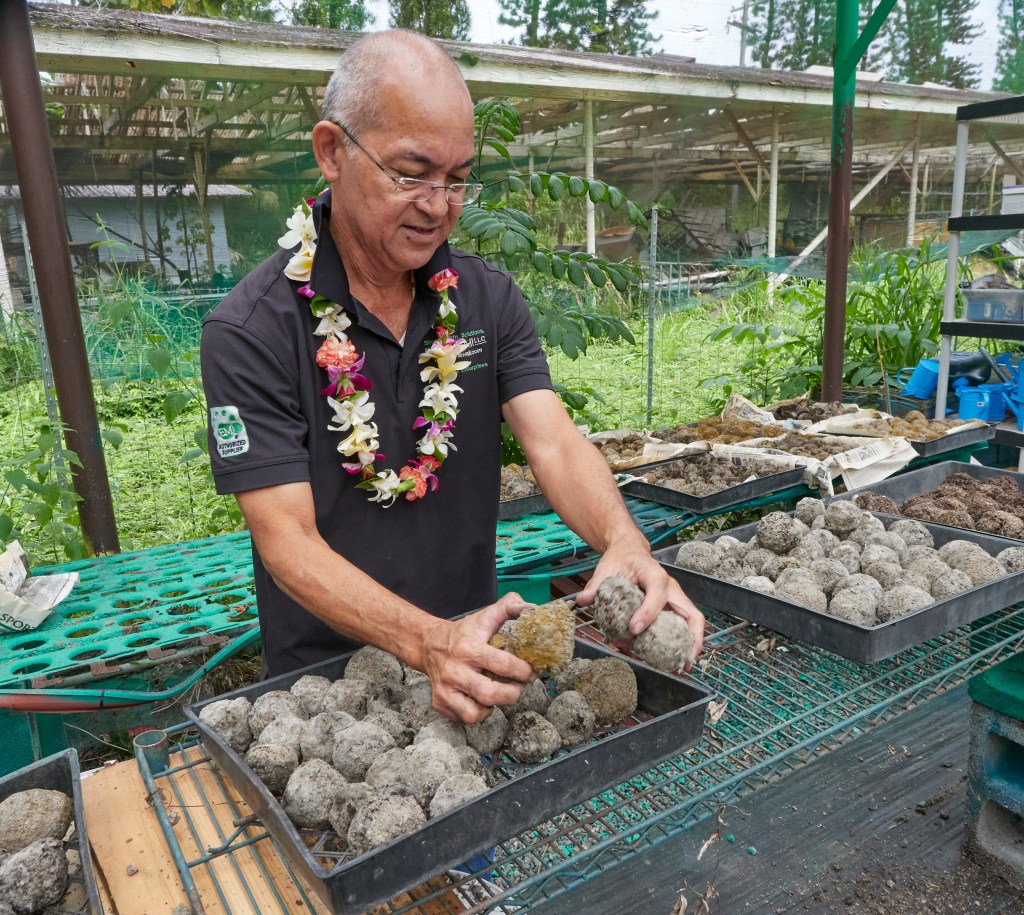
The key ingredient baked into every dry, cured ball tossed in the water is a trademarked substance called “EM,” short for “effective microorganisms.”
It was pioneered in the early 1980s by a horticulture professor in Okinawa, Japan, who combined naturally occurring yeasts and bacteria to help boost farm crop yields. Since then, people also found that they could take it to improve digestion and gut health.
Nago sells variations of EM out of his store on Nimitz Avenue, near downtown Honolulu, and he said he considers it his life’s mission to share the product’s benefits for better health and sludge-cleansing across Hawaiʻi.
He has helped to organize numerous outdoor ball-making and ball-tossing events, which are tailor-made events for school classes, community groups and businesses looking to do volunteer service activities.
Some earlier studies done abroad and posted on the EM Hawaii website state the genki ball approach holds promise. But the EM’s Japanese pioneer, Teruo Higa, acknowledged in a 1990s study that the scientific community didn’t widely accept his product because it was “difficult to consistently reproduce their beneficial effects.”
The Ala Wai represents the first major waterway in the U.S., Nago said, where genki balls are being tested. The balls were recently deployed in other polluted waterways across the state, including in Kahaluʻu Lagoon and Liliʻuokalani Gardens in Hilo.
‘We All Loved To Believe In The Idea’
The HPU study launched after Star-Advertiser readers wrote to the paper asking whether genki balls could be tossed into Kailua’s wetlands and streams to help reduce the persistent stench there, similar to the Ala Wai project.
Aaron Works, a state Division of Forestry and Wildlife researcher, reached out to HPU to set the project in motion.
The nine aquarium tanks were split into three sets: Three tanks with no genki balls, three tanks with the recommended amount of material based on the EM website and three tanks with a huge amount of genki ball so that, the researchers said, no one could question whether they used enough.

The ecologists presented their findings at the Hawaiʻi Conservation Conference earlier this summer. The final paper hasn’t been published yet.
Deborah Rosenblum, a board member and coach with the canoe club Hui Lanakila, has spent more than 20 years paddling on the Ala Wai.
In recent years, Rosenblum said, paddlers there have definitely noticed a difference in water quality. There’s a greater difference, she said, in the clarity of the water when it hasn’t rained in a while.
In prior years “it was brown all the time,” Rosenblum said. “It could have just rained or hasn’t rained in weeks, but it was all the same.”
The canal’s quality has been notably good this year, she added, but she largely attributed that to the lack of rain, which brings chemicals and other pollutants down the watershed — plus debris ranging from dead animals to discarded couches.
Rosenblum wondered whether dredging might be a big reason for the recent improvements at the canal. Work crews, according to the state’s Department of Land and Natural Resources, last dredged the Ala Wai in 2020 and 2021, around the time those improvements started to emerge.
“I’m quite saddened to hear that they have this study out that has suggested a disproval of the idea,” Rosenblum said, “because we all loved to believe in the idea.”
Civil Beat’s coverage of the environment is supported by The Healy Foundation, the Marisla Fund of the Hawai‘i Community Foundation and the Frost Family Foundation.