The road above Waimea Bay was closed to traffic on May 17, with alternating single-lane traffic planned for another two months. Or more.

Defying Gravity To Secure An Unstable Hillside Above Kamehameha Highway

The road above Waimea Bay was closed to traffic on May 17, with alternating single-lane traffic planned for another two months. Or more.

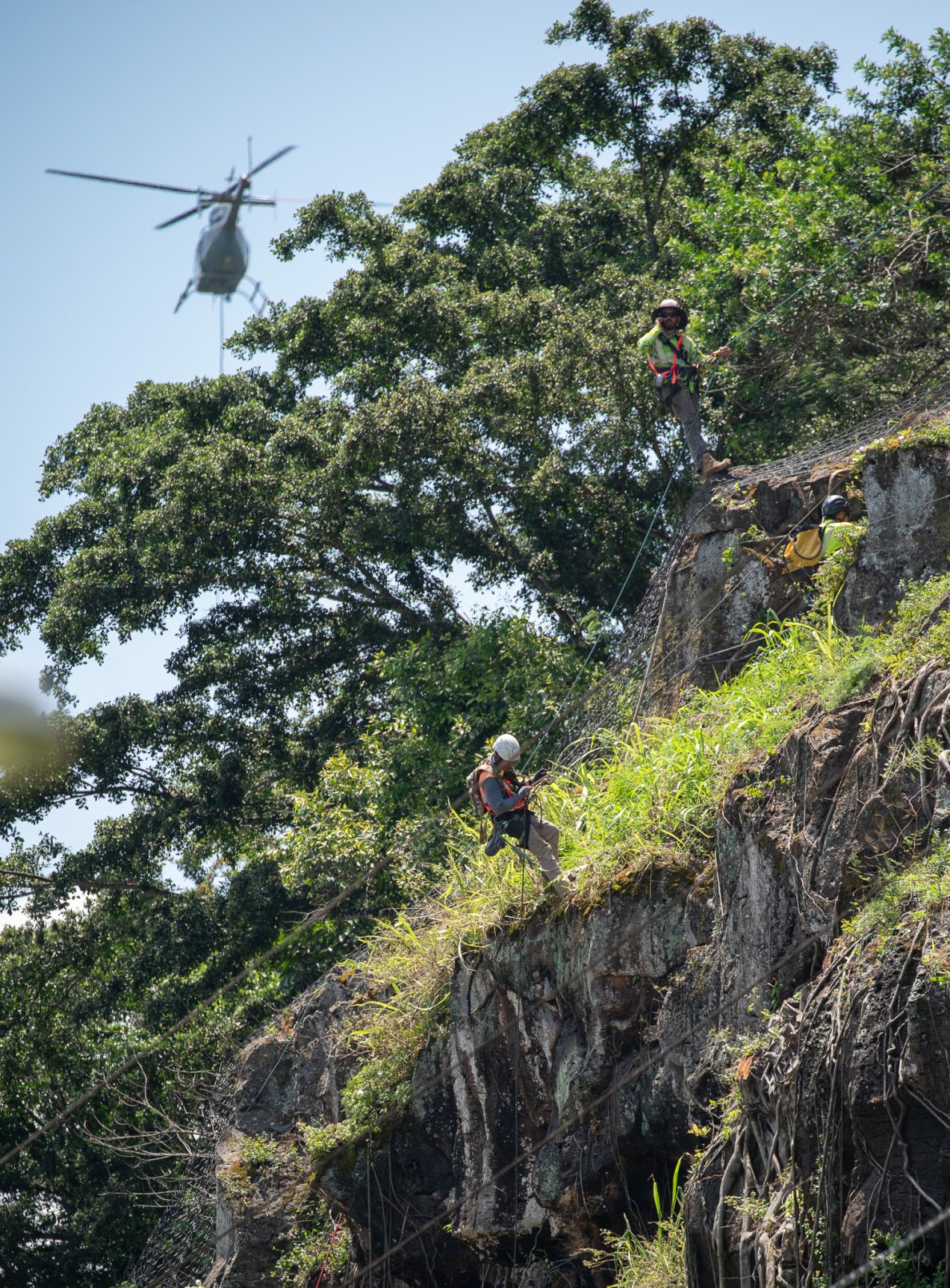
Workers rappell down the 230-foot-tall hill above Waimea Bay as their helicopter lifts a length of 1000-2000 pound netting May 17, 2026. (Craig Fujii/Civil Beat/2026)
Workers rappel down the 230-foot-tall hill above Waimea Bay as their helicopter lifts a length of heavy netting. (Craig Fujii/Civil Beat/2026)

There was a dance last Sunday out on Kamehameha Highway. It was delicate, nuanced, practiced and choreographed — and it was performed in hard hats, neon safety gear and steel-toed boots. 

Incessant chatter blaring from radios provided the soundtrack as a helicopter delivered giant sheets of wire netting — each 150 feet long — to workers dotting the 230-foot hillside above Waimea Bay, who in turn stretched the net across rocks and boulders to hold them in place.
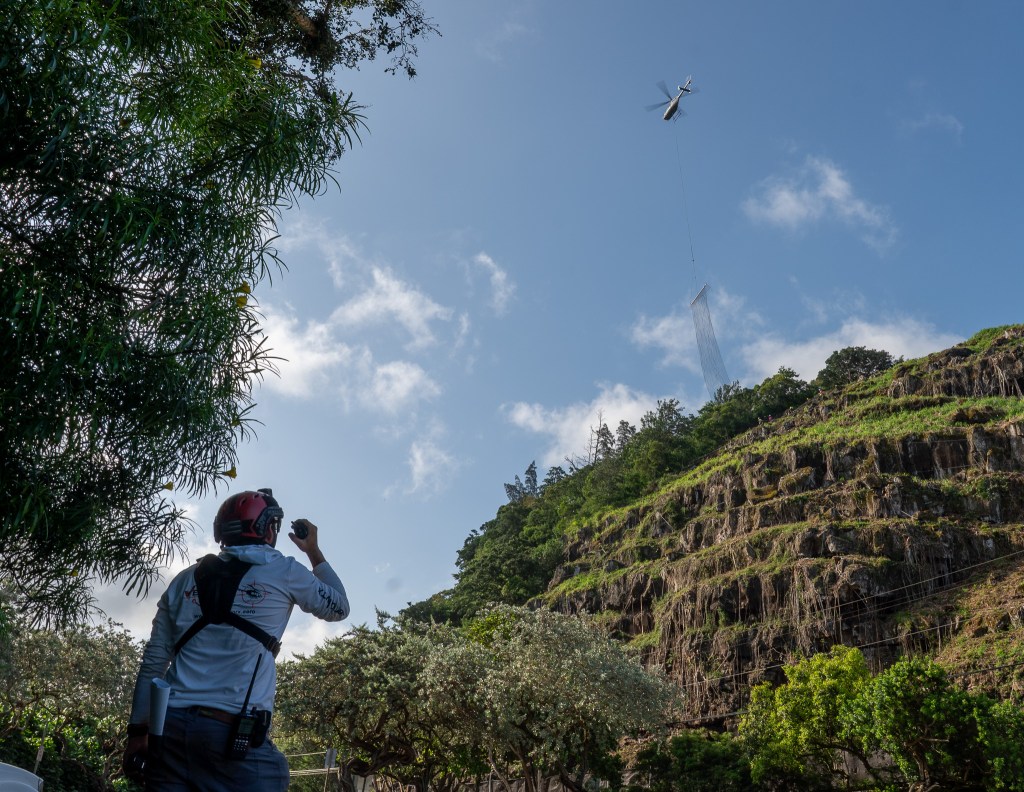
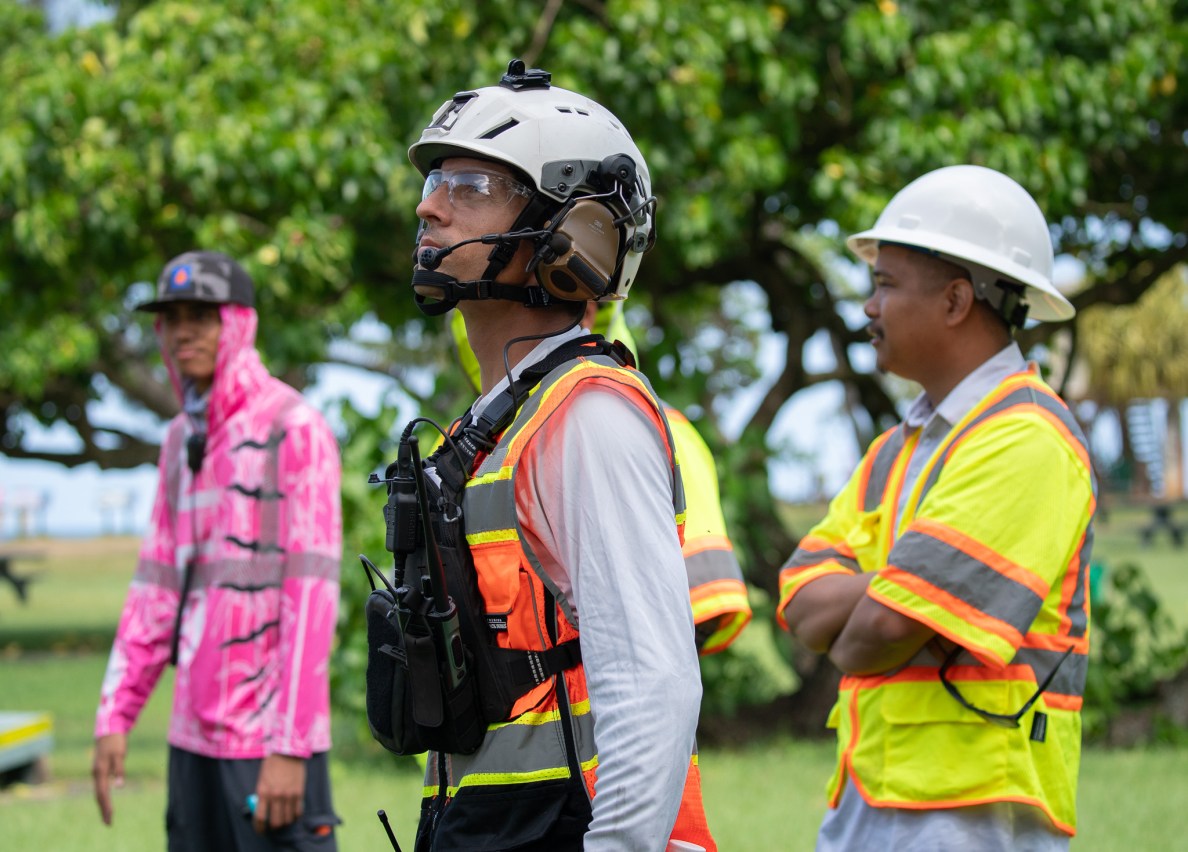
A Vertical Worx (cq) safety worker monitors radio communications as their helicopter lowers a 1000 lb. length of netting onto the unstable hillside above Waimea Bay May 17, 2026. The highway was closed to traffic during operations Sunday. (Craig Fujii/Civil Beat/2026)
A Vertical Worx safety worker monitors radio communications as the company’s helicopter lowers a 1,000-pound length of netting onto the unstable hillside above Waimea Bay when the highway was closed to traffic. (Craig Fujii/Civil Beat/2026)

The plan was pulled together in a matter of weeks after two car-sized boulders fell onto the road on April 10, kicking the state Department of Transportation into emergency gear.

Weeks before, a landslide below the roadway at the western end of the bay had looked to be a problem that would tie up traffic for days — and it did. But that problem was dwarfed by the risk the giant boulders posed to motorists and pedestrians.

The daunting scope of the job soon became clear, complicated by the steepness of the hill’s contours, its dense foliage and sheer size. Add to that hard-to-net overhangs and at least one cave that required special care because it houses iwi kūpuna remains.

So much of the greenery that would act as natural anchors was missing from the landscape, exposing a 200,000-square-foot patch of boulders and rocks. Plans are ongoing to replace the greenery with native Waimea plants, such as the Milo tree, Pōhinahina and fast-growing ‘Ānapanapa — work being done by Rick Barboza and his crew at Hui Kū Maoli Ola plant nursery, according to the state.
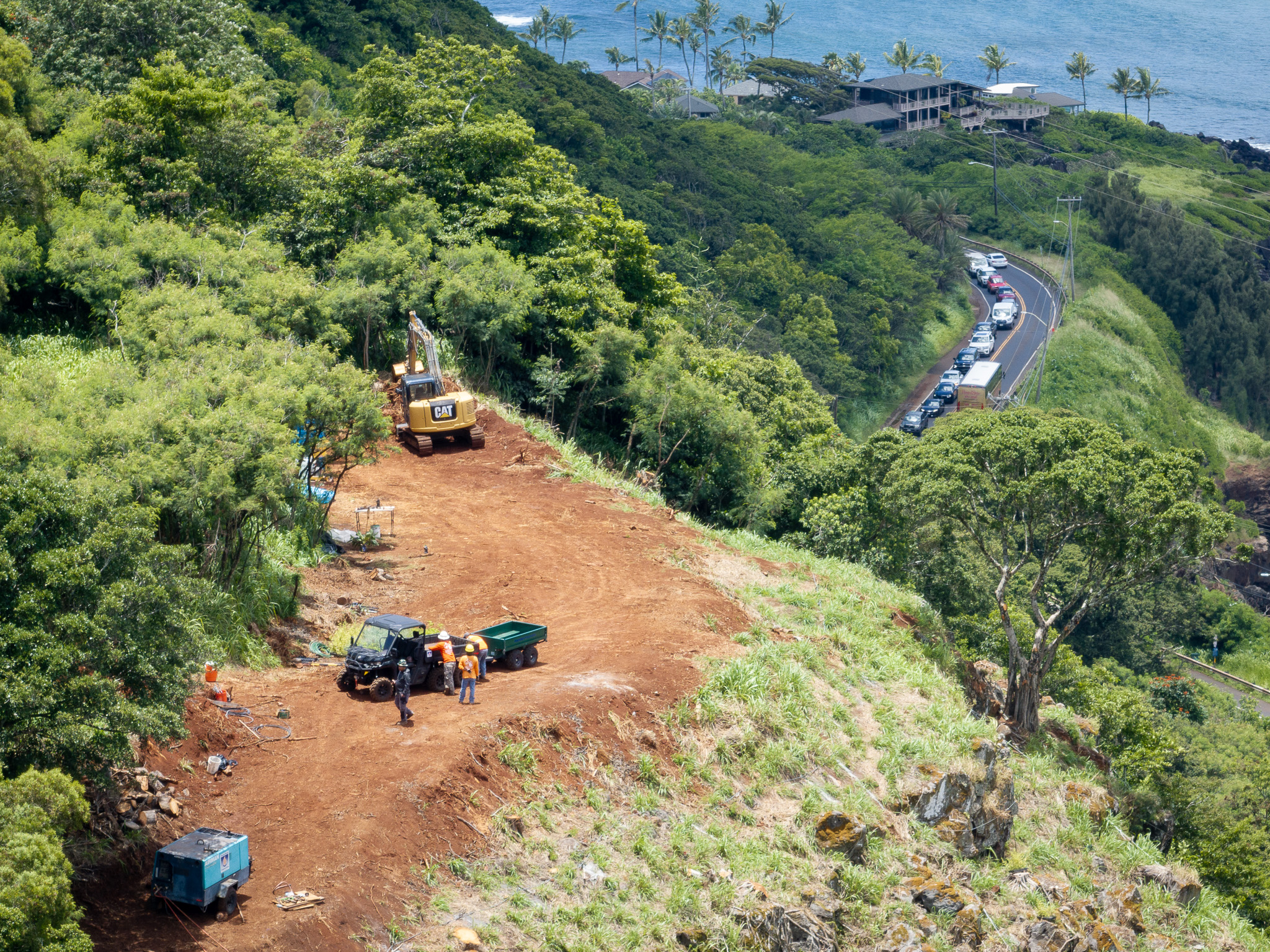
Department of Transportation workers work to stabilize the steep hill adajcent to Waimea Bay May 11, 2026. The Kona low storms in March loosened boulders and rocks which crashed onto the roadway below. (Craig Fujii/Civil Beat/2026)
Department of Transportation workers work to stabilize the steep hill adjacent to Waimea Bay. The Kona low storms in March loosened boulders and rocks, which crashed onto the roadway below. (Craig Fujii/Civil Beat/2026)
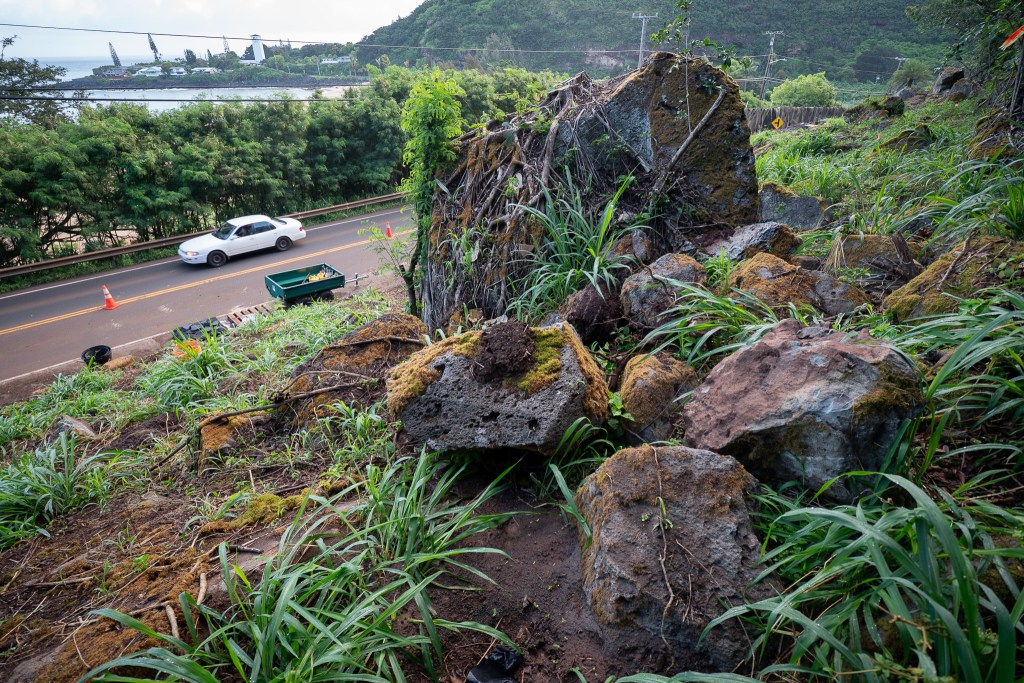
Rocks and a boulder at rest on the lower section of a 230-foot hill next to Kamehameha Highway May 17, 2026. Workers have been shoring up the hillside after boulders crashed onto the road surface April 10. (Craig Fujii/Civil Beat/2026)
Rocks and a boulder rest on the lower section of a 230-foot hill next to Kamehameha Highway. Workers shored up the hillside after boulders crashed onto the road surface on April 10. (Craig Fujii/Civil Beat/2026)

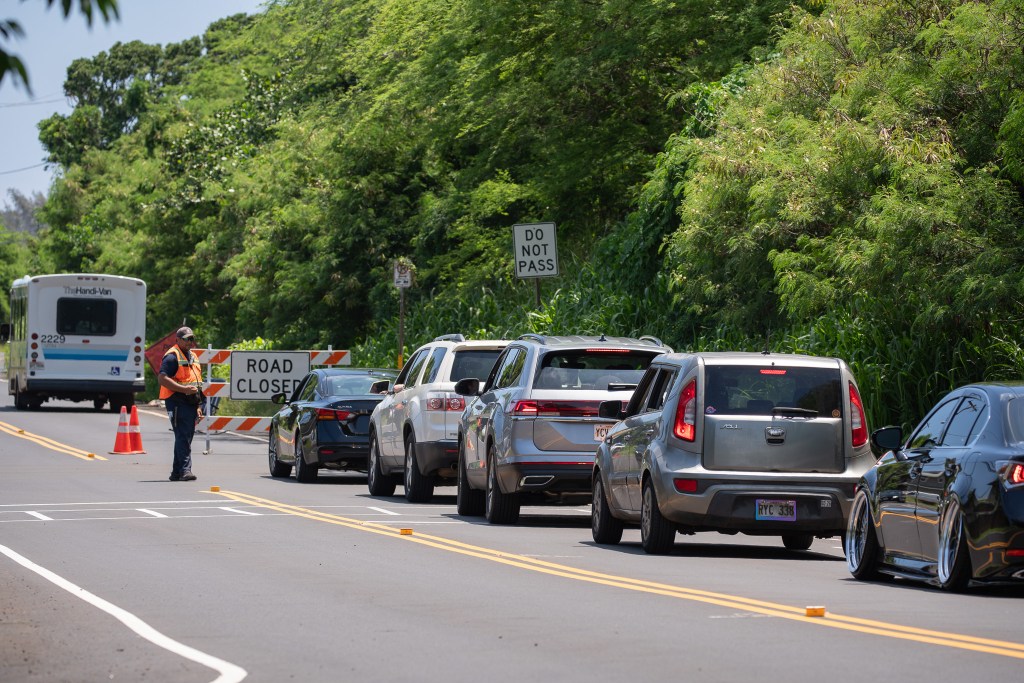
As part of the shoring up plan, traffic had to be halted all day on May 17, from 7 a.m. to 5 p.m., inconveniencing many. TheBus and TheHandi-Van were allowed to cross at intervals, and no emergency vehicles ended up needing to get by. Waimea Bay Beach Park was closed as an emergency landing site for the helicopter.
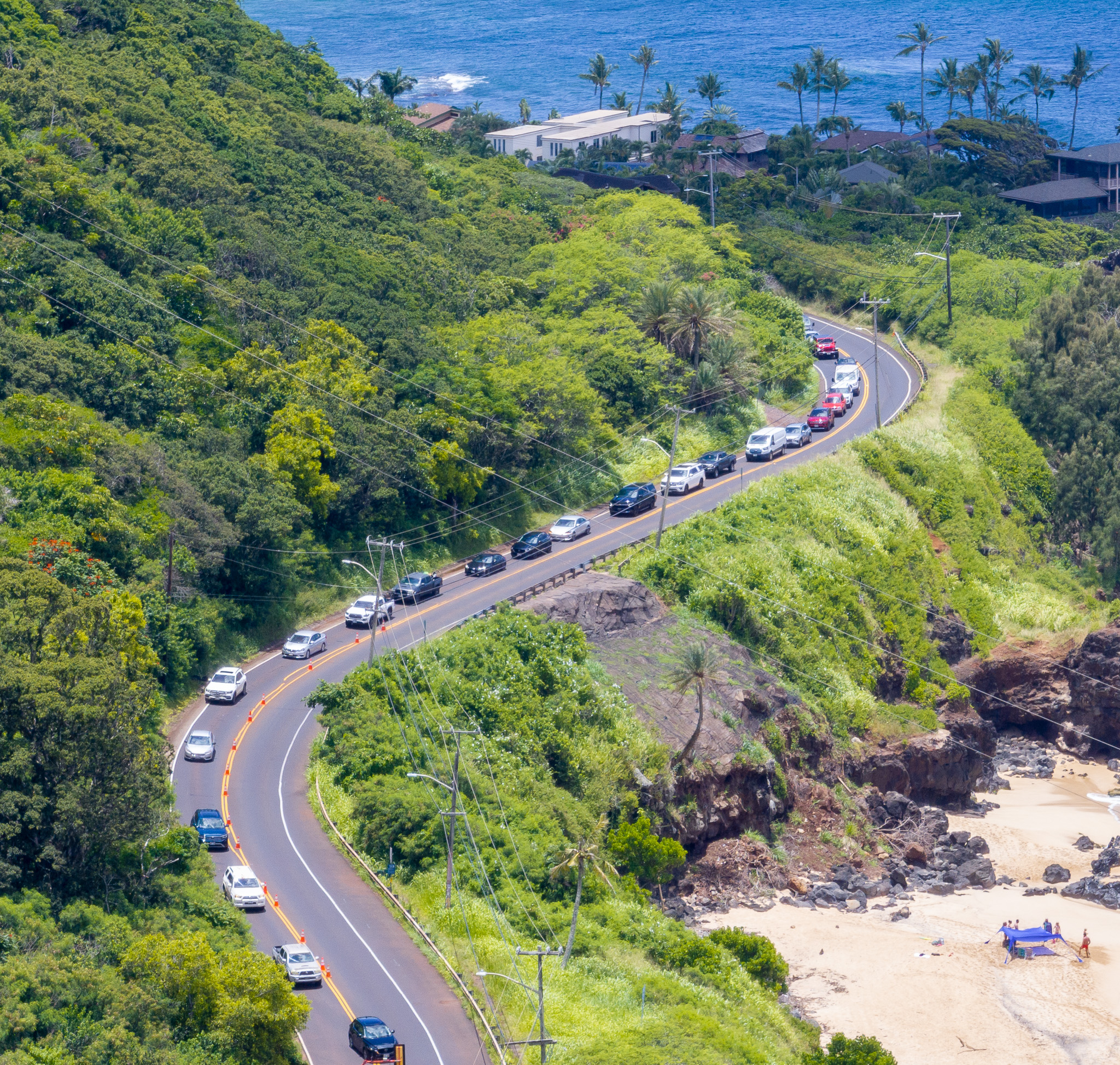
Kahuku-bound traffic moves single file over Kamehameha Highway at Waimea Bay May 11, 2026. Rock falls and landslides have created a safety which is being shored up by the Department of Transportation. (Craig Fujii/Civil Beat/2026)
Kahuku-bound traffic moves single file over Kamehameha Highway at Waimea Bay before the repairs began. Rock falls and landslides had created a safety hazard, which was being shored up by the Department of Transportation. (Craig Fujii/Civil Beat/2026)
Safety workers with a helicopter crew walk near one of the boulders that fell onto the Kamemehameha Highway from a 230-foot-tall hill above the roadway in early April. The Roadway was closed May 17, 2026 for hillside stabilization. (Craig Fujii/Civil Beat/2026)
Safety workers with a Vertical Worx helicopter crew walk near one of the boulders that fell onto the Kamehameha Highway from a 230-foot-tall hill above the roadway in early April. The Roadway was closed on May 17 for hillside stabilization. (Craig Fujii/Civil Beat/2026)
Vehicles are turned around on the Haleʻiwa side of Waimea Bay as crews worked to place safety netting on the 230 foot hill above Waimea Bay May 17, 2026.  Buses and Handivan were allowed through at intervals. (Craig Fujii/Civil Beat/2026)
Vehicles are turned around on the Haleʻiwa side of Waimea Bay as crews work to place safety netting on the 230-foot hill above Waimea Bay. Buses and TheHandi-Van were allowed through at intervals. (Craig Fujii/Civil Beat/2026)

That 10-hour hiatus allowed for intense focus. Twenty-two loads of netting were completed by helicopter, shaving weeks off the time it would have taken to use cranes, said CEO Kevin Dorn of Vertical Worx helicopters, formerly Paradise Helicopters. Prometheus Construction provided expertise and labor on the ground. 

A helicopter lowers a 24 by 150 foot length of  rockfall netting next to workers visible on the ridgeline above Waimea Bay May 17, 2026. The 150-foot-long length of netting weighs about 2000 pounds. (Craig Fujii/Civil Beat/2026)
A helicopter lowers a 24-by-150-foot length of rockfall netting next to workers on the ridgeline above Waimea Bay. The 150-foot-long length of netting weighs about 2,000 pounds. (Craig Fujii/Civil Beat/2026)
Vertical Worx' Kevin Dorn monitors his helicopter as work progressed on stabilizing the hillside above Waimea Bay May 17, 2026. (Craig Fujii/Civil Beat/2026)
Vertical Worx CEO Kevin Dorn monitors his helicopter as work progresses on stabilizing the hillside above Waimea Bay. In the background are Prometheus Construction’s Shaydon Teixeira-Lum, left, and DOT’s Jaron Tejada. (Craig Fujii/Civil Beat/2026)
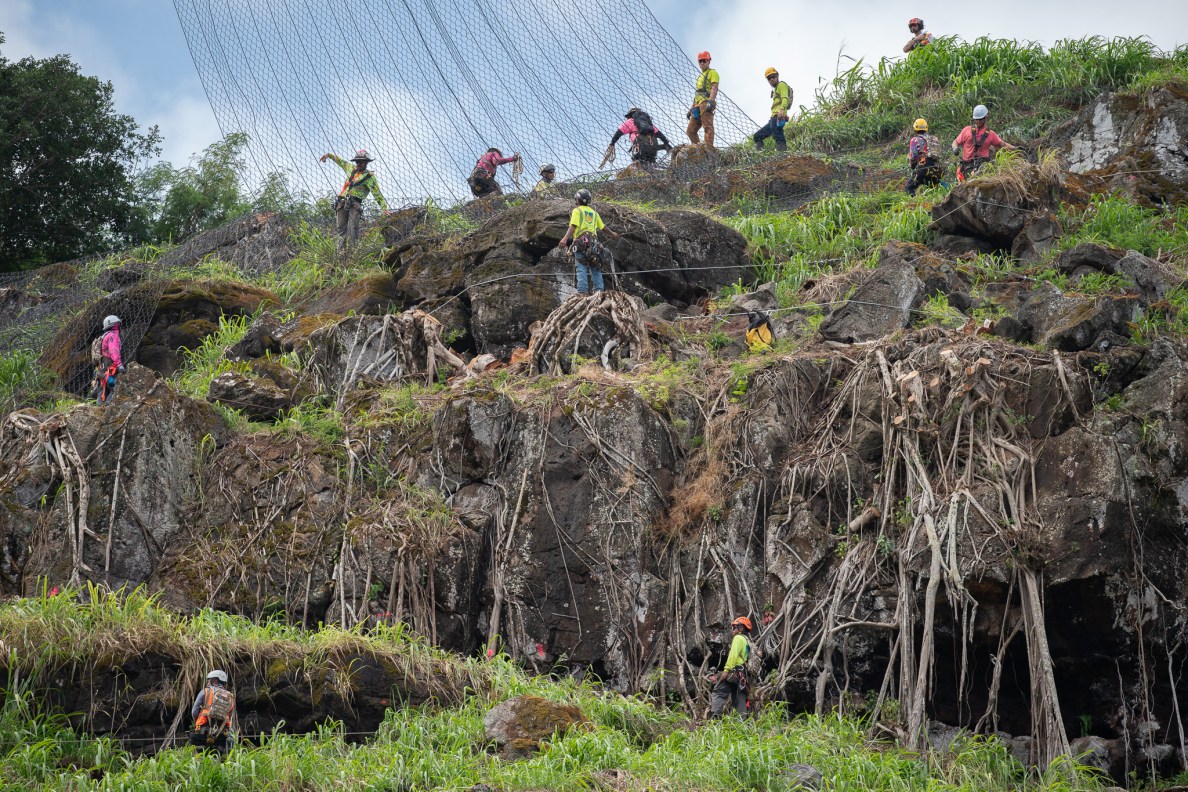
Ant-like workers cover the massive hillside above Waimea Bay May 17, 2026.  The crew laid rockfall safety netting and the roadway was closed Sunday. (Craig Fujii/Civil Beat/2026)
Ant-like workers cover the massive hillside above Waimea Bay. The crew laid rockfall safety netting and the roadway was closed Sunday. (Craig Fujii/Civil Beat/2026)
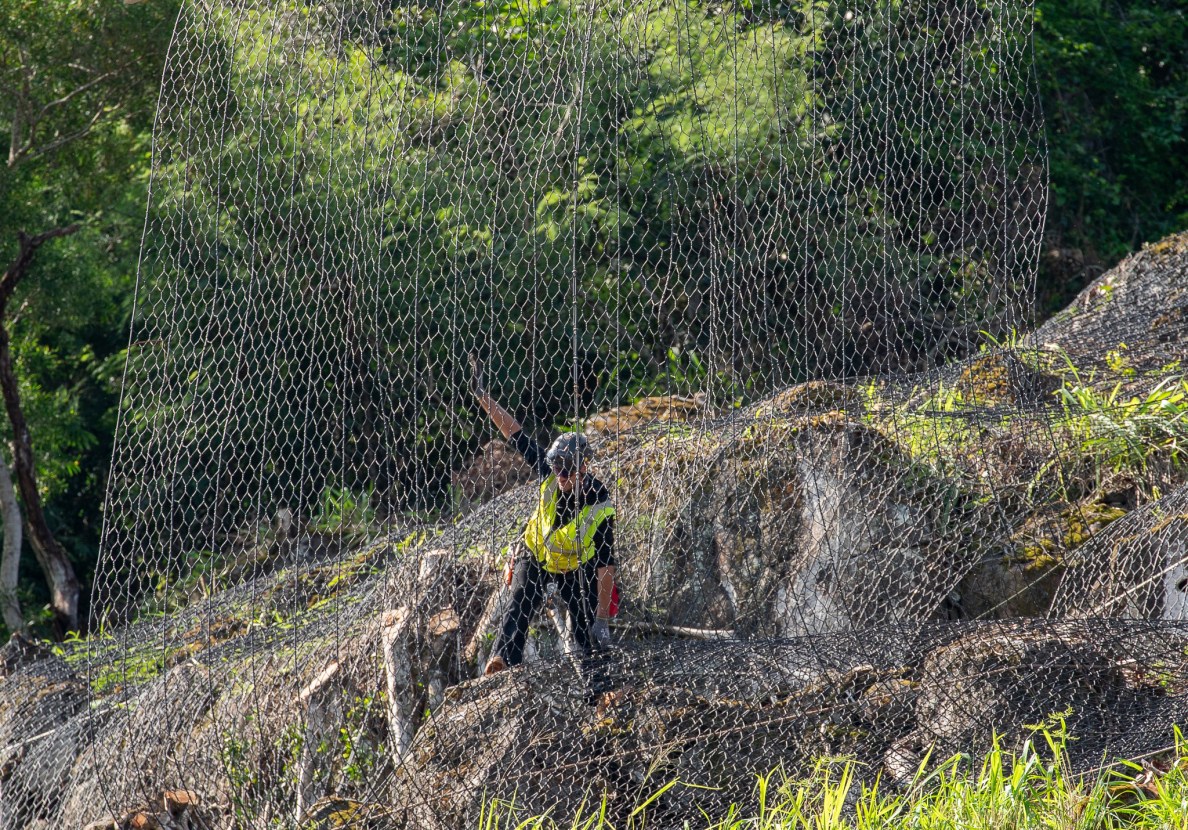
A worker guides rockfall safety netting onto an unstable hill above Waimea Bay May 17, 2026. Boulders fell onto the roadway in early April which kickstarted stabilization work. (Craig Fujii/Civil Beat/2026)
A worker guides rockfall safety netting onto an unstable hill above Waimea Bay. Boulders fell onto the roadway in early April, which kick-started stabilization work. (Craig Fujii/Civil Beat/2026)

While the road reopened Sunday evening, delays on the highway are not over. Alternating single lanes of traffic are expected to continue for a couple more months while cranes place a second section of netting and impact fencing is added to cover a 500-foot stretch adjacent to the hillside.

All that still laid ahead on Sunday, though, when worry came with every pulse of the helicopter blade and every gust of wind, each causing the netting to twist ever so slightly, like a uncontrolled 2,000-pound sail.

Yet the work continued like clockwork, interrupted only when a coconut-sized rock came loose and fell. A cry rang out. The crew froze.

It fell harmlessly, without hitting anyone or anything.

About the Author

What it means to support Civil Beat.

Supporting Civil Beat means you’re investing in a newsroom that can devote months to investigate corruption. It means we can cover vulnerable, overlooked communities because those stories matter. And, it means we serve you. And only you.

Donate today and help sustain the kind of journalism Hawaiʻi cannot afford to lose.