

Artificial Intelligence Is Here To Stay. Are Hawaiʻi Schools Ready?
From preschoolers to high school seniors, Hawaiʻi students share how artificial intelligence is shaping their learning and plans for the future.

For many schools, it’s a race to keep up. Others are leading the pack. And some are unsure what to do with it.
Artificial intelligence is playing an increasingly prominent role in Hawaiʻi education, from the recent opening of the state’s first AI-focused charter school to the development of new coursework teaching students how to navigate rapidly changing technology. Teachers are also coming face-to-face with new technology, whether it’s using AI avatars to test students’ grasp of Mandarin Chinese vocabulary or confronting kids who are submitting assignments written by ChatGPT.
But there’s wide variation in how much teachers and students are willing to engage with the new technology. Civil Beat spoke with nearly two dozen educators, administrators and students across the state about their experiences with AI in schools and what they expect the future to look like.

A few years ago, the focus of AI in education was preventing students from cheating, said Michael Latham, president of Punahou School. Since then, he said, administrators and teachers at the Oʻahu private school have pivoted to teaching students how to use new tools responsibly, rather than banning them altogether.
“We wanted our students to become really thoughtful and critical users,” Latham said, “to be able to understand these tools, but do so really with eyes wide open, aware of what some of the challenges would be.”
Public schools are piloting their own technology, including MagicSchool, a platform with AI tools like image generators and chatbots that teachers can tailor to their own lessons, said Winston Sakurai, educational administrative services director in the Department of Education’s Office of Curriculum and Instructional Design.
While teachers receive training on how to use these platforms, Sakurai acknowledges that some are faster to embrace technology than others. It’s important for schools to find a balance between innovating with AI and meeting teachers where they’re at, he said.
“We want people to embrace it,” Sakurai said, “but we cannot afford to burn people out with the adoption of it.”

Students also have varying levels of enthusiasm for the new technology. Some are emerging as statewide experts in the field, with one Punahou student developing resources to help teachers incorporate AI into their lessons. Others are more skeptical of the technology after they’ve seen their classmates cheat on assignments or receive incorrect information from AI chatbots.
“I think personally, AI is a useful and dangerous tool,” said Charwin Irebaria, a junior at McKinley High School. “People should be cautious about what they try to get out of AI, because it can really affect our future.”
McKinley High School
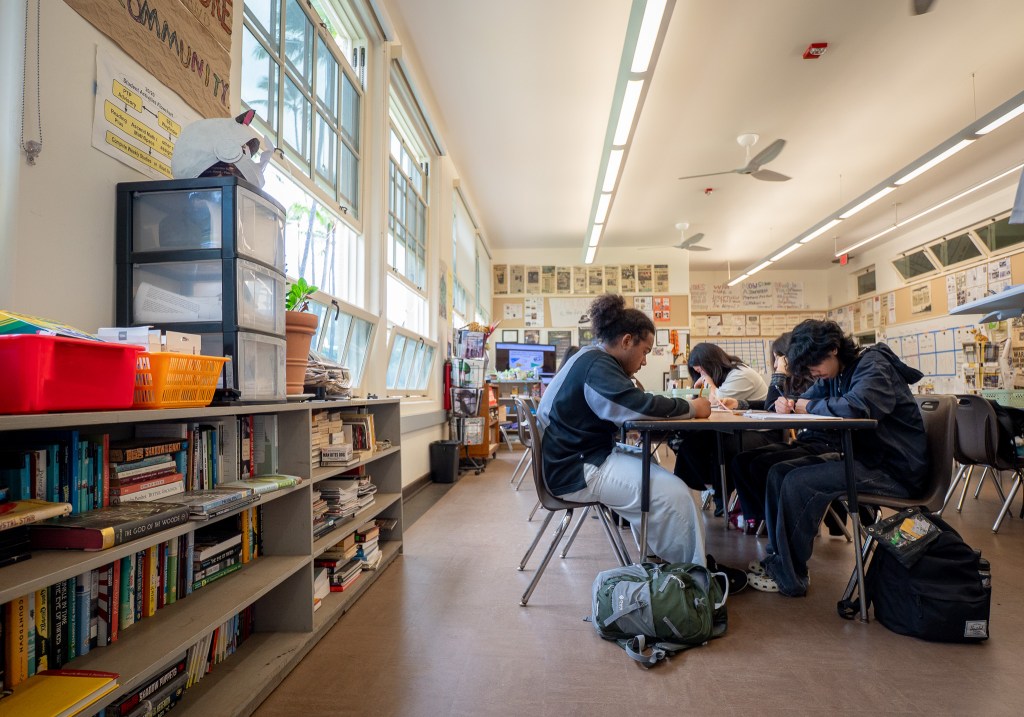


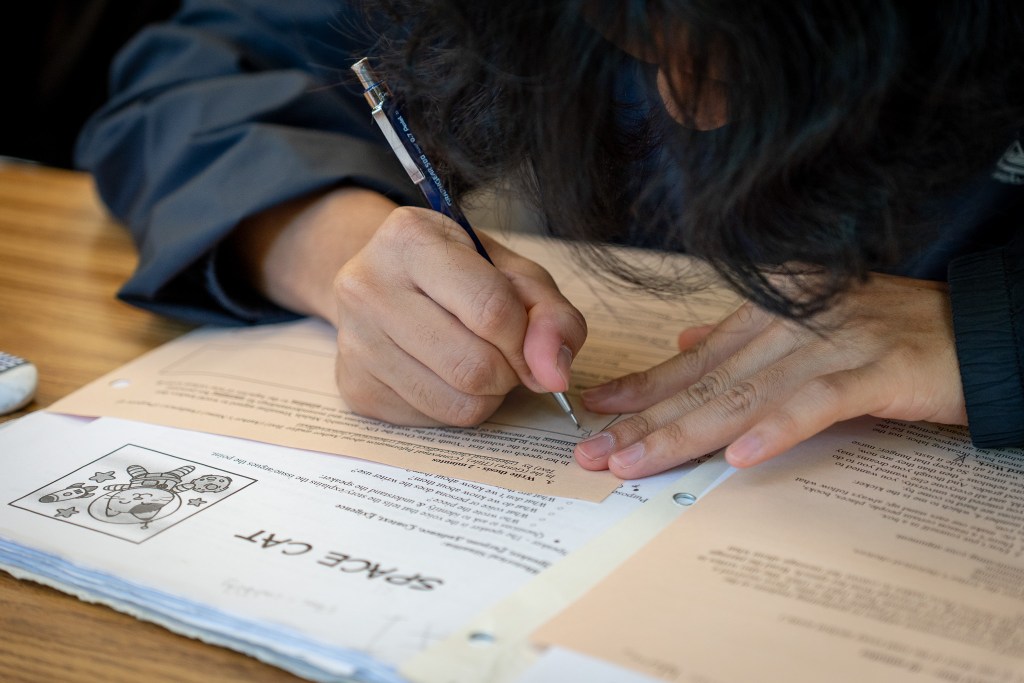
Some teachers have shifted away from technology in recent years to ensure students are completing the coursework by themselves. (Craig Fujii/Civil Beat/2026)
In Cynthia Reves’ McKinley High School classroom, an assortment of items litter students’ desks: a bear-shaped pencil case, neon highlighters, a manila folder stuffed with papers.
Laptops and iPads are conspicuously absent from students’ workspaces. Teens place their cellphones in mint green containers minutes after the bell rings and leave their devices there for the remainder of class.
Like many teachers, Reves is questioning if her students are using AI on their assignments – and whether it’s appropriate for them to do so. In the past year, she’s tried to eliminate some of the uncertainty by doubling down on paper and pencil assignments and reducing students’ use of laptops and cellphones in her class.
“What is dishonest use of AI?” Reves said. “That implies there’s an honest use of AI. What is that?”
On a Friday morning in May, Reves ran her students through a series of short writing exercises to prepare them for their upcoming Advanced Placement English Language and Composition exam. Although the test would be online, Reves tasked her students with annotating passages and writing thesis statements by hand.
“It feels like this huge tension,” Reves said. “I feel like I’m walking backwards, and yet there’s this AI thing that’s pulling forward.”

Reves went to school in the 1980s, when students used typewriters to complete assignments and Macintosh computers were the newest technology. Reves has constantly adapted to change in her 30 years in education, from teaching remotely to managing cellphones in class, but she’s worried about how the latest AI tools could impact students’ learning.
In the past, Reves said, she could quickly identify when a student didn’t write a paper on their own. Just by plugging the opening sentences of a paper into Google, she said, she could tell when students found a copy of a similar assignment online and claimed it as their own.
Now, Reves doubts herself. While she occasionally questions if students have written an essay on their own, they’ll deny using AI – and there’s no way to prove it, Reves said. Many AI detection tools have proven unreliable.
Reves now confines most of her writing assignments to the classroom, rather than assigning essays as homework. If students want to finish a writing assignment during study hall, she said, she requires their teacher to sign off on the paper at the end of the period, affirming that the student completed the work on their own.

But Reves also knows she can’t avoid AI forever. At the end of a recent English class, she assigned her students homework requiring them to read a short passage and answer questions. Once they completed the assignment, she said, they could run the writing prompts through AI to see how their answers compared to what the chatbot suggested.
She wouldn’t have offered this option in August, Reves said. But her students have developed stronger writing skills and judgment throughout the year, and she believes they can now evaluate the AI responses’ critically.
“I trust you,” Reves told her students.
Mid-Pacific Institute


Preschoolers at Mid-Pacific Institute excitedly contribute to a class discussion as ChatGPT transcribes their conversation. (Craig Fujii/Civil Beat/2026)
Leslie Gleim’s preschool students at Mid-Pacific Institute are confident they can outsmart ChatGPT.
On a recent Wednesday morning, Gleim led a small group of 5-year-olds in a lively conversation about the observations they made on a recent field trip to Hoʻomaluhia Botanical Garden. She encouraged students to use their imagination to describe the clouds and explain how they came to life during their visit.
“It was the happiest cloud!” one boy said. Another student speculated some of the clouds looked sad because the class hadn’t visited the garden for a few weeks.
As the children chimed in, ChatGPT transcribed the discussion word for word on Gleim’s phone. Later, Gleim asked it to summarize the themes that emerged during the students’ conversation and compared the notes against her own observations.
The AI tool didn’t go unnoticed by the kids.
“We seem smarter than Chat,” one student, Knox, said as Gleim checked the AI transcription on her phone.
“Are you?” she asked. The group of kids erupted into cheers and enthusiastic nods.
A few minutes later, Knox and his classmates put their theory to the test. One by one, they spoke into Gleim’s phone, asking ChatGPT abstract questions about their field trip to the garden and the personalities they gave the clouds during their discussion.

After every question, Gleim asked her students to evaluate ChatGPT’s answers. Students were skeptical of the responses the AI generated – and Gleim was proud.
“You guys won!” she said as students gave ChatGPT’s answers a resounding thumbs-down.
Using ChatGPT to record and transcribe her discussions with students has significantly saved her time over the past year, Gleim said. It also increases the stakes for students. When students know ChatGPT is listening to their conversation, she said, they’re more intentional with their words.
But Gleim doesn’t want kids to think AI is the source of all answers. When she uses ChatGPT in front of her students, she said, she’s not afraid to point out its mistakes, using phrases like, “Chat didn’t get it.”
“It’s not the gospel, but a tool,” she said.
Hawaiʻi Technology Academy

Two years ago, Kingston Collman came to a sombering realization: AI was coming for his dream job.
Collman, a recent graduate from Hawaiʻi Technology Academy’s Waipahu campus, spent his early years of high school studying game development and planned to pursue a career in computer science. But as AI became more advanced, he realized projects taking him a year and a half to complete could be completed in minutes by new technology.
“I was like, freshman year, AI is going to take over,” the 18-year-old said. “I don’t want to study for six years ahead and then be jobless.”

Collman pivoted to using AI to pursue his passion of producing social media content. For his end-of-year project, Collman developed an AI assistant to expedite the process of creating videos for social media. The assistant can generate scripts, suggest a list of video shots and assist with creating social media posts in a matter of minutes — a process that previously took him over an hour, Collman said.
The goal is to increase content creators’ efficiency, not to remove humans from social media altogether, Collman said, adding that viewers still want to see authentic content.
It’s hard to tell what the future will look like for social media creators, however, and he’s worried more content could become AI-generated. Already, AI slop – low-quality videos created with AI – are becoming increasingly popular on YouTube and other online platforms.
“You don’t know what’s real or not,” he said, “which is very dangerous.”
Some of Collman’s peers are equally skeptical of AI and how it could dominate fields traditionally untouched by technology.
Adriana Hunt, another recent graduate from Hawaiʻi Technology Academy, is still reconciling how she can use AI to promote her artwork without compromising her creativity. For her end-of-year project, the 18-year-old asked ChatGPT to analyze her TikTok and Instagram art accounts and provide feedback on what types of posts were most likely to grow her online following.
ChatGPT offered her advice she previously hadn’t considered, Hunt said, like adding more hashtags to her social media posts or posting more about her process of creating drawings.

Hunt draws the line at using AI to create new art.
When one of her teachers suggested using AI to generate ideas for her art or assist with her drawings, Hunt immediately rejected the idea. She uses art as a way to express herself and challenge her creativity – something that can’t be replicated by a few keystrokes on the computer, Hunt said. She’s also worried that relying on AI to generate art could set impossibly high standards.
“It’s never going to go away, because it’s now so woven into the fabric of everything,” Hunt said. “But we can learn how to rely on it less.”
Kūlia Academy


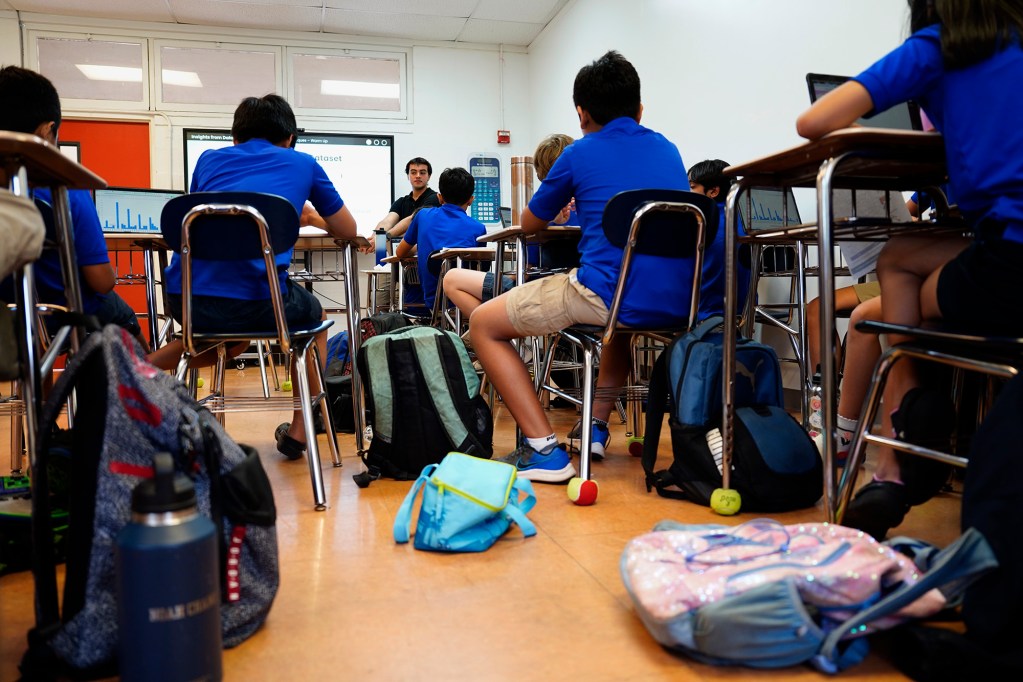

Kūlia Academy puts a heavy emphasis on data analysis and coding to help students understand how AI works and how they can develop new technology themselves. (Kevin Fujii/Civil Beat/2026)
In James Morice’s data science class, sixth graders throw out phrases like “bimodal distributions” and “right-skewed graphs” with ease.
At Kūlia Academy, a charter school in Kalihi, data science and coding are just as important to the curriculum as English and math. Kūlia is Hawaiʻi’s first AI-focused middle and high school, opening in 2024 with ambitious plans to develop a seven-year program specializing in data science and coding.
Before students can pursue careers in AI engineering and technology, Morice said, they have to learn the basics.
On a recent Thursday morning, sixth graders at Kūlia were working together to examine graphs and input formulas in Google Sheets that could help them analyze a large dataset on the maximum speeds of roller coasters across the country.
“What does every case represent?” Morice asked the class. “What are the attributes you see?”

The goal is to give students the expertise they need to understand how AI works so they can go on to develop new tools.
Students still receive plenty of opportunities to work with new technology at Kūlia Academy, executive director Andy Gokce said. In English classes, Gokce said, students work with ChatGPT to receive feedback on their essays under the guidance of their teachers. Others have learned how to train AI models to distinguish between venomous and non-venomous snakes.
But Gokce doesn’t want his students to simply consume AI – he expects them to go on to lead the field and develop new technology as engineers or cybersecurity experts.
“We want them to know, inside and out, how it actually works,” Gokce said.
Waiākea Intermediate School

Can students beat AI?
It’s a challenge sixth graders were eager to tackle in Tyler Kojima’s world history class at Waiākea Intermediate School on the Big Island.
On a recent Tuesday afternoon, Kojima tasked his students with defending a historical invention of their choice to an AI chatbot. He had programmed the chatbot to be skeptical of students’ inventions, which ranged from the Mesopotamian wheel to the woodblock printing technique.
Kojima’s students could hold a conversation with the chatbot to convince it of the value of their invention, but they had to prove their point in eight messages or fewer.
“You’re not trying to throw in the towel,” Kojima told his students. “You’re trying to beat it.”
For the next 30 minutes, students furiously typed on their laptops as they responded to detailed questions from the chatbots.
“How do you know it’s more comfortable?” the chatbot challenged one student who was trying to sell it on the value of a new camel saddle.
“Why should we trust ordinary citizens to make important decisions about our city?” it said in response to a pitch about Athenian democracy.

It’s natural for people to be resistant to new innovations and change, Kojima told his sixth graders. When AI emerged a few years ago, he said, many adults were skeptical of the new technology – and so were his students.
At the start of the year, Kojima said, many students believed AI was taboo. Most sixth graders don’t seem to use AI in their personal lives, Kojima said, and were wary about using it for the first time.
Kojima is hoping to change students’ perceptions by introducing AI tools like chatbots and image generators that can make abstract topics in world history feel more concrete and exciting. He said he’s also careful to set clear limitations on how students can use the technology, instructing the chatbots not to give students immediate answers during class activities and occasionally rejecting the feedback kids receive on their essays from AI writing tools.
“This tool is not going away,” Kojima recalled telling his students. “It’s up to you guys to know how to use it responsibly.”
Civil Beat’s education reporting is supported by a grant from Chamberlin Family Philanthropy.
