

One of Hawaiʻi’s hottest hobbies is old-school: wooden cups, a ball and string. For the uninitiated, it’s called kendama.
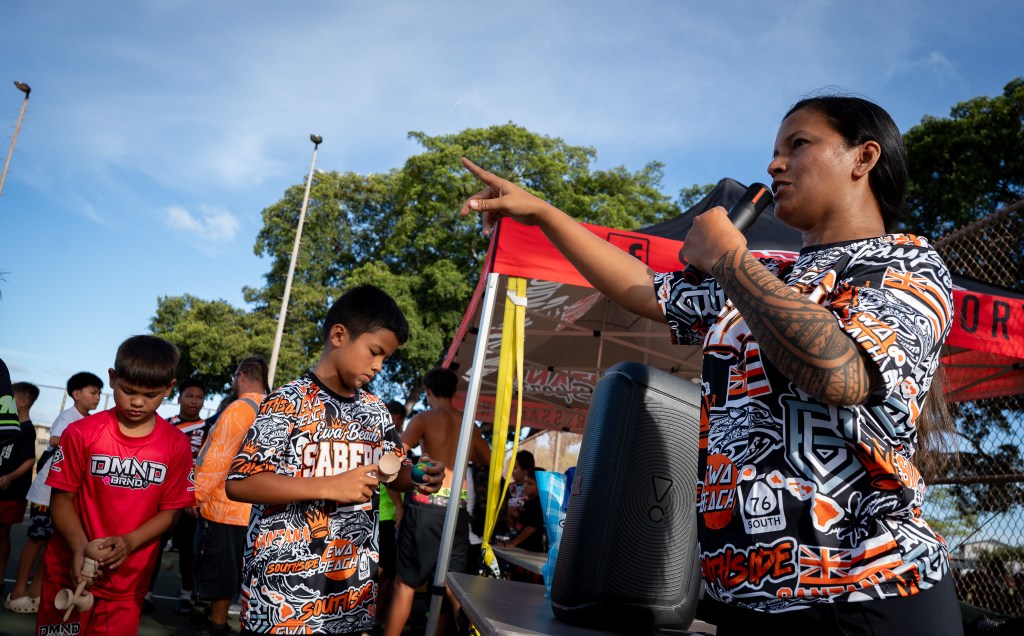
Every Monday, the Southside Kendama Club brings the community together at ʻEwa Beach Community Park for people of all ages to hang out and practice their toss and catch tricks.
The Japanese cup and ball game club began in June to give Oʻahu’s keiki a place to gather this summer to build friendships and have fun while playing, said Club founder and owner Tasha Santana, 47.
“I just want to provide a safe place for the kids and everyone in the community to come together,” she said.

The club, which is free to enter, quickly gained momentum, growing from more than 60 kids in its first week of June to about 200 participants by its sixth week.
It’s a challenging skill game that, according to some sources, was inspired by the French game, bilboquet. The French version consists of a handle with a cup attached to a ball on a string. Once the concept came to Japan, it was modified to have cups on the side, resulting in today’s kendama, according to Sean Abbott, one of the leaders of the Hawaiʻi Kendama Club.
Basic kendama tricks involve tossing and catching the ball in the three cups or landing a hole of the ball onto the spike of the handle. There are a variety of ways to combine tricks and balancing the ball on the handle — allowing each player to create their unique style when they play.

According to Kendama USA, the traditional skill toy helps develop coordination and physical motor skills such as hand-eye coordination, balance, and reflexes. With countless tricks to learn and master, the kendama continues to keep beginners and experienced players engaged as they build their skills.
Alongside Santana’s club, leaders and members of the Hawaiʻi Kendama Club join the weekly gatherings to help keiki learn tricks, connect with other players and grow the local kendama community.

“One of our main principles is to foster a cohesive community of all kinds, really, from young to old, mom, dad, auntie, uncle. That’s what we’re here for,” Ethan Santiago, founder of Hawaiʻi Kendama Club said. “We see a lot of opportunities to get the keiki and anyone who’s interested in playing kendama to really be unplugged.”
Santiago admits he spends a lot of time on his phone, whether it is for work or social interaction. However, playing kendama gives him a break from the screen and a chance to focus on something hands-on — something he hopes others can experience as well.
“This is a way to enjoy face-to-face interactions, sort of touch grass,” he said. “There’s something very special about that. And for kids, you can build empathy. You can build a lot of social skills, and community building.”


Kendama offers a challenging yet fun hands-on way to spend the day — whether it’s interacting and challenging others in games or mastering new tricks.
“We want to help the kids out, to get them off their phones and like to learn patience and perseverance,” Abbott added. “Like they can do it; they just have to practice.”
Bryson Lee, the 2016 Kendama World Cup Champion from Mililani applauded the clubs for giving keiki a place to get together and keep kendama alive.
It not only benefits community relationships, but it also helps the players enhance their coordination that can be applied to every-day activities and sports.
“It’s a good reason for them to get outside and socialize with each other,” he said, “and you know, just be present.”
Danny Wade, a dedicated kendama player from Lāʻie, first discovered the game when it became popular among students at his school in St. George, Utah. After his friends moved on, Wade kept playing but eventually took a break to focus on basketball.
After moving to Hawaiʻi in 2019, Wade quickly rediscovered his love for kendama and continued to play as the community here started to grow.

Like Wade, other kendama players added playing kendama reached a popularity spike around 2010 before fading away. Today, they believe it is making a comeback.
“It’s booming here. Like it’s probably not like this in Utah,” he said. “It’s so fun to see everyone loving kendama here. I’m just excited to see like younger generations picking it up because that’s kind of what kendama needs to stay alive”.
For Wade, playing kendama is more than just a hobby. It’s a way to get outside and connect with others.
“It was just a good way to get off my ass, like do something with my life. I don’t know, just not be sitting down all the time, getting outside,” he said.
Santana added her original plan was to provide a space for the community and keiki to come together for the summer, but now she’s thinking of how to keep it going during the school year.
“I definitely think it made this summer a memorable one for the kids and the families,” she said. “’I’m just trying to think through how we can continue doing this. Doing it for the kids.”

