


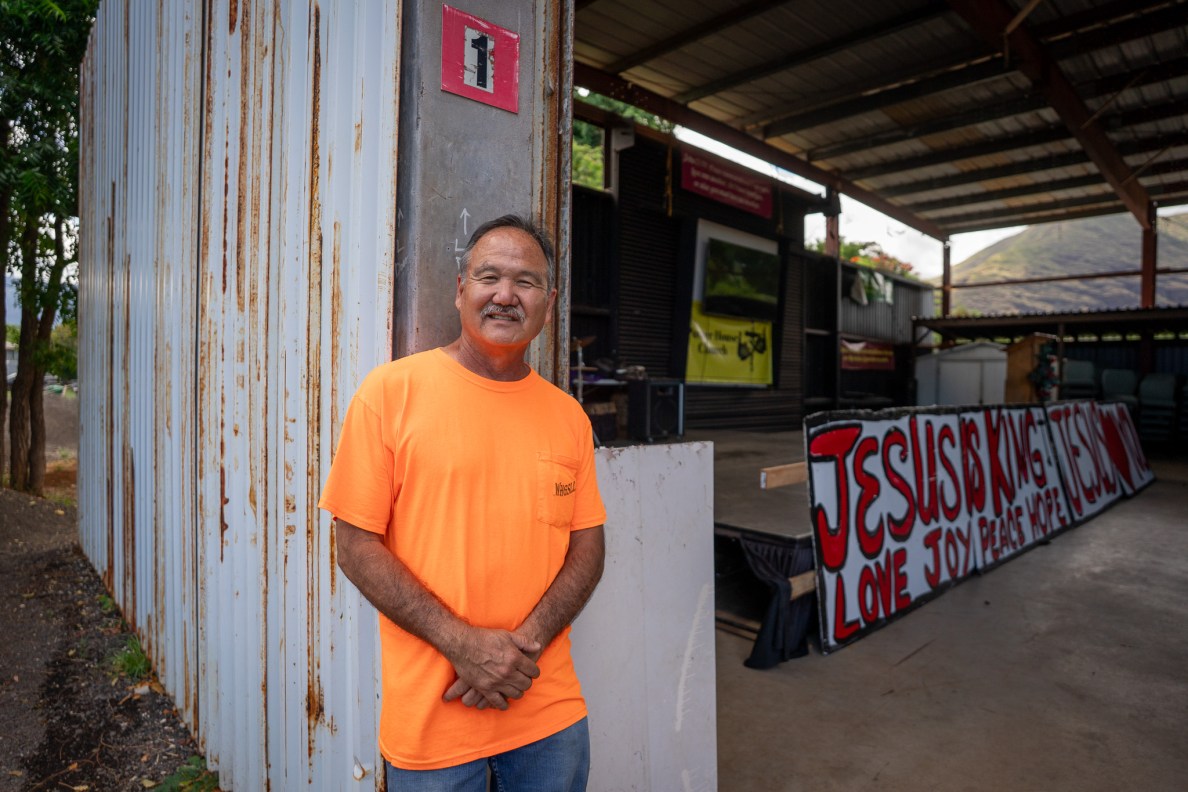
Church music mixes with the clucking of chickens to break the Sunday morning quiet along a country road on Oʻahu’s Waiʻanae Coast.
Under the high, corrugated metal roof of Powerhouse church, Pastor Kimo Matsumoto points toward the church’s success stories up on the stage: a guitarist, a bass player and one of the band’s singers on the ʻukulele all had worked their way through the church’s residential recovery programs for those with histories of incarceration or drug addiction.
Another – who Matsumoto calls their evangelist – is Jodi Keaulana, who was addicted to meth before she turned to Christ. Standing before the congregation, Keaulana read a verse from the Old Testament Book of Proverbs about an ant.
“It survives the heat, it survives the fire, it survives where others don’t,” she said. “Some of us feel small, some of us feel overlooked. But just because you’re small, doesn’t mean you’re weak. God built you to survive the fire.”

A couple months ago, it was not fire, but water that this congregation survived.
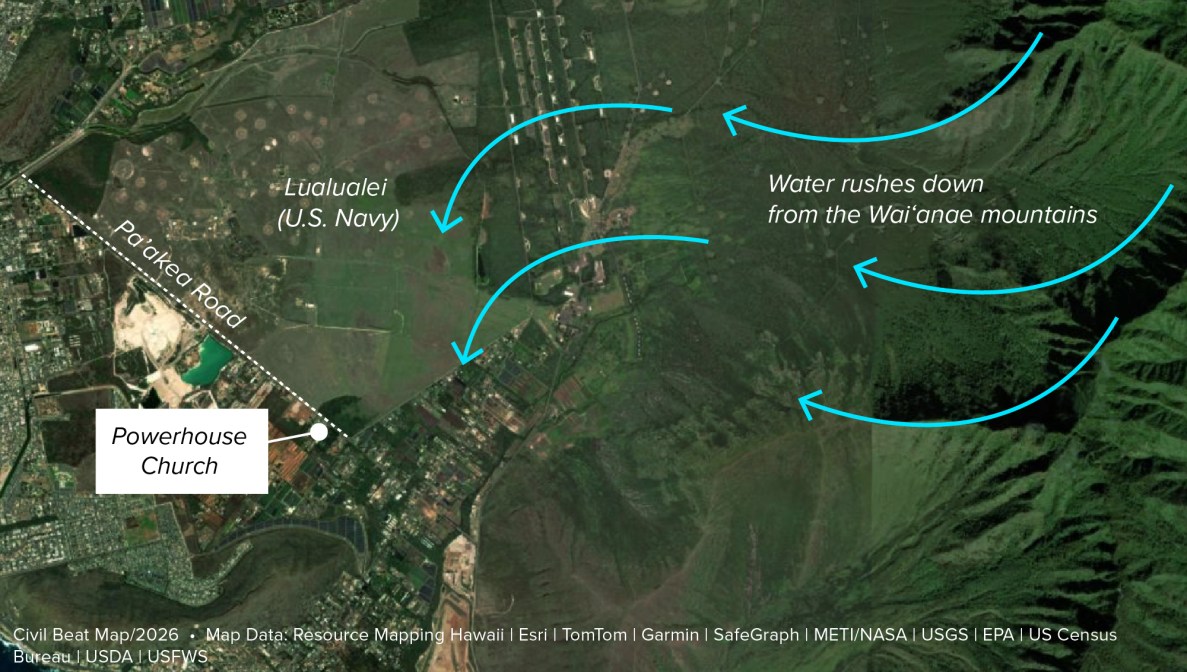
The March Kona low floods inundated the church property on Paʻakea Road closer to the Nānākuli side of Lualualei, severely damaging at least one housing unit and overflowing the largely agricultural region’s septic system.
The area, which also contains the coast’s designated backup emergency road, has flooded regularly over the last 20 years because the U.S. Navy, private property owners, and officials from the state and county have never installed flood mitigation measures first laid out a quarter of a century ago.
“Nothing was done,” said Patti Teruya, a community activist who advocated for those projects. “No one wanted to put money into solving the flooding issues. And nobody did anything.”
After the second Kona low, about a mile of the 2.7-mile-long road remained impassable for weeks. Residents relied on groceries from a nearby convenience store and on neighbors with trucks lifted high enough to clear the floodwater.
“That’s not an emergency access road,” Teruya said. “How are we going to go through there in an emergency if that road is going to be flooded?”
By then they already had had a warning — one that left lingering questions.
The week before, during the first Kona low storm, Masina Wond rushed home from work after her husband called to say their house was flooding. By the time she got to Māʻili, police had already closed Paʻakea Road due to flooding. They told her she could try to drive home if she wanted.
She made it, but only after flooding her van’s engine. The storm destroyed her husband’s power tools, and left their home inundated. Damages would come to about $10,000.
Later, looking for the source of the floodwaters, Wond waded through the streets to see water flowing from the Navy’s Lualualei complex.
Officials with Joint Base Pearl Harbor-Hickam, which oversees the complex, referred Civil Beat’s questions about flood mitigation to the state Department of Transportation, which recently took over Paʻakea Road from the city and several private owners, and the Army Corps of Engineers, which produced the original flood mitigation recommendations.
Transportation Director Ed Sniffen wasn’t available for an interview. In the aftermath of the Kona lows, the agency plans to install two drains on Paʻakea Road between Apana Road and Morse Street to keep the area from flooding in the future, according to a department press release.
“I don’t want to say it’s a silver bullet,” Rep. Darius Kila, whose district includes Lualualei, said. “But in areas we can’t get proper, modern infrastructure, this might be our next best bet.”
It’s a near-term solution. In the long run, the state will need to undertake yet another comprehensive drainage study.

Solutions ‘Sitting On A Shelf’
During heavy rains, waters rush down the Waiʻanae mountains and pass over the flat plain where the Navy has a pair of towering radio transmitters. It’s from across those lands, then and now, that residents say the floodwaters came.
After flooding on Paʻakea Road in 1996 and again a year later, a local fire official put the blame on the Navy. Following those floods, the Army Corps undertook a $400,000 study to develop a flood control master plan. The result, published in 2002, called for an enormous amount of work.
It recommended installing a berm on Naval reservation land with diversion channels to the Māʻiliʻili Stream on the Waiʻanae side of the valley. In the center of Paʻakea Road would be a new detention basin, culverts and a drainage channel to convey water to the Māʻiliʻili Stream about a mile away.
On the Nānākuli-side of the valley, the plan called for another series of drainage channels and culverts to take the water to the Ulehawa Stream. All together, the flood improvements in Māʻili were projected to cost more than $35.4 million in 2001 — the equivalent of more than $67 million today. But none of those projects were funded, so nothing happened.
Three years later, when Lualualei flooded again, irate residents demanded answers at a neighborhood board meeting. Paʻakea Road had already been flooded for a week by then. Some of those answers were no doubt tucked away in that flood study, which was by then “sitting on a shelf somewhere,” neighborhood board member Cynthia Rezentes said at the time.

How much damage the storms caused in Waiʻanae in 1996 and 2004 is unclear today, but the state Department of Defense estimated that the 1996 storms caused more than $12 million worth of damage across Oʻahu.
But money to address the problem was hard to come by. Then-U.S. Sen. Dan Inouye earmarked $2.6 million for Lualualei flood control projects in 2005. In subsequent years, federal contracting data doesn’t show any flood control work for Lualualei. The state and the City and County of Honolulu also did not allocate funds to those projects, according to a city memo from 2012.
Added to the hefty cost of the solutions were difficulties getting private landowners to agree to having some of the mitigation work done on their properties, the state said in 2016. A follow-up study said that private property owners on Paʻakea Road were unlikely to grant permission for stormwater drains. That report also noted that a proposed retention basin on Navy land would endanger the foundations of its large antennas at the radio array.
Follow-up Study Failed To Yield Results Too
As the flood challenges persisted, Waiʻanae’s delegation in the Legislature convened a working group of federal, state and county officials to come up with workable solutions.
Paʻakea Road wasn’t the only problem. Deeper in the valley, Puhawai Stream was prone to overflowing and flooding a street of the same name. Privately owned sections of streams weren’t being maintained.
The group organized ditch and stream clearings, according to Jo Jordan, a former state representative who represented parts of the coast in the Legislature. Inouye was part of that group too, Jordan said, and started looking for more projects that the government could fund.
“We realized we were going to have a money problem,” Jordan said. “Senior senator (Inouye) said, ‘Lets go find some money, pick some things out of that original study that could be doable.’”
At the time, Paʻakea Road had multiple owners, which made coordinating projects difficult.

Then Inouye died in 2012. Jordan lost reelection in 2016. There was turnover in other seats on the committee, too. New City council members. New representatives. New senators.
And with those new faces, work on flood control projects faded amid other issues facing a community that must often claw and scrape for attention from elected officials.
“It’s not something you write home about,” Jordan said of flood mitigation efforts. “But when people are in stagnant water, 3- or 4-feet deep, it is a big deal.”
Instead, the state and federal government decided to study the flood issue one more time. That study, published in 2017, recommended raising parts of Paʻakeaa Road, installing new culverts and digging drainage ditches along the side of the road. The total cost for those improvements and others in the valley totaled about $9.7 million.
Those cheaper projects still required cooperation from dozens of landowners. They also failed to come to fruition.
Love Thy Neighbor
In March, Keaulana — daughter of legendary Mākaha surfer Buffalo Keaulana — was among those working to get help to residents on Paʻakea Road and other areas in West Oʻahu that flooded.
In Lualualei, she said, the Wonds had it worse.
Their house at the front of the property filled with water about knee high. Their icebox was floating, and the flood damaged their clothes, beds and dressers. It took quite a while for the water to drain off the relatively flat land.
A film crew working on a project with actor Jason Momoa brought pumps to pull out the water after the first Kona low. It was a welcome relief, because Wond said she was told that city pump trucks weren’t allowed to help on private property.

For a few days, the Wonds were able to make repairs. Then, the night of March 19, Masina Wond couldn’t sleep. The downpour got her thinking about the flood from a few days before. When she walked downstairs to check, the water was coming in again.
Help was slower in coming the second time around because the film crew with its pumps, along with most of the island’s resources, were focused on the North Shore.
The city tried to pump water from the street, but residents said it was slow in receding. The water pooled deepest in a dip near Apana Road. That area used to have a drainage ditch that let floodwater escape to the ocean but development over the years had plugged that drain.
Natural flows have been blocked over the years in many areas, as the 2017 report noted. It identified blockages made by structures, solar farms or even places where sediment had been filled in by residents trying to keep water off their properties. Other drains were clogged up, too.
In early June, Keaulana drove her van down Iliili Road, pointing to portions of the ditch clogged with mounds of trash. One section is completely dammed up with tires.

The whole stretch used to be a couple feet deep, she said. Now, with the piles of trash and branches, it’s about level with the road. At least some water would otherwise be able to escape. Instead, it pooled on nearby agricultural lots waist high, Keaulana said.
Following the floods, engineers examined the Powerhouse church property for drainage solutions, too. They said the church cannot block floodwater from inundating its property, but it can dig trenches to allow the water to pass to other properties, Matsumoto said.
But the pastor doesn’t think that’s a solution if it just pushes the water into becoming someone else’s problem.
“It’s terrible, right? It’s going to go to the neighbor,” Matsumoto said, standing under a church banner with biblical reminders to love one another.
Instead, Matsumoto is looking to city and state leaders to work on a coordinated drainage plan for the area.
In the short term, the state Department of Transportation plans to install detention basins called aqua cells under the road that can hold water and allow it to evaporate.
That work can begin because the state now owns Paʻakea Road, having acquired it from numerous private property owners and the city in October. It was part of a decades-old plan to help provide residents with an alternative to Farrington Highway along the coast.

Kila hopes the aqua cells can be a model for resolving flood issues elsewhere in the state. He said the Navy also plans to plug drains that let water out onto Paʻakea Road so it instead flows down into Māʻiliʻili Stream.
Jordan, the former lawmaker, credits Sniffen and transportation officials for pushing forward to acquire the road, allowing them to begin implementing some flood control measures.
“But, there should be this ongoing conversation about how to really look at flood mitigation for this particular area, and how do we find the dollars for it?” she said.
After the aqua cell project is completed, the DOT plans to conduct a drainage study for the area of Paʻakea Road that flooded in front of the church along with an area just south of it.
It’s the same area that the Army Corps of Engineers examined in 2001, and again in 2017.
Civil Beat’s coverage of climate change and the environment is supported by The Healy Foundation, the Marisla Fund of the Hawai‘i Community Foundation and the Frost Family Foundation. Civil Beat’s reporting on fresh water issues is funded in part by the Ulupono Fund at the Hawai‘i Community Foundation.
