

Luke Evslin: To Stop the Sprawl, We Need A Big Toolbox
Saving our open spaces requires thinking about all the inter-related aspects of development.
This is the third in a three-part series on land use and transportation. Read part 1 and part 2.
A recent community workshop hosted by the Kauai County Planning Department began with a question: “What do you envision for the future of Kapaa?”
In a chorus of diverse voices, my neighbors contributed answers: “Maintain our rural atmosphere … no more traffic … increase walkability … affordable housing … keep the country country.”
At the time, these seemed like irreconcilable concepts. Until an answer from the back of the room connected the dots for me: “Stop the sprawl.”
Ironically, in trying to maintain our rural atmosphere by resisting high-density development, we’re ending up with coast-to-coast sprawl.
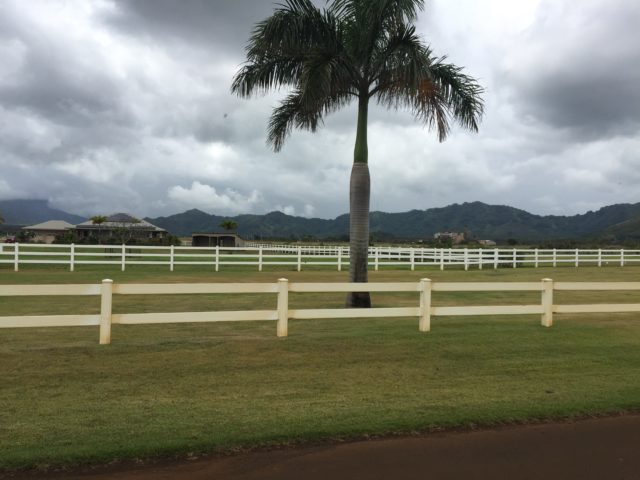
Which, as I wrote last week, is one reason why the County of Kauai is adopting new incentives for developers using form-based codes, mixed-use developments and multimodal transportation.
But some within our community worry that those types of long-term investments aren’t addressing our chronic traffic problems. The Garden Island Newspaper recently quoted County Council Chair Mel Rapozo as saying, “this whole movement to making Kauai look like Seattle where you got the bike lanes, that energy needs to be redirected to fixing the congestion that’s happening on this island.”
So, is increasing density and revitalizing town cores a waste of time and resources? Or, even worse, does it betray our rural nature?
Push Me-Pull You Problems
I asked Lee Steinmetz, the transportation planner for the County of Kauai, what we can do to fix congestion:
“If our goal is ‘solving’ congestion, that often leads to reduced mobility for other modes. As roads and highways become wider, crossing them as a pedestrian becomes more unpleasant, if not threatening. Signals need to be added to accommodate the longer pedestrian crossing time, which then slow down the cars we were trying to speed up.
“Instead of creating connections, we end up creating barriers. Because the pedestrian environment becomes so unpleasant, people who are close enough to walk choose to drive instead. And so the design that is supposed to solve congestion actually ends up contributing to it,” he said.
“A crucial factor contributing to traffic congestion is the desire of most Americans to live in low-density settlements.” — Anthony Downs, Brookings Institution
Steinmetz was also careful to point out that road improvements do play a role in managing congestion, but they aren’t a full solution. And he’s not alone in recognizing the complex, counterintuitive relationship between roads and traffic. As I’ve written before, the fundamental law of highway congestion has been around since 1947: Repeated studies have shown how new roads induce more demand and ultimately wind up with the same level of congestion that they were designed to alleviate.
“Traffic congestion is caused by vehicles, not by people in themselves,” wrote Jane Jacobs, in her 1961 book, “Death and Life of Great American Cities.”
“Wherever people are thinly settled, rather than densely concentrated, or wherever diverse uses occur infrequently, any specific attraction does cause traffic congestion,” she wrote. “The spaces required for roads and for parking spread everything out still farther, and lead to still greater use of vehicles.”
Island Of Desires
While it’s clear that additional roads alone won’t solve congestion (and could make it worse), Jacobs was one of the early activists to understand the causal relationship between land use and congestion. As this Brookings Institution paper said, a “crucial factor contributing to traffic congestion is the desire of most Americans to live in low-density settlements.”
We have chickens, cows and corn-fields. As Kauaians, we take justifiable pride in our rural surroundings. And since driving is just the price that we pay to live in paradise, we are quickly laying claim to every last quiet corner of our island.
According to Kauai’s Land Use Buildout Analysis, over the last 15 years, 39 percent of new homes were built on agricultural or open zoned land, while only 17 percent were built in the medium-density zoning district (R-6), and less than one percent in the multi-family zoning districts (R-15 and R-20).
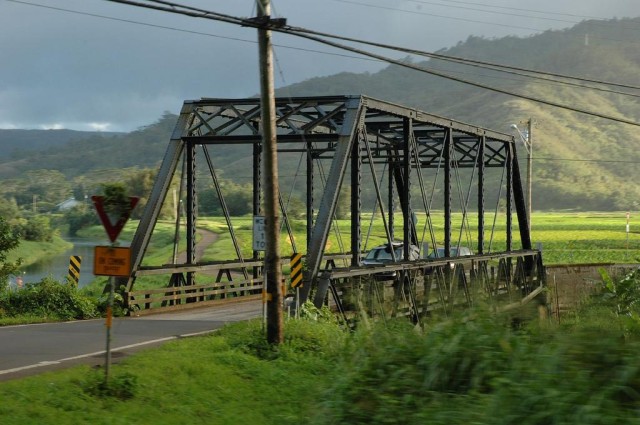
Beyond just contributing to congestion, every one of these distant agricultural subdivisions or low-density residential developments costs the county significantly more to provide services to — water, roads, fire and police protection — than do homes in the heart of Lihue or Kapaa. And so the County of Kauai currently spends 30 percent more per resident on services than the City and County of Honolulu.
As our agricultural land competes in the high-end market of homesteads instead of cropland, we have experienced a 28 percent decrease in small farms on Kauai since 2007. This decline in farms (along with the fall of sugar) has led to an average annual loss of 3,500 acres of cultivated land over the last two decades.
“And so, each day,” wrote Jacobs, in explaining this pattern across America, “several thousand more acres of our countryside are eaten by the bulldozers, covered by pavement, dotted with suburbanites who have killed the thing they thought they came to find.”
While we continue to blaze forward with these developments, the opening pages of our General Plan proclaim that in 2020 “Kauai will be a rural environment of towns separated by broad open spaces.”
Noble Goals
In pursuit of that noble goal, Hawaii became the first state in the country to enact a statewide zoning policy through the 1961 Land Use Law. As George Cooper and Gavan Daws wrote in their seminal text, “Land and Power in Hawaii,” that law “was written with two principles uppermost: make urbanization efficient in the use of all types of resources; and preserve agricultural and conservation lands as much as possible. These twin principles gave the LUL in its early years the name ‘greenbelt law,’ since it intended urbanization to be compact rather than scattered, with belts of green agricultural and conservation land all around.”
But, because the land-use law directed rural neighborhoods towards half-acre lots and left agricultural subdivisions as the purview of the county, we’ve now had 50 years of low-density development stretching from mountainside to ocean.
And as those developments bleed into each other, instead of contributing to our rural environment, they are eroding it.
“We need to intensify our existing towns in order to preserve the green space between.” — Lee Steinmetz, transportation planner, County of Kauai
“We’re definitely losing our open space” Steinmetz explained to me over the phone. “With the exception of Kapaia, you no longer get a sense of distinction from Hanamaulu to Lihue, to Puhi.”
According to the land-use definitions provided by FiveThirtyEight and density values from the USDA, every zip code on Kauai, other than Kekaha and Hanapepe, is now considered entirely suburban.
“We need to intensify our existing towns in order to preserve the green space between,” Steinmetz continued. “And this isn’t just about open space or rural nature. If we really are serious about creating homes for the next generation, then we have to prioritize affordability. But land prices are simply too high, so one component of the solution is to increase density in our town cores.”
The County estimated that we’ll need 395 new homes built every year through 2035. Yet, in the first four months of 2016, we had 170 island home sales, with a median sales price of $600,000. That’s far out of reach for most local families.
A Question Without One Specific Answer
When I began writing this series last month, I thought I was setting out on a simple path: How do we begin to reduce carbon emissions from transportation?
Yet after my 47th probing question for Marisa Valenciano, the 26-year-old Kauai County planner, she patiently explained again the holistic nature of her profession: “This isn’t a zero-sum choice between roads and sidewalks, or density and rural nature. We have a range of tools available, and we need to use them all.”
The mistake I kept making was to look for a specific answer to what I thought was a specific problem.
But without realizing it, I’d jumped into a rabbit hole of complex and interwoven solutions. Reducing carbon emissions depends on pedestrian transportation; yet we can’t walk, ride our bikes, or even take the bus without connectivity in our land-use patterns; that connectivity depends on reducing sprawl; and reducing sprawl means turning to high-density and mixed-use developments; which in turn requires adequate pedestrian transportation options. And so we’re back at the beginning.
Meanwhile, cars are sitting in perpetual gridlock, locals are being priced out of their homes, farmers are being priced out of their land, and we are pumping increasing amounts of carbon dioxide into the atmosphere.
Cities, towns, and neighborhoods are not a force of nature; they are a reflection of human ingenuity. Whether dense or sprawling, rural or suburban, vibrant or stagnant, affordable or exorbitant — they take on the characteristics that we endow them with. If they succeed, then we succeed.
And if they fail…

