

Luke Evslin: To Cut Emissions And Car Use, We Need Better Planning
Is it really too late to rebuild our communities to pedestrian scale?
I recently helped organize a series of panel discussions on climate change. We listened to stories about Pacific islanders whose ancestral homelands are disappearing beneath the sea, about the endemic plant species that can no longer survive in Hawaii, and about the acidification of our oceans.
Yet, while we sat around trying to formulate individual goals for reducing our fossil fuel use, the 600 pounds of carbon emissions that we had released collectively just driving to the event already were trapping heat in the atmosphere. And that CO2 will be affecting our climate for the next thousand years.
So goes the persistent irony of climate change: We are so dependent on fossil fuels that we’re hypocritically using them even while we talk about how to not use them.
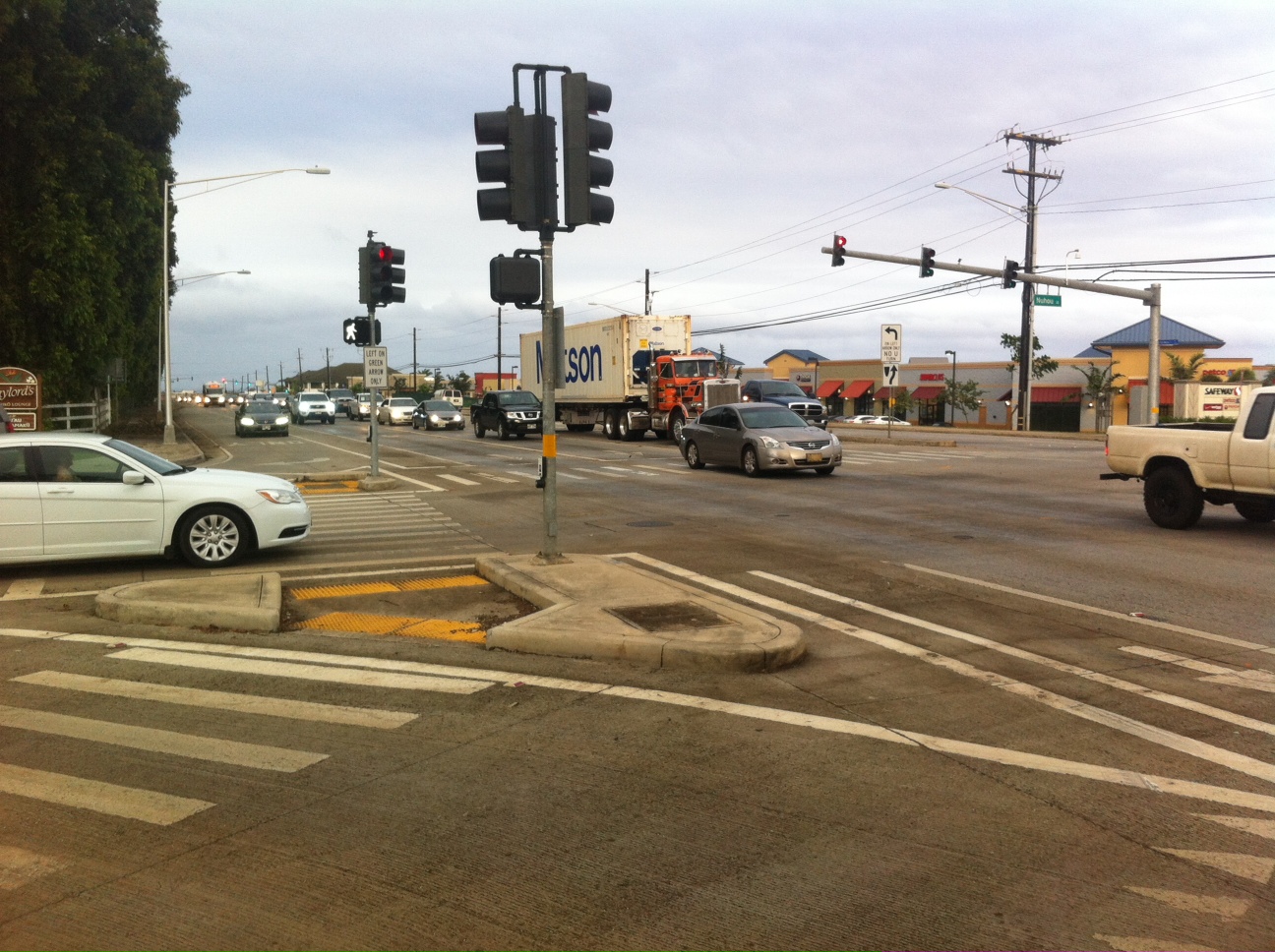
While I’ve stopped eating meat and gone off the grid in an effort to reduce carbon emissions, I can’t give up my Toyota Tacoma. And, apparently, I’m not alone.
The Hawaii Automobile Dealers Association predicts a record-breaking 58,400 vehicle sales for 2016. Here on Kauai, nearly 70 percent of new vehicles registered last year were trucks.
And those sacred Tacomas are more than a mode of transportation; they are the embodiment of our rural lifestyle.
Drive More, Do Less
Still, because of Kauai’s success on the renewable energy front, 2016 will be the first year that our carbon emissions from transportation are higher than they are from electricity. And so the front line in the war against climate change is shifting to our tail pipes.
But we’re losing the battle. While total vehicle miles traveled have plateaued nationwide, Hawaii is leading the nation with a 10 percent annual increase in driving.
Despite all of those humming Nissan Leafs, the success of the Prius and the fanfare of Tesla, only one in 20 vehicles on the road in Hawaii is hybrid or electric, a number that has been declining since 2012.
While shifting to renewable energy requires us to overhaul of our utility model, reducing our vehicle emissions requires us to overhaul our built environment. We need to live near our work, we need to stop relying on our vehicles as our sole mode of transportation, and we need to rebuild our communities to a pedestrian scale.
That might sound radical, but we already know what it looks like.
Close your eyes and imagine walking down the street in the center of your favorite town in Hawaii.
Let me guess—the buildings were close to the street, the blocks were short, and there were lots of people around.
While we may not remember a time before cars, our infrastructure remains to tell the story. Hilo, Hanapepe, Waimea, Kaunakakai, Haleiwa, Paia, Lahaina— the most vibrant towns in Hawaii predate the automobile.
As this history of jaywalking represents, it was only in the 1920s that the automobile won the war over ownership of the streets. And since then, every American generation has driven twice as much as the generation before. Because instead of building towns for humans, we began to build for our vehicles.
Mainlining Cars
Traffic goes faster with fewer intersections, so blocks got longer. We need somewhere to park, so stores moved back from the street and surrounded themselves with asphalt. And over the last century, we’ve continued to sacrifice our trees, our sidewalks and our public spaces to the perpetual worship of speed.
But it was OK for cars to suck the lifeblood out of our towns, because they also enabled us to live far away.
In a self-reinforcing cycle: The faster we can drive, the farther away we can live, the more dependent we become on our automobiles, the more our towns decay, the more we move away. And by separating commercial and residential use, our local zoning ordinances helped codify our vehicular dependence.
As urban planner Lewis Mumford wrote in a famous and prescient 1955 essay on the automobile:
“Your one-eyed specialists continue to conduct grandiose plans for highway development, as if motor transportation existed in a social vacuum and as if (our town) were a mere passageway or terminal for vehicles, with no good reasons of its own for existence.
“To these experts, a successful solution of the traffic problem consists of building more roads, bridges and tunnels so that more motorcars may travel more quickly to more remote destinations in more chaotic communities, from which more roads will be built so that more motorists may escape from these newly soiled and clotted environments.
“Instead of curing congestions, they widen chaos.
“Because we have apparently decided that the private motorcar has a sacred right to go anywhere, halt anywhere, and remain anywhere as long as its owner chooses, we have neglected other means of transportation … The major corrective for this crippling overspecialization is to redevelop now despised modes of circulation — public vehicles and private feet.”
Back To A Human Scale
But we’ve come too far to just get out of our cars. Because unless you’re willing to risk your life on a bicycle, you happen to run marathons in your spare time, or you can afford to wait an hour for the bus, the concrete corridors and asphalt arteries of our auto-centric towns can only be navigated from within the climate-controlled comfort of an automobile. And so, in order to reduce emissions from transportation, we need to rethink our development patterns — starting with our own communities.
In the center of Lihue there is a windowless building surrounded on all sides by parking lot. Sleeping on the sidewalk, out front, are the human casualties of our affordable housing crisis. Inside, the cold fluorescent interior hums with the sound of municipal government. To the right is the endless line of people at the Vehicle Registration Division, and to the left is the County Planning Department. With a long list of questions on land use and transportation planning, I walked to the left.
How can we build to a pedestrian scale? How can we make our communities more livable and affordable? And how can we reduce the amount that we drive?
Expecting the bureaucratic friction of circular logic, I discovered the exact opposite. There is a clear route toward bringing development back to a human scale, and the County of Kauai Planning Department already is leading the charge.
For next time: Form Based Code and the journey to reclaim our towns.
Disclosure: Luke Evslin is a member of the Kauai General Plan Community Advisory Committee.

