

Hawaii Among “Worst States” for Human Trafficking
Hawaii ranks among the worst states in the nation on its response to human trafficking, according to a report released Wednesday by the Polaris Project. 1
Hawaii is one of 12 states that has done little to enact basic human trafficking provisions to address the growing crime, the report states.
The Washington D.C.-based group advocates for stronger domestic anti-human trafficking laws. A colorful map shows Hawaii among the “Dirty Dozen” states meeting less than three out of 10 criteria Polaris Project used to evaluate states.
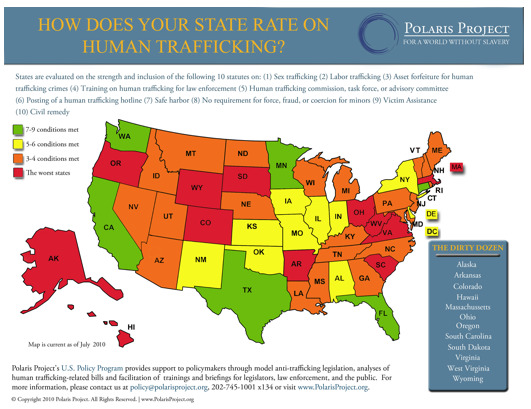
Polaris Project ranked states based on “the strength and inclusion of the following 10 statutes” on:
- Sex trafficking
- Labor trafficking
- Asset forfeiture for human trafficking crimes
- Training on human trafficking for law enforcement
- Human trafficking commission, task force, or advisory committee
- Posting of a human trafficking hotline
- Safe harbor
- No requirement for force, fraud, or coercion for minors
- Victim assistance
- Civil remedy
Hawaii does have a task force and provides some victim assistance.
Rounding out the bottom twelve are Alaska, Arkansas, Colorado, Massachusetts, Ohio, Oregon, South Carolina, South Dakota, Virginia, West Virginia and Wyoming.
-
The Polaris Project receives support from Humanity United, a nonprofit organization founded by Pam Omidyar, spouse of the publisher and CEO of Civil Beat.
↩
Hawaii remains one of six states without a law criminalizing human trafficking. Earlier this year, the Hawaii Legislature unanimously approved Senate Bill 2045, which would have been Hawaii’s first law criminalizing human trafficking, specifically sex trafficking. But law enforcement, prosecutors and public defenders all lined up to oppose the bill, saying vague wording would actually make cases harder rather than easier to win. Supporters of the bill said it was a first step towards shifting law enforcement’s focus from prostitutes to their pimps and customers. The bill would also have helped recognize some prostitutes as human trafficking victims instead of criminals, they said.
Gov. Linda Lingle vetoed the bill in July. The bill’s advocates plan to return in the next legislative session with another bill.
Kathryn Xian, spokeswoman for the Pacific Alliance to Stop Slavery, a local advocacy group that was behind SB 2045, said she wasn’t surprised by the Polaris Project rankings.
“They’re pretty much on the dot,” she said. “Victims are still being victimized while the traffickers are getting away, often times with a slap on the wrist.”
“Whatever the case may be about why Hawaii is one of last states on the bandwagon, we really need to work together to address this issue — there’s no excuse anymore,” Xian said. The state’s slowness to adopt a tougher stance on human trafficking “strikes me as strange since we were the first state to enact legislation that made sex tourism illegal in 2004.”
Meanwhile, two brothers who pleaded guilty to keeping 44 Thai immigrants as indentured laborers on one of Hawaii’s most well-known farms will be sentenced in September. The case, involving Aloun Farms in Kapolei, is one of the state’s largest labor trafficking cases.

