

A Surcharge on Safety: Union Contract and Turnover Blamed for Outsized Overtime
UPDATED 2/17/11 12 a.m.
Editor’s Note: This story is part of an ongoing a series about the use of overtime at the Hawaii Department of Public Safety. Civil Beat requested a list of overtime hours taken by each department employee in the 2009 and 2010 budget years. We published this series in December based on the information we received. In subsequent conversations with the department, we learned the document we were given lists hours paid. Employees were paid time-and-a-half for overtime. The stories have been updated to reflect that fact:
- A Surcharge on Safety: Outsized Overtime at the Department of Public Safety
- A Surcharge on Safety: Union Contract and Turnover Blamed for Overtime
- A Surcharge on Safety: As Overtime Piles Up, Department Caps Sick Day Use
- A Surcharge on Safety: Six Employees Worked Over 1,300 Hours of Overtime
- A Surcharge on Safety: 16 Employees Logged More Than 1,000 Overtime Hours
- A Surcharge on Safety: Sheriffs Earning More Than Hawaii’s Chief Justice?
- Public Safety Director Promises to ‘Address Overtime Issues Efficiently’
The Hawaii Department of Public Safety says high turnover and a rigid union contract have hamstrung efforts to rein in unusually large overtime claims.
Hawaii taxpayers paid out $19 million in overtime to department workers over the last two fiscal years — the majority of it to adult corrections officers, many earning more in overtime than regular pay, according to records obtained by Civil Beat under the state open records law.
Department officials say several factors are behind the high overtime claims, including the challenge of staffing 24-hour posts while simultaneously dealing with high turnover. There are an average of 300 vacant positions within the department every year, officials said.
The department also cited a labor union contract with the United Public Workers that requires overtime assignments be “fair and equitable,” even though working overtime shifts is not mandatory.
Dayton Nakanelua, the union’s state director, did not return Civil Beat’s calls or e-mails seeking comment for this story. He was not available to meet on two visits to his office.
“For a department with 24/7 operations, it’s very difficult to man posts and provide security around the clock. We have posts that have to be manned no matter what; no matter if someone calls in sick or takes vacation or family leave or is out on workers’ (compensation),” said David Festerling, former deputy director for Department of Public Safety’s administration division. “That movement triggers overtime. You have to have the individuals there to provide safety for the inmates, for the general public — without that, you jeopardize everything.”
Festerling, who became an investigator under the new governor’s administration, says the method for assigning overtime is defined by the UPW contract covering workers in Bargaining Unit 10, which includes all uniformed corrections officers. He said the contract requires certain “posts” be filled around the clock and requires that union members “have equal amounts of chances to work overtime.” Yet the contract also states that overtime is not mandated, but is a choice.
The portion of the UPW contract that details overtime, states:
“The employer shall endeavor to assign overtime work on a fair and equitable basis giving due consideration to the needs of the work operation.”
It also states an employee must complete a form like this one to be considered for overtime:
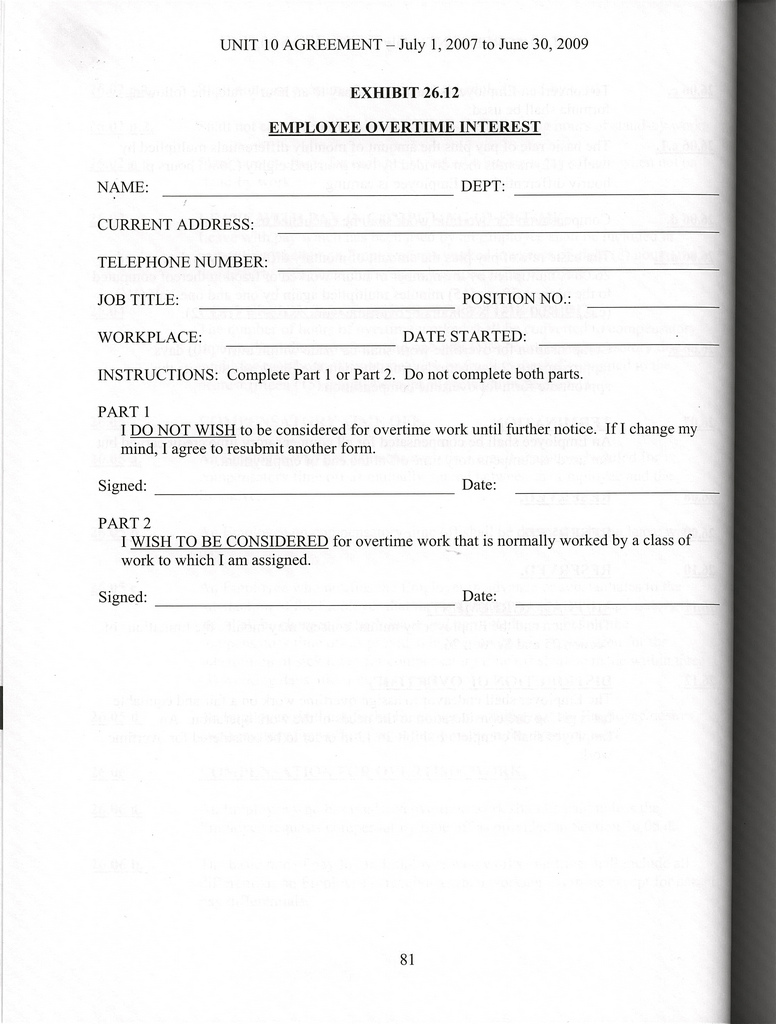
Those willing to work overtime are put on a so-called “call list” to be offered shifts as
available, based on seniority. At the two largest facilities — the Oahu Community Correctional Center jail and Halawa Correctional Facility prison — employees willing to work overtime shifts are asked to sign up for specific dates because there are more than 300 officers at each location.,
Workers are able to rack up high amounts of overtime hours because only half of the department’s approximately 1,350 corrections officers opt to work overtime shifts, said May Andrade, the former executive assistant to the department’s director. Andrade retired last month before the new governor’s administration took over.
“Some sign up for all 365 days of the year,” Andrade said. “For some, work is their family.”
“Some employees are gung ho,” Festerling added. “They might not have family obligations. That’s how some of their hours get so high.”
More than a dozen ways to Trigger OT
The UPW contract covering corrections officers specifies 14 instances that can prompt overtime pay, including the most familiar cases such as when an employee works more than an eight-hour workday or in excess of a 40-hour work week.
These provisions — intended as a deterrent to protect unionized employees from being overworked — can allow employees to earn overtime early in a work week, even before they hit their 40 regular-pay hours. The department says that because these employees are salaried to work 40 hours a week, five days a week, they can earn overtime at any point during the work week.
For example, an employee could get paid overtime on a Monday — as long as one of the 14 conditions that trigger overtime occurs — and could then call in sick or take vacation for the rest of the week. They’d receive their base salary for that week, plus overtime pay for the OT shift.
Here are a few of the conditions that cause overtime, according to the UPW contract:
If an employee is required to report from one scheduled shift to another scheduled shift between two consecutive workdays with fewer than 12 hours of non-work rest, “the employee shall continue to earn overtime for all hours worked from the second workday until the rest period is granted.”
If an employee’s work schedule is not posted at least four weeks in advance, as required in another section of the contract, overtime is earned “for each hour worked on the first workday of a new work schedule.”
If an employee has to work on his or her scheduled day off “and there has been no change, by mutual consent or due prior notice, in the work schedule,” overtime is earned.
If an employee has less than 48-hours advance notice to work a non-scheduled shift, he or she “shall be credited for overtime work for each hour worked on the first workday of the new shift.”
If an employee is required to work full-time for more than six consecutive days, he or she “shall be credited with overtime for each hour of work performed on the seventh day and each succeeding day until the employee is granted 24 non-work hours of rest,” or a day off.
Next: Read the second part of our series about efforts to stop sick leave abuse at the the Department of Public Safety.

