This is the archive for the live blog of the Dalai Lama’s visit, April 14-16. For more on the Dalai Lama and his trip to Hawaii, go to Dalai Lama Visits Hawaii 2012.
After his speech, the Dalai Lama said he would answer questions. He’s told they already have questions from the students.
He leaves the podium and takes a seat at the center of the state. More than 2,000 questions were asked online.
What makes you happy? What makes you laugh?
If I laugh when I’m alone, that looks mad. Seeing people’s faces gives me a genuine sense of satisfaction, then a laugh comes. We are social animals. When I talk, I consider you my friend. Same emotionally. Same physically. No barrier. There’s no barrier to smiling. Language problems can be there. Cultures can be different. Locations can be different. But we can smile at each other.
In light of recent global demonstrations for peace, such as the Arab spring, what advice would you give the people who risk their lives demonstrating against their governments?
They already achieve new opportunity. Individual people can do more constructive things. They already achieved something. Now they should unite, work together and forget about past differences. Look forward to their common interests. Economic development. Education. Including education of warm-heartedness.
What is the most peaceful thing you’ve seen here in Hawaii?
I think there also may be a gap between appearance and reality. In the past few days, only experience appearances. In order to know the reality, you have to spend more time and meet more people to understand what’s really going on underneath. Your own culture seems a very peaceful culture. The ancient people, without much technology, there relation with nature is more alive. Taking care of nature. Respect for nature. Sometimes they worship nature. Very relevant in today’s world. We’re part of nature. Nature creates humanity. If nature becomes something really disrupted, it’s a question of our own survival. It is wrong to think we can control nature. Unrealistic. We have to take care of nature, the environment.
Student says he struggles showing compassion to others who don’t reciprocate.
There are two levels of compassion. One is biological. This is oriented about others’ attitudes. If I show love, compassion, how much will I get? That is not genuine compassion. Genuine compassion doesn’t consider response. There is no room for expectation. You don’t expect anything in return. You unconditionally give. You don’t expect anything in return. Some people are totally dedicated to serving others without expectation. Some social workers are truly dedicated without expectations. They help strangers. Unknown people. We have that capacity. When we’re born, at a very young age, children don’t care about social background, race or religion or family background. They see each other as playmates. Through education, we stress religion or social background. Then they focus on importance of those things. Our education should nurture the good seed already there. Describes how as the youngest in his family, he got a lot of attention. His mother was very kind. Sometimes I jokingly tell people that his mother was so kind to him that it spoiled him. Describes holding his mothers’ ears when he was on her back and how he guided her directions by pulling her ears. Gets a big laugh. People who received maximum affection from mother, relatives, deep inside they have more self confidence, less fear than those children who grew up in an atmosphere of fear and loneliness. Deep inside they have a feeling of insecurity.
The Dalai Lama adds something about companionship, genuine companionship. If your basic mind is calm, the part of your brain you use to study functions normally. But if at an emotional level if you feel distrust or extreme competitiveness, it’s negative. He’s talking about extreme competitiveness. It’s positive to strive, to compete, he says. But if there’s a negative feeling toward others, that’s blind competitive feeling. That’s negative. Anger. Distrust. Every student entering a classroom full of a sense of brotherhood is good. Better for studying. Anger, distrust harmful.
With questions over, the event begins to wrap up with a performance.
After taking off all but one of his lei, the Dalai Lama takes to the podium at the Stan Sheriff Center. He’s wearing one lei and a visor.
Tells the students to think of him as another human, a brother.
Everyone has a common desire to be happy. Very purpose of our life is for happiness. For joyfulness. Our life depends on hope. Our existence. Our survival.
Hope means something good.
The very purpose of life is a happy life. Joyfullness or happiness. Happiness is not necessarily physical pleasure.
Two levels in daily life. One level sensorial. One level mental. Between the two, the mental level is much more superior, effective.
We have to think more seriously about mental level experiences. Physical level, our experience and animal experience more or less the same. But there’s a big difference on the mental level. Because of our brains.
I believe the very purpose of education is to reduce the gap between reality and appearances. As far as material things are concerned, modern science is highly developed, through research and experimentation.
At the mental level, emotional level, modern education doesn’t seem adequate.
Gap between physical and mental level. We must look for a deeper way. The real destroyer of our inner peace is fear, distrust.
Fear develops frustration. Frustation develops anger. Anger brings violence.
On the national level, even family level. Whenever we face some problems, we often use force.
Totally wrong.
Using force totally wrong.
Through the non-violent way, if you can change a person’s attitude, that’s a real victory.
When there are differences, talk and listen.
Education is supposed to reduce the gap between appearance and reality. I’m trying to talk according to my own experience.
Not talking of Buddhism. Just talking at a human level.
Promoting ethics.
What’s the real meaning in Latin of ethics. Some connection to god or spirituality, I don’t know.
Says English professors know better.
Some of his friends feel that any moral ethics must be based on religious faith. Muslim friends. Christian friends. They’re not happy when I use the word secularism. But in Indian thought, secularism not at all negative toward religion. It respects all religion, including non-believers.
By secular ethics I mean based on our common experience, common sense and latest scientific findings.
Scientists now begin to feel that for inner peace mental health very essential.
Now scientists are showing more interest in proper mental development.
On the basis of our common experience, common sense and scientific findings, we can make more awareness of the ultimate source of happiness within ourself. More self confidence. Not blind self confidence. But combined with compassion. Inner strength. That reduces fear.
More sense of respect. Sense of concern of others’ well being, including your own enemy. Your enemy is also a human being. They also have every right to achieve happy life.
We have the ability to develop a genuine sense of concern for them. No basis for hatred. For anger.
Respect of your enemy, keep lovingkindness to your enemy, doesn’t mean you submit. In case of injust action by some people, you have to take counter measures. But with respect. But with genuine concern for their long-term future interests.
Compassion, there are two levels. One biological. Another level of compassion, through training, through reasoning.
According to my own experience, when you pass through a difficult period and some people criticize you, it doesn’t disturb your mental peace.
My point, the awareness of the value of positive thought, love, compassion, forgiveness, tolerance. Not through meditation. But through analysis. Through awareness. That I call education.
A big portion of the 7 billion people are non believers. They may say they’re following a religion. But it’s more tradition. Out of habit.
Was asked by a Chinese journalist why he described him as a son of India. Thought it was a political statement of some kind.
He says he studied ancient Indian thought. Ate Indian food. Then the journalist understood it.
I respect India. I love India.
Indian people are generally very religious minded. Every Indian home has some statue of god or goddesses. They pray. But in the meantime…
Worship god or money…no third way.
Formally, some people are religious believers. But they’re not. That’s why he thinks so many of the 7 billion people on the planet aren’t genuinely religious.
It’s wrong to think that people not interested in religion aren’t interested in love, compassion.
Human beings are social animals. On the emotional level, the sense of concern for others’ well-being brings people together. An individual’s future is entirely dependent on the community.
Today, with the global economy, the world has become one entity.
That’s the reality. We’re just a big human family.
It’s secondary whether we’re from a different country or different religion.
I have three commitments.
No. 1. Promotion of non violence. Promotion of peace. Depends on mental attitude. Compassion through mental thinking. Can be a big difference between what people say and do. Must deal with motivation level.
No. 2. Promotion of religious harmony. On this level, I’m a Buddhist. The first level, I’m a human being. In philosophy field, even within the Buddhist tradition, there are different philosophical views, different views. But all carry the practice of love, compassion, forgiveness. All faiths carry the same practice. The real purpose of these different philosophies is the same. Same goal.
No. 3. Handed over political responsibility to an elected leader. This is about leadership of the Tibetan people. He formally handed that over.
Without trust, how can people live happily. As social animals, we need genuine cooperation. In order to have that, you need a sense of community, of belonging. For that, trust is a key factor. Destroyer of trust is fear. An open heart is very important for a healthy family, healthy community.
Speaks directly to the generation in the audience. There was too much violence, too much destruction in the 20th Century.
20th century a marvelous century. Many inventions. But such immense violence.
Now this century must be a century of peace. A century of peace does not mean no longer problems among humanity, even increasing. The only way is to deal with the problems. Not through violence. But through logic. Reason. Mutual respect. Dialogue.
This century should be a century of dialogue. You have a heavy responsibility to build a happy humanity, a happy century.
Ukulele maestro Jake Shimabukuro delivered a video message to the Stan Sheriff Center in which he spoke about the lessons he has learned from the Dalai Lama — namely, how to make yourself happy without material things, and how to be humble.
Shimabukuro performed an original song, as yet unnamed, that was inspired by His Holiness and Buddhism. For the song, Jake played only three strings rather than the usual four — something symbolic, I guess, like doing more with less.
Jake was followed by Jack Johnson, another local music star, who was greeted with rapture. “His hair is so long,” noted one fan sitting near me.
Johnson is wearing shorts and slippers and singing “So Much Better When We’re Together.”
Jack Johnson had the crowd humming along to his mellow groove when the Dalai Lama stunned the audience — and Johnson, who was in the middle of a song — by walking out on stage. The crowd went nuts.
Jack then introduced the Dalai Lama. The lights in the center came on and everyone leaped to their feet.
That talk is set to begin, reportedly 35 minutes in length.
Organizers of the student talk at Stan Sheriff Center had initially prohibited bringing in cellphones. But they later relented, recognizing that parents needed to be in contact with their kids.
During the hip hop dance and musical performances, not a few people in the audience recorded what they saw with those phones — another no-no that appears to have been relaxed. The emcee — he’s one half of the comedy duo Da Bruddahs — warned folks not to record “or you’re going back on the bus.” Everybody laughed.
To set the scene a bit: Cameras in the arena project what’s on stage to large video screens above. A “Pillars of Peace” banner is brightly illuminated just below the screens.
Local singer Anuhea has the audience singing along to her hit, “Simple Love Song.” And Jack Johnson, I’m told, will perform after all.
Taimane Gardner, a 21-year-old ukulele whiz, played the theme from Mission: Impossible and Stairway to Heaven, among other familiar tunes. Leaping about the stage barefoot as she played, she blew the crowd away.
Interesting dietary note: I am told by someone who knows the Dalai Lama that he eats breakfast at 5 a.m. and has lunch around 11:30. That is his last meal of the day, except for a cookie or two late in the day.
“That’s the way to keep calories off,” I was told. “Helps you live longer.”
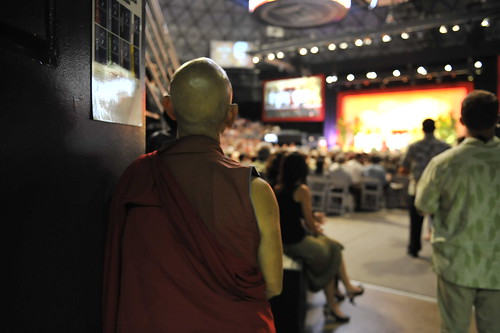
A steady stream of excited youngsters filed into the University of Hawaii’s Stan Sheriff Center late this morning, anticipating the Dalai Lama’s 1:45 p.m. appearance. They were being warned of high security and told they couldn’t bring in anything that wouldn’t fit in their pockets. No bags, not even any purses.
Jayson Barba, a 28-year-old Fulbright scholar from the Philippines, is here working on second language studies. He said he hoped to be inspired on “how to work on peace and hopefully also convince people war has no option in the world.”
Twenty-four-year-old Julie Jezequel, an intern with the Hawaii Institute for Human Rights and a French student, said she works on issues with indigenous peoples. Asked why she was coming to see the Dalai Lama speak, she said, “just to see him because people say he has an aura or something about him. Not just what he’s going to say, but what he’s going to bring in the atmosphere.”
Many of the attendees were college and high school students. Maggie Desmond, a 25-year-old teacher at Nanakuli High School, said 10 students and six staffers took a long bus ride to the center. She said she hoped her students would get messages of peace as well as be inspired by the environment.
“Apart from hearing and seeing the Dalai Lama speak I just am always excited when they get to be in this environment, when they get to be on a college campus and they get to interact with people who are not necessarily where they’re from and they can hear different perspectives. Thats what I’m excited about.”
Just before leaving Iolani Palace, the Dalai Lama got back out of his car and walked over to greet a small group of tourists that had gathered on the palace’s front lawn.
He didn’t say much, other than a string of “hi’s” and “thank you’s” as he shook people’s hands.
“This made my day,” said Florence Miyasato, a palace docent who’s been volunteering at Iolani Palace for 35 years. “I got so close to him, but I didn’t get to shake his hand.”
Miyasato said she came to work not knowing the Dalai Lama was scheduled to visit the palace. She was told her 10:15 tour was canceled due to a private event.
“We drove around the back, and I wanted to check out what all the commotion was, and I thought, I bet the Dalai Lama’s here,” said Miyasato’s daughter Carrie.
Carrie has tickets to tomorrow’s speaking event.
“I’ve always admired him. What’s amazing is … I didn’t realize I’d have this kind of a reaction,” she said tearing up. “He’s just so amazing.”
— Nanea Kalani
Read more about the Dalai Lama at Iolani Palace here.
The Dalai Lama’s motorcade arrived at Iolani Palace around 10 a.m., escorted by three Honolulu Police SWAT cars, and entered through the King Street gate.
The palace’s front entrance was draped with two large flags: the state flag and a kingdom-era flag, which palace officials said is only hung for dignitaries.
The Dalai Lama was greeted on the palace steps by Kippen de Alba Chu, executive director of the Friends of Iolani Palace. Princess Abigail Kawananakoa was on-hand representing the royal family.
Following a private tour, chairs were set up on the palace’s front lanai, where the Dalai Lama and a handful of guests enjoyed beverages in small white teacups.
Just before leaving, the Dalai Lama got back out of his car to greet a small group of tourists that had gathered on the palace’s front lawn.
After leaving Bishop Museum the Dalai Lama took a tour of Iolani Palace, the only royal palace in the United States. He was escorted by Kippen de Alba Chu, executive director of the Friends of Iolani Palace.
The tour included the Blue Room, the Dining Room, the Grand Hall and the Imprisonment Room, where Queen Liliuokalani was imprisoned after the Hawaiian monarchy was overthrown in 1893.
The Dalai Lama concluded his visit at the palace by having tea with Princess Abigail Kawananakoa, a descendant of King David Kalakaua.
The princess made headlines a few years back when she posed for a Life magazine photographer by sitting on a fragile, 115-year-old throne.
The Dalai Lama and his entourage were met at Bishop Museum by the impossibly cute keiki of an Hawaiian immersion school — Kahaaha Punana Leo O Honolulu — who sang to him in Hawaiian, of course. He smiled widely and later embraced the children.
The Dalai Lama was also given a lei of kou, or orange blossom, grown on the museum grounds and made by staff.
Marques Hanalei Marzan performed a welcoming chant. Museum President Blair Collis and museum board chair Allison Holt Gendreau then escorted the Dalai Lama through Hawaiian Hall, which exhibits Hawaii history from pre-contact through key moments in local history.
Afterward, the Dalai Lama was presented a kapa print and a Hawaiian helmet, or mahiole, which he promptly planted on his head. That got lots of laughs, especially when he turned it around and said the position was useful when riding a horse.
The gifts, he said, were a sign that he had been accepted “as a Hawaiian.”
The Dalai Lama then spoke about the importance of indigenous cultures and their connection to nature, and how culture, language and tradition should not be lost in a modern world full of technology.
The Dalai Lama visited the Bishop Museum this morning for a tour (see Civil Beat story on what museum officials hoped to accomplish.)
He arrived in his motorcade about 9:15 a.m. and stayed about 45 minutes.
Watters Martin, vice chair of the museum’s board of directors, said: “It’s wonderful that he’s able to come to the Hawaiian Islands and is making a point to meet with Hawaiian leaders.”
Martin had met the Dalai Lama once before, about 15 years ago. “He has this amazing aura.”
Kealoha Kelekolio, a Bishop Museum staff member, said he felt someone tugging on his hair during the Dalai Lama’s tour. It was the Dalai Lama.
Kelekolio said the Dalai Lama took his long white hair and put it over his own bald pate.
“So basically, I’ll never wash my hair again,” he said after the Dalai Lama had left.
”It was just magical,” he said. “I never thought I’d ever be in his presence. We were just blessed.”
Befitting his status as a global leader, security for the Dalai Lama is comparable to that of a head of state. It includes dogs to sniff bags, hand wands to detect metal and mirrors to look under cars.
The 20 reporters and photographers who gathered before sunrise at an Oahu hotel (sorry, we can’t tell you where) include four people from Hiki No, the PBS Hawaii program produced by students. (Hiki No means “can do” in Hawaiian.) The kids are pretty excited about the assignment, as you can imagine.
Also here is Victor Chan, founding director and trustee for the Dalai Lama Center in Vancouver, B.C., and Agapi Stassinopoulos, who is the sister of Arianna Huffington. Agapi asked me to take a photo of her and Victor and then asked me how to send it to her sister in her iPhone — a recent gift from Arianna.
“Agapi” means “love” in Greek, Agapi tells me — commonly spelled “agape.”
After the Dalai Lama wrapped up his brief address, he stepped down from the short platform where he’d been sitting and touched foreheads with Kamehameha Schools Trustee Corbett Kalama. Kalama had chanted the Buddhist leader’s entrance. The Dalai Lama did the same with student Kealohi Foster, who had danced hula for him.
“I was shocked,” a visibly moved Foster told Civil Beat after the Dalai Lama had left the room. “It was an amazing feeling to be in his presence.”
Student Jonah Hookano, who shook hands with the Dalai Lama and allowed the leader to smell his lei (above), described him to reporters as a “jolly person.”
Kalama explained the connection between Native Hawaiian culture and the Dalai Lama:
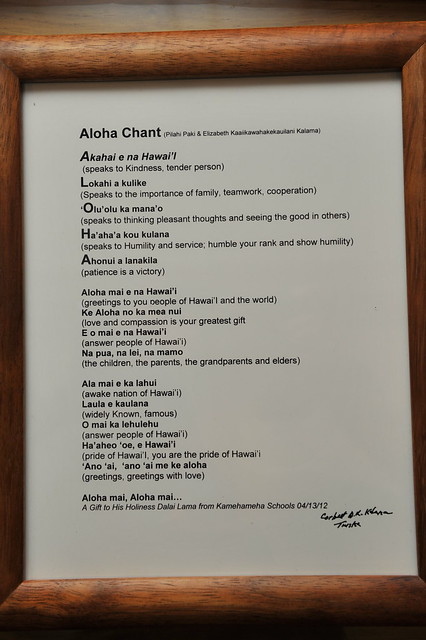
“We look at the universal values that exist. Every culture has that. Every religion has it. And aloha is at the core of that. We call it that,” he told me. “But if we look at religions, it’s that of kindness, that of the importance of family, of teamwork, of cooperation. That of seeing the good in people. That of being humble. That of showing patience and perseverance, which His Holiness has exhibited throughout his life.”
The Dalai Lama was welcomed to his Honolulu hotel on Friday with a Hawaiian chant, performed by Kamehameha Schools Trustee Corbett Kalama. Afterwards, the Tibetan leader was given a copy of the words.
The Dalai Lama arrived at his hotel (location to remain undisclosed for security reasons) a short while ago, and was greeted by high school seniors from Kamehameha Schools. They chanted, sang and danced.
The Dalai Lama cracked some jokes. He shook hands. Before anyone could give him lei, he grabbed an orchid and a maile lei and threw them over his own head and grinned, drawing laughter from the crowd.
He said he liked seeing the students’ smiles — genuine smiles, not fake or sarcastic ones. He said Hawaii feels familiar to him after his prior visits.
“I think humanity is like … different flowers. Different shape, different color,” he said, but we’re all the same.
After speaking for a few minutes, he left without taking questions.
The Kamehameha Schools Glee Club welcomed the Dalai Lama to his hotel with Hawaiian songs, a chant and hula. Here’s a snapshot of the Dalai Lama posing with the group for a throng of cameras.
I’m downstairs at this undisclosed location where the Dalai Lama will be arriving within the hour. Among the dozen or so journalists assembled are the Associated Press, KITV, Hawaii News Now, etc. Mostly local reporters — but not all of them.
Joshua Edelstein works for Radio Free Asia, which broadcasts video and audio via short wave and the Internet into six Asian countries with state-controlled media — China, Cambodia, Korea, Laos, Myanmar and Vietnam. In China, it broadcasts in four langugages — Mandarin, Cantonese Uyghur and, most interestingly for this event, Tibetan. The Tibetan Language Service was his assigning editor for this assignment.
Edelstein said he was until two weeks ago the webmaster for the private nonprofit in Washington D.C., the organization’s only U.S. office. If he hadn’t moved home (he was born and raised in Hawaii, Iolani class of 1990), Radio Free Asia would have been without a presence for the Dalai Lama’s visit. He called it a “press pass of opportunity,” and he’ll be attending most of the events in coming days.
He said he was told he doesn’t have to ask questions but just shoot “good video of other people’s questions.” Normally Radio Free Asia wants five- to 10-minute clips, “but seeing as I’m not a reporter, I’m just going to shoot everything and let them choose,” Edelstein said.
For more information on Radio Free Asia, visit their website.
Civil Beat has confirmed that the Dalai Lama is in Honolulu.
He left the Honolulu International Airport with his entourage of about 12 cars — 8 or 9 of which were police cruisers and Sheriff’s SUVs. There was also a Roberts Hawaii shuttle bus.
The Dalai Lama is headed to his hotel and will begin his public activities tomorrow.
A question from Vanessa: I’ve struggled for so many years to find inner peace. How do I maintain my peace when I feel I need armor instead.
Dalai Lama: In my case I have plenty of excuses for why I cannot practice compassion. Because there are a lot of problems, you have to make effort. My own view is that it’s best to keep at least my own peace of mind. Three or four years ago, I had surgery to remove the gall bladder. A lot of stones in gall bladder. After that surgery, usually the experts told me the anesthesia will finish in 15 or 20 minutes. But he had a complication. My gall bladder was enlarged two times and almost ready to burst. Because of that, surgery took more than two and a half hours. Recovery was very fast, within four days, except for the wound. Doctor described me as a young patient. I felt my emotional state quite peaceful. I think that really made the difference. Develop full conviction, your own practice, your own view. If you remain firm, strong, there is greater chance to influence others. We all have to make some effort. A lot of problems. A lot of injustice. We have to fight about this. Not by force. But by promotion of moral ethics. Plenty of reasons to be determined.
Question: How does someone achieve forgiveness when not all parties are open to change?
Dalai Lama: If you keep anger, that should not happen. You still remain calm mind. Forgiveness does not mean you accept their wrong deeds. As far as action is concerned, sometimes you need appropriate counter measures. No anger. Ill feeling. But action, you realize that’s wrong, that’s injustice. So in order to stop that, appropriate counter measure to stop that wrong doing. Real sense of forgiveness is not to keep negative feeling toward that trouble maker.
Question from Sonny: So many people feel fear and distrust about the future. What can each of us do every day to deepen our trust?
Dalai Lama: If a mad dog comes here, realistic fear, much better than if you relax. Fear much depends on mental projection. When he was young, during winter time he describes living in one place, another in summer. Downstairs many dark rooms. Ghosts. These are unrealistic fears. In human society, I think if you yourself are open, let them express the same way. Unrealistic to close yourself and expect others to be open. If you’re open, and their response is not that way, you have freedom how to act. If you always remain distant, then you feel others with the same attitude.
Question from Angela: How should indigenous people who have become strangers in their own land, try to regain inner peace when surrounded by their oppressors?
Dalai Lama: Today my favorite word is realistic. Indigenous people have every right to save their culture. But at the same time, times change. You have to accept reality. With Tibet, I talk about middle way. You think broadly, those people from a different background, area, they’re also human beings. Basically, we are the same human beings. It’s unrealistic to think of yourself and isolate. That’s wrong, I think.
Question from David: Your smile makes me smile. It suggest life is a gift to be enjoyed. Are you always smiling even when not in public?
Dalai Lama: Yes. When I am in bathroom, and still smiling, that looks silly. (laughter) In case, sometimes difficult to come out, you need a little pressure. No time smiling. (applause and laughter) Translator says the Dalai Lama asked him, have you ever experienced that?
How happy can anyone expect to be?
Dalai Lama: Now here, I think, if serious answer. There are different levels. Some kinds of happiness which comes with animal, that’s very limited, very low. As human beings, with intelligence, that’s the higher level of inner peace, joyfulness. Here you need a lot of mental work. There are plenty of reasons to feel sad. But at same time plenty of reasons to feel happy. Things are relative. From one angle, look at that event, you may get some uncomfortable. From another angle, you may get more hope. In spite our intelligence, our ability, we usually look from one angle. We must look from all angles. Not one dimension. Four dimensions. Six dimensions. Through that way you get a better answer. In my own case, I lost my own country. That tragedy also some positive result. That tragedy opened Tibetan eyes. Before that, they close their eye. Now open their eye. Good. Me personally. The last 53 years, life in exile in India is best period, gaining more knowledge, experience. Immense help gaining more experiences. With that, more realistic thinking. I often tell Tibetans, pilgrims to India, I always meet them. I express entire Tibetan population, in five provinces, a really remarkable feeling of unity there. This unity brought by Chinese communists. Very sad event. But brought some positive result. If you look only negative side, then sad, sad, sad. If you look at positive things, then you see much less distress. That is the quality of human intelligence. Everybody has that capacity, that ability. You must utilize that.
The Dalai Lama emerged onto the stage at the Stan Sheriff Center while Michael McDonald and Henry Kapono were singing ”What the World Needs Now Is Love Sweet Love.”
He strode toward Gov. Neil Aberbcrombie who is in the front row and grasped his hand. Also acknowledged were the governor’s wife, Nancie Caraway, and the sister of President Barack Obama, Maya Soetoro-Ng.
Now they’re showing a video of Jake Shimabukuro playing a song on the ukulele with three strings, without the C string.
All the musicians who had performed joined the Dalai Lama on stage. He presented each with a white Tibetan scarf, the same scarf he gave Native Hawaii panel members earlier in the day.
He knows how to create a photo moment, taking hold of the hands of the musicians next to him.
Kelvin Taketa, president and CEO of the Hawaii Community Foundation, host and sponsor, takes the stage. He speaks of how we in Hawaii find a way to a more tolerant and civil society.
Here, our food, our language, our traditions, blend into chop suey, he says.
Now Pierre Omidyar, publisher and CEO of Civil Beat and with his wife, Pam, the sponsor of this visit, introduces the Dalai Lama.
Points out that the Dalai Lama fled Tibet in the same year as Hawaii entered into statehood, 1959.
The Dalai Lama has been a refugee ever since. Today, he says, the Dalai Lama accepts that Tibet should remain a part of China. In 2011, he officially devolved his political leadership to an elected body, ending a tradition of dalai lamas holding responsibility for religious and temporal affairs.
Topic of today’s talk, Advancing Peace through the power of Aloha.
Finding peace can seem like a constant struggle. But here in Hawaii we’re blessed with a precious gift from the Native Hawaiian people. And that gift is Aloha.
Five qualities: kindness, unity, joyfulness, humility and patience.
Those are similar to Dalai Lama’s central themes.
Says the Dalai Lama is the embodiment of compassion and thanks him for being here.
The Dalai Lama moves to the podium.
He acknowledges the governor as a longtime friend.
We’re all human brothers and sisters. We’re all the same human being. Mentally, emotionally, physically, we are the same. So whenever I give a talk to people, I always feel I am just one of you. No differences. No barrier.
This kind of mental thinking is really helpful. Whenever I give a talk without notes, without preparation. One factor, I’m a lazy person. (laughter) Another factor, whenever I meet people I feel I’m with my long time friend. It’s an immense help to maintain a calm mind.
I usually call the audience, brothers, sisters. I have been a few times here. This time having the opportunity meeting more people. Yesterday children. I feel some sort of meaningful day. Now here a public talk. I am very happy. My friend, in his introduction, gave a clear explanation of the meaning of aloha. Now I learned some sort of deeper meaning of aloha. Very helpful. Thank you.
Expressing the word aloha very easy. But implementing the real meaning of aloha, not easy.
Basically, all beings want a happy life. Do not want disturbances. That is a basic right. All living things have a basic right to survive. Everyone, every piece has the right to survive.
Instinctively, we have the desire to achieve a happy life. Happiness, joyfulness is a result. Every result entirely depends on its own causes. I think joyfulness, happiness entirely depends on ones own action. Three levels. Physical. Verbal. Mental. Here mental action is the key factor. It’s quite logical.
In order to achieve successful life, we pay every attention about education or training. Education is the cause of successful life. Good health, taking medicine or some vitamins, is cause in order to achieve positive results.
My study started as a 6 or 7 year-old. Till I was about 12 or 13, I had no interest in study. Only play. Study was something compulsory. When the time for study came, even the sun became darker. That kind of feeling. On a holiday, felt weather seemed brighter. At that time, no interest about study. Later I found, these sort of knowledge from study immensely helpful. For my case, mainly for peace of mind. Today’s peace of mind the goal. In order to achieve that my approach must be realistic approach.
The very purpose of education is to reduce the gap between appearance and reality.
Prosperity must come through action, not prayer. Therefore, world peace must come through inner peace, at the individual level also. In order to have a happy life, inner peace very essential, including a healthy body. Healthy mind, healthy body. Healthy body very much linked with healthy mind.
Too much stress, too much anxiety, develops frustration, hopelessness, then anger, hatred.
Destructive emotion, such as anger, hatred, mainly come through mental thinking. One American scientist I met a few years at Stockholm in Sweden. He told me when we develop anger, the object which we feel angry, that object appears very negative. Actually, 90 percent of that negativeness is mental projection.
Through training of mind, try to develop proper mental attitude. Any attitude based on mental projection is unrealistic. Any decision under strong emotion often becomes wrong. Because much emotion is actually a biased view. Through the view, you cannot see the reality.
Now the question, recently the global economic crisis. I asked some of my friends. These people involved in money matters, they must be expert about that. So can these experts be wrong about money matters? So I asked some of these people, what’s wrong. Their answer: Too much greed. Too much greed is unrealistic desire. Then, too much speculation.
The economic crisis ultimately our mind. These policies, differences of countries. Of course Mr. Bush, I really love him. Really nice person. Describes getting Congressional Gold Medal. Nancy Pelosi also there. Mr. Bush whispered too me, they always create problems for me. But today we are peaceful. (laughter) Mr. Bush on a human level really nice person. I love him. I respect him. But that does not mean I fully agree with all his policies. (applause)
After the Iraq crisis, meeting with him, I expressed, I love you but some of your policies I have some reservations. He nodded. Iraq crisis. His motivation is very good. To bring democracy. Rule of law. Very good. But method become unrealistic. So fail to achieve that noble goal.
At any level, unrealistic method never bring satisfactory result.
So how to bring inner peace?
What is the real basis of inner peace? It’s warmheartedness. Once we develop warmheartedness, that means consider all others just like myself. Every one has the right just like me to achieve happy life. With that kind of attitude, automatically develop respect.
Through that type of mental attitude, fear no basis.
Once you become closer to your neighbor, anxiety is reduced, distrust reduced. More compassionate feeling toward others. That is an immense help to reduce fear.
Love and compassion, no longer distrust.
Of course this is not something realistic. Not blind love. Utilize human intelligence. Research. Investigate. That’s compassion combined with wisdom.
Love, compassion, wisdom there are two levels. One level is physical. Always mixing with attached. Always emotion. Always becomes one-sided, biased. However that biological factor of compassion is a seed. Utilize human intelligence. Use our common sense. And most important, scientific findings. It brings inner peace. Peaceful family. Peaceful community. That also brings good health.
All major religious traditions carry this practice. But without religious belief we can develop universal compassion, through education.
Talks of Northern Ireland, a rubber bullet hitting the forehead of Richard Moore. He lost his sight. When he came to in the hospital, he thought of not seeing his mother’s face. Not anger. Not hatred. Because of that attitude, very happy life. Eventually he found a very happy wife. Daughter. Even with such a tragedy, he still remained a calm mind. Not develop anger, frustration. He furthered his education. I always describe him as my hero. Really wonderful. He’s not religiously minded. But as human being he developed that kind of attitude. Result a tremendous benefit. Later he tried to find the British soldier who shot him. Both of them become very close friends. We have that kind of ability. These positive mental attitude not at all based on religious belief. I usually call secular ethics. Secular way. Without touching religion. That I think is quite crucial. Many people essentially are non-believers. Not much care about religious teaching. Even though some of them claim I am Christian, I am Hindu, I am Jew. We really need a universal way to approach this universal value. If we rely on religious faith, it will never be universal.
Through education, from kindergarten through university level, we have to find ways and means to make aware of these universal values.
The 20 century a wonderful century. But that century became a century of bloodshed.
There’s no other way but to try to build this century as a century of dialogue, peace.
We must find how to tackle when we face problems, not use force, but through talk, with respect, listen to others’ point of view. That’s the only way.
In order to do that, you must have will power to talk. And then you need wisdom to know the reality about others’ interest and one’s own interest.
Combination of wisdom and will power, I think we can develop this century as a century of peace through dialogue. (applause)
In your family, whenever you face some problems, try to find some solution through some mutually agreeable way.
Education about the value of non-violence. Adopt one school as an experiment. Then after five years, examine the experiment. If positive result, then 10 more schools, or 100 schools. You can expand that way. That’s the way to change the way of thinking in our society. Through that way you can build a happy, peaceful society. The initiative must come from the individual.
The problem is created by human beings themselves. The answer must be found from human beings. The answer must come from individual. Don’t feel helplessness. Create inner peace. And share with more people. Your friend. And then your enemy. That’s the way to transform our world.
“Only Jesus will give you eternal peace, not Buddha!” Strider Didymus yells at nobody in particular as I walk up to talk to him outside of the Dalai Lama’s speech at the Stan Sheriff Center.
Didymus is the famous Biker For Christ that Chad Blair profiled in his story last month about civil unions returning to the Hawaii Legislature. The leather-clad biker is holding a sign with what looks like PVC pipe forming a cross. The front says “Jesus Loves You — Repent or Perish.” The back has some bible passages.
Didymus is being largely ignored by those walking past him, except for those who are turning to their friends to chuckle.
“I feel sorry for these people,” Didymus says, motioning to the throng of people filing in. “They’re searching, they’re soul-searching, but they’re searching for the wrong thing. There’s no eternal peace, there’s no eternal light, there’s no eternal salvation in the teachings that these people are going to listen to. And it’s just sad.”
When I asked him if Christians could attend a Dalai Lama speech, Didymus said people who call themselves Christians might, but not real followers of Christ.
“I am the way, not a way. I am the truth, not a truth. I am the light. No one comes to the father except through me. Period. So if you follow what Jesus says, what the word says, you cannot be a disciple of Christ and sit here and expect to get something out of it. You cannot drink from the cup of the Lord and Satan at the same time.”
And when I asked if he was likening the Dalai Lama to Satan, he didn’t say no.
“His teachings have all the appearance of being nice and sweet, but the undertone of it is demonic,” he said. “The teachings are demonic. Anything that does not follow the teachings of Christ goes back to Babylonian paganism, including Buddhism.”
Michael McDonald and Henry Kapono just did a killer version of the Doobie Brothers chestnut. McDonald said the song was particularly appropriate to the occasion of the Dalai Lama’s visit.
That it is. Sample lyric:
Take this message to my brother
You will find him…everywhere
Wherever people live together
Tied in poverty’s despair
Are you … telling me the things you’re gonna do for me
I ain’t blind and I don’t like what I think I see
Takin’ it to the streets (takin’ it to the streets)
Takin’ it to the streets (no more need for runnin’)
Takin’ it to the streets (takin it to the streets)
The Dalai Lama recorded an interview before coming to Hawaii.
In the interview with Taiwanese broadcasting station Next TV, he says China’s “totalitarian” policies sparked Tibetan self-immolations.
“I think this problem is not created by Buddhism, not created by Tibetan Buddhism culture [which is] very peaceful, very compassionate,” the Dalai Lama said in the interview.
“This problem started from totalitarian, blind sort of unrealistic policy. So, the people who create that policy must think seriously about this—that’s my response,” he said when asked about the self-immolations in the interview recorded before his Hawaii trip
It’s a stellar lineup of local entertainment. Also on the bill are Henry Kapono, Jeff Peterson and Jerry Santos.
Michael McDonald, the former Doobie Brother and a frequent visitor to the islands, is the headliner. The closing performance will be by Halau Hula Olana.
According to the program, Gov. Neil Abercrombie is scheduled to make remarks on behalf of the state. In his office, he has a photo of the Dalai Lama; he is also known to read from his many writings.
We’re back here at the Stan Sheriff Center for day two of the Dalai Lama’s public speeches. Today’s is the only event for the general public following yesterday’s talk for students.
The crowd is noticeably different today — high school and college students have been replaced by mostly older couples and a few others sporting tie-dye and dreadlocks.
Retired nurse Marilyn Chong, 73, said she lived through the era when the Dalai Lama was driven into exile in 1959, a year before she moved to Hawaii in 1960. She’s since married a Hawaiian and had Hawaiian children.
“I’m happy that he’s investigating and trying to find out more about the Hawaiian culture and what has happened to them through the years,” she said. “I was here when the renaissance started. … History is my passion, and I think we need more of this in our world right now. Absolutely.”
Chris Giles said attending Sunday’s event was the ideal way to spend his only day off.
“I thought it’d be really nice to see someone as popular as he is on a positive level,” Giles, 38, said. “I want to learn whatever he has to say and just educate myself.”
His wife, Stacy, who identified herself as a holistic healer, added: “I’m super excited. I almost want to cry at the thought of seeing someone so spiritual.” (That’s the Giles in the photo above.)
At a short Q&A with John DeFries, Pualani Kanahele and Nainoa Thompson after the panel with the Dalai Lama, Kanahele took a little umbrage at a Mana Magazine reporter who asked how it was possible to resolve disagreements among different leaders.
“Are you saying this is a political problem?” she responded. “What we were talking about wasn’t politics.”
Rather, it’s about humanity’s responsibility to the people and the planet, she explained.
Thompson agreed, saying that disagreements were necessary. But he also said this: “Just because you are an elected officer does not mean you are a leader.”
Thompson said that for people to come together and resolve differences requires vision of human values.
“Acts of kindness and compassion are not inconsequential,” he said.
Asked if leaders with differing points of view were invited to the “Native Intelligence” panel, DeFries said there was outreach and that many were in attendance at the East-West Center talk.
Speaking of political leaders, Honolulu Mayor Peter Carlisle quietly snuck into the panel talk after it had begun.
Earlier, as invited guests began trekking up the hill to the East West Center’s Keoni Auditorium, some carried what appeared to be gifts for the Dalai Lama.
One man, dressed in a malo and red kikepa, carried a clear bag of fresh fish — possibly opelu or awa’awa.
Two other men, dressed in aloha shirts, carried wooden canoe paddles.
Security is tight outside. University of Hawaii campus security, state sheriffs, and Honolulu police officers are all stationed outside. Drivers, bicyclists and morning joggers approaching the area have been turned away.
The Dalai Lama is attending a private event Sunday morning at the East-West Center.
He’s on a panel with Nainoa Thompson and Dr. Punalani Kanahele, with John DeFries acting as moderator.
The title of the session is “The Importance of Native Intelligence in Modern Times.”
Kanahele is a master hula teacher, writer, researcher and community leader and is president of the Edith Kanakaole Foundation. She is also director of Hawaiian Traditional Knowledge Research at Hawaii Community College.
Thompson is president of the Polynesian Voyaging Society and a former trustee with Kamehameha Schools.
DeFries is board president of Friends of the Future, which focuses on Native Hawaiian cultural practices and traditions.
A beautiful chant opened the panel, the last lines being “being sacred, being firm, so that Hawaii can live forever.” It was immediately followed by a stunning mele performed be Kekuhi Kanahele, a daughter of Pualani.
The entire room stood in rapture as Kekuhi moved about the room in her bare feet, gesturing to the land and the sky and other elements.
“What meaning?” asked the Dalai Lama. The short answer is the connection between man and nature.
The Dalai Lama laughed, easing the tension. Then the audience sang “Hawaii Ponoi,” deeply and reverentially.
Dalai Lama: Reincarnated person is supposed to remember past life. But sometimes in my case it’s difficult to remember what happened yesterday. On the level of human being, I very much enjoy and am also impressed since the day before yesterday when I reached here. The audience, old and young, they’re full of smiles. Very friendly attitude. That I very much enjoy. It shows we are human brother, sisters. I always stress we all now 7 billion human beings, mentally, emotionally, physically, we are same. He asks whether Hawaii ever receives snow. Says our life in Hawaii very much related to the sea. We develop our own life and cultural heritage. Culture doesn’t come from some organization, but it develops.
The Dalai Lama is wearing the same visor he wore at the Stan Sheriff Center. He is projected on to two giant screens above the dais where the panelists are sitting in arge, comfortable chairs.
The feeling is intimate and, after a chicken-skin opening, relaxed. Adding to that mood are purple-blue curtains and discrete lighting that gives the room a warm glow.
Dalai Lama: People remain basically the same. So culture, which you see develop according to your own environment, way of life, is very important exterior material development. Important to preserve your own cultural heritage. Not only your own identity. But it helps your mental way of thinking, peace of mind. We must keep our own culture, heritage, language. I didn’t have opportunity to test your own native food. What kind of food native? Unique native food?
He’s told poi. Taro poi.
Dalai Lama: If possible, I want to test. See, test, smell. You here are very much concerned about preservation of your own identity, language, cultural heritage. That’s my impression. Serious discussion always welcome. Including argument. Me personally, student of ancient Indian Buddhist tradition. We study through debate. Logics. Some heated discussion. I’m ready.
DeFries: Asks Nainoa Thompson to relate what the Dalai Lama has been saying to his own experience.
Thompson: Thanks for the honor of being with you today. I’m struck by how extraordinary your life must have been because you were taken from your homeland. In some ways, that’s what happened to us. Our homeland was taken away by government and big money. What’s important to suggest is that in urbanization time when I grew up, nobody cared. Hawaiians were trying to find their identity in this changing world where schools had no value for it. This changing world didn’t care. Dying younger. Less educated. I was a product of that damage. That damage looks like this. It looks like feeling deep down inside of being inferior in your own homeland. I didn’t grow up immersed in native intelligence. My mother kept her door open for dogs and cats. I’ve never met a person so fiercely protective of living things. My father tried to protect Native Hawaiians. Those values I grew up in made it possible for me to remain who I was. Protect your family. Your children. Your land. The language I tried to learn is about the language of the sea, the language of the ocean. My 36 years in voyaging. We were too damaged. We felt too inferior. The most courageous person I know. Eddie Aikau….We in the urban setting, had to find our way and we just stepped into this extraordinary set of teachers. Hokulea had to find Tahiti. We were very close to cultural extinction. What you see today is not what you would have found 40 years ago….The only island we have in the universe is the Earth. It has to be cared for. We have to take care of these islands. These islands being pillars of peace for the Earth. Everybody in this room has the capacity to make that happen.
Kanahele: Welcome to Hawaii. I’m one of the few pure Hawaiians left. This is what we look like. (laughter). Beautiful and round. That’s what Hawaiians look like. Every summer all of us used to go to the ranch and stay with grandpa and grandma. (Talks of growing up in Keaukaha on the Big Island, near Hilo.) They were all Hawaiian ranchers. They all spoke Hawaiian. We were exposed to a high level of Hawaiian culture. We didn’t know it until we left the community to see what was outside the community. Even when we went to church there were only Hawaiians. On Hawaiian homes, we all grew our own crops, went fishing. That was our lifestyle. My mother came from a tradition of dancers. That’s what she taught us. About dancing. About how to chant. She taught us that these kinds of dances, these types of chants had to do with nature, with environment. Didn’t have the word environment at that time. Didn’t find that word till I was 57 and I’m well beyond that. We knew about weather systems and the different moods of the ocean, because that’s what we depended on for food. That wasn’t culture. It was lifestyle. That’s the way we lived it. We ate poi every day, and rice and canned spam. We didn’t have money for canned spam. In order for us to live in the western world, we have to be educated. Father sent all his children to college. We all became brown haoles. Now we’re not But we knew both worlds. And we knew both worlds easily. That was a learned world. The other world was our lifestyle, what we grew up in. We still encourage our kids to go to school. They still have to go to college. But when they come home….We live on 10 acres, subdivided…children there. We’re so busy that we don’t get to see each other enough. We make time count. It’s quality time. We still have the same lifestyle that my parents had. It doesn’t matter that this is 2012. We still have the same lifestyle my parents had in 1945. We still communicate in the same way. We have iPhones, iPads, computers. Doesn’t matter.
Kanahele: Talks about generations. We don’t cut our children. We still need each other for support. In this lifestyle that we live in, we have developed within our family a foundation, a family foundation, a 501c3. I’m the president. My daughter who chanted is the executive director. The whole idea of the foundation is to elevate Hawaiian intellect. Dancing hula is not cute. It’s a serious part of our life. It’s part of the space we live in. The space stays the same.
Says she’s not pau.
Kanahele: I wanted to talk about the Merrie Monarch. Very visible for the past week. If you saw it on TV, I hope you saw me. I was beautiful. I had makeup on. The fabulous thing about Merrie Monarch is that it deals with an old time and it also brings us right up to today. Lots of people look at it as a hula contest. It is a hula contest. But it is more than that. It goes back to the 1600s, to the eruptions of the 1600s. It goes back to the ocean voyagers of early times. It comes up to today. It’s a time link. There is a time link. The other thing about Merrie Monarch is that all of the 1,000s of people that come, we have one focus in mind, and that is hula. Do you know how powerful that is to have one focus in mind. We need to develop a passion about this space we live in. If we don’t develop a passion for it, we’re not going to do anything about it. It’s our minds that develop what the space looks like at any given time. We’re responsible for this space now. Not 20 years from now. Not 100 years from now. Now. If we all had one thing that we’re passionate about, one focus in mind, that would be powerful. Talk about mana. That would be top of the line mana. Nobody would be able to break through that. The other thing about Merrie Monarch is that there’s a camaraderie there. There’s a camaraderie among people that come, wherever they come from. They’re kind with each other. They share food with each other. They exchange gifts with each other. It’s all because they have one thing in mind. It’s hula. That’s a lesson in itself.
DeFries: Your holiness, as you can tell there is deep passion for the ocean, for the coastal zones. The Hawaiian culture is deeply rooted. At this moment, could we transition to your message of universal responsibility that we have as native peoples around the world, not just here in Hawaii?
Dalai Lama: The concept of universal responsibility. Many problems in the past, and today also, including violence, war, not based on humanity concept, but my nation, my country, my religion. Nationalities, different countries, different religious belief, different color, different races, these are the factors that divide. For example, if I meet you and I emphasize that I’m a Buddhist, I’m a Tibetan, that makes a distance itself. Then you see problems. In order to gain for my community, don’t care for others. That’s the source of problems. Counter for that, we must think humanity the same. I do not want suffering. They as human beings don’t want suffering. The sense of respect as brothers and sisters. Sense of oneness of humanity. Then there’s not a basis for killing each other. Mutual respect and thinking of common value. In ancient time, I think Hawaiian people, like Tibetan, were self-sufficient. They remained isolated. Complete independence. Today’s reality no longer that. For example, global economy. In Hawaii, your economy much depend on other countries. Also now, we have to think of humanity because of the population. Many years ago, in London, I think maybe in the ’80s, on one occasion, a talk and then some discussion with some sort of specialist, at that time world population 6 billion. Of course there’s a huge gap between rich and poor. Between nationalities. Even in Washington, many poor people there. How much gap here in Hawaii?
Dalai Lama: We have to think seriously about the future of humanity. We have to think about humanity. If humanity peaceful, happy, adequate facilities, then each country, each nation get benefit. If not, we will suffer. We have to think about humanity. Then, second, each individual community or country, they have their own cultural heritage, something suitable to the people, their environment, climate. You mentioned 500 words for rain, more than 400 words for clouds. We in Tibet have few words about rain or clouds. First we should think of humanity. Then about individual interest. Times are changing. Time change not necessarily bad. But it depends how to utilize time by humanity. Use time destructively, very bad. No force can stop time. Modern science and technology has brought immense benefit to humanity. I would have remained in Tibet with a few yaks. Technology brought a lot of comfort for human beings. At the same time, cultural heritage not part of materiality. Technology cannot produce peace of mind, calm mind. Modern medicine cannot produce calm mind. Alcohol, drugs create our brain some dullery. Very bad. Our intelligence is something very marvelous. If that becomes dull, that’s really a pity, a disaster. Our intelligence has the ability to create inner peace, to create self-confidence, a counter force to inner disturbances. Other animals cannot do that. Preserve your own cultural heritage. I always make the distinction from when we became refugees. One part of cultural really worthwhile to preserve. That helps us get through hard times. Other part is not relevant to today’s life. Put it in a museum. No use to preserve that. We made that distinction. We and them, that’s the basis of violence. We must create Big We, entire humanity. Then the world will be much happier.
Thompson: My heart is lifted by your message. Everything you say are things we’re concerned about but haven’t found solutions for. When I was a young boy and TV was black and white. I remember the eyes of this German lady. It was a picture of a city crushed by bombing. It was the horror in her eyes when she found out that Germany wasn’t a just country, when she found out that its whole national intention was so horrific. The worldwide voyage is just what we’re supposed to do, to help build a lei around the Earth, with humanity. What’s going to happen on the earth to get humanity together is going to be through young people. You can’t keep people in the dark because children today in Hawaii can talk to children in Tibet. The humanity is going to come from the inner connections between young people. The ability to connect through technology. All the issues we couldn’t solve, they will. The worldwide voyage is a way to visualize people coming together. If you’re not terrified, then you don’t understand the data. Children more informed, educated. Sustainability is the biggest issue of our time that we can’t solve. If we don’t, it’s going to be immensely painful. The great human rights issue of our time is access to quality education for all children. The earth is lucky that the Auntie Puas are here. What I hear is holiness is saying you’re not going to come together unless humankind can embrace the diversity of the earth. The heritage embedded in this dirt that you stand on. When you talk about Hawaiian intelligence, when you look at the gift that Hawaii has for humanity, it’s to be intelligent enough to live that story. The best gift that Hawaii has is that its culture is still kind. This issue of diversity is amongst us every day. In Hawaii, we still aloha. We still take care. Hawaii needs to be a pillar of peace. The earth needs it.
Kanahele: Asks how many have Facebook and Twitter. Asks how many friends people have on Facebook. Communication is not a problem. Young people are really good on texting. They text everybody in the world. You can get out there and put out ideas. Technology is a great thing. Although I come from a different world, I’m a techie. I have four computers. iPad. iPhones. When I talked about hula, I wasn’t talking about hula per se. I was talking about having a commonality. What we’re talking about today is what that commonality is all about. Hula among humanity. In order to do anything, we have to have a commonality. How do we spread it out. Communication. Facebook. Your computer. Commonality is a very important focus for us. Religion is really difficult to talk through. The thing about hula that is a commonality is that it gets to you individually. It allows the individual to shine, to bring out their soul.
DeFries: One of the commonalities we have is we’re out of time.
Nainoa Thompson presents two paddles, one to the Dalai Lama, using Koa wood and woods from around the world. The other to Kanahele.
Dalai Lama shows how he would paddle with it.
The crowd is asked to rise. As final parting gift to the Dalai Lama, the crowd sings Hawaii Aloha.
The Dalai Lama is asked to say his final words.
Dalai Lama: This reminds me in Thailand the monk usually carries something, in order to concentrate.
He uses his paddle to block the light.
Dalai Lama: (through translator) Buddhist literature has poetic expressions. By using this human life as a boat, you can cross the ocean of human suffering. His holiness would like to think of this paddle, imagine there’s another one, this is the paddle of ultimate wisdom that sees the way that everything actually exists. The other paddle symbolizes conventional altruism. (Now he speaks English.) In reality, in our land, no ocean. Not much use for this (the paddle).
The Dalai Lama presents a scarf to Kanahele and Thompson.
Dalai Lama: The tradition of the scarf comes from India. In India, in order to show respect. This originally comes from India. Tibetans use the tradition. The material is made in China. Tibetan script mentions Buddha, or God. It says that the person who keeps this be happy day and night. Symbolizes harmony. Made in China. (laughs)
Presents a scarf to someone in the audience who had led the singing. Poses for a picture with Thompson and Kanahele. Puts the paddle blade over his shoulder.
The East-West Center ballroom is slowly filling up with guests, an estimated 300 people who received invitations to “The Importance of Native Intelligence in Modern Times” talk with the Dalai Lama. The Dalai Lama’s motorcade arrived at about 9:40 a.m. Sunday.
Lots of familiar political, business, education and community leaders are here, including Calvin Say, Brickwood Galuteria, Faye Hanohano, Robbie Alm, Bernard Carvalho, Colette Machado, Mitch D’Olier, Bill Meheula, Lilikala Kameeleihiwa, Henk Rogers, Puakea Nogelmeier, Charles Morrison, Nikki Love and Oswald Stender.
One of the purposes of the panel — which along with the Dalai Lama will feature Nainoa Thompson and Pualani Kanahele with moderator John DeFries — is to connect older Native Hawaiian leaders with representatives of younger generations. They include Kaiulani Murphy, an apprentice navigator with the Polynesian Voyaging Society
Country Comfort and Bruddah Iz are playing on the sound system, singing songs of loss and love.
At a brief press conference after the blessing, the Dalai Lama was asked about the recent self-immolations of Tibetans who opposed Communist Chinese rule.
The Dalai Lama called the events “very sad” and said that, if anything hopeful could come of it, the Chinese government should institute “political reform.”
He called North Korea “a sick society” and said that, while he seeks full demilitarization across the globe, he said he could accept the fact that countries like the U.S. need to maintain military forces for now because of unstable situations in the world. The biggest moral problem: government corruption, which he called the “new cancer.”
During the press conference, Honolulu Mayor Peter Carlisle sat closely next to him in the dais. The Dalai Lama frequently held the mayor’s arm or and turned to him to ask him about what he just thought. The Dalai Lama smiled broadly, as if he knew he was putting the mayor into an awkward spot. At one point, though, Carlisle gently lifted part of the Dalai Lama’s robe that had slipped off his shoulder and returned it to its place.
The Dalai Lama came to Kualoa Park for an emotional ceremony on Monday where he blessed the Hokule’a, the storied Hawaiian canoe that has sailed throughout the Pacific.
There were about 200 invited guests waiting at the eastern end of Kualoa Park where the Hokulea had pulled up to shore. The traditional canoe bounced gently on Kaneohe Bay, tethered to the shore. Security officers on Zodiacs patrolling the area.
An emcee explained to the crowd, which included families who live in the area, that the area is a puuhonua and the birthplace of chiefs. At one point the emcee explained how the Dalai Lama would be escorted to his “resting place,” but soon enough he corrected that to say “resting area,” The crowd tittered.
When the Dalai Lama arrived, he was met with a chorus of conch shells by men wearing only black malo. Holding the hands of John DeFries and Nainoa Thompson, the Dalai Lama was escorted to a tent near the Hokulea surrounded by ironwood trees.
The Dalai Lama was greeted by several different chants. Cy Bridges, the cultural director of the Polynesian Cultural Center, said in to him English, “Your blood is our blood, your bones are our bones, our stories are intertwined forever.”
The Dalai Lama would remark later at a press conference that that was very moving to hear an echoed his belief of the oneness of humanity.
The blessing and consecration involved the throwing of what looked like rice, but it was hard to tell, as the media were cordoned off some distance away. Flowers were also thrown into the water. The Dalai Lama intoned what appeared to be a chant of his own in Tibetan, and rhythmic and repetitive sermon of sorts.
He presented the crew with a Tibetan scarf which they tied to the mast. He rose and walked toward the boat and boarded the craft with his entourage. The public couldn’t hear what the Dalai Lama was saying, but his laughter carried across the water. He was clearly having fun.
They stayed on the boat a couple of minutes, had a photo opportunity with the crew members and then walked to a press conference, his only media conference of the visit.
Throughout the visit, there were six law enforcement water craft hovering around the boat: four jetskis and two small craft. They had closed the very far end of the park where the canoes are kept.
Here’s a video from outside the security zone shot when the Dalai Lama boarded the Hokule’a.
Guests were allowed to visit the boat after the Dalai Lama had left.
Not surprisingly, the Dalai Lama’s message was consistent with his beliefs and what he has shared throughout his Hawaii visit.
“Violence always brings suffering, so a happier future means peaceful nonviolence ultimately in our mind,” he said in his broken yet clear English. He singled out bullying as something to avoid, encouraging the students to be “wise selfish” rather than “foolish selfish.”
The Dalai Lama’s vaunted sense of humor resonated with the students. Pointing to his gray-haired translator and said he feels older when he looks at him. When he looks at the students, however, he feels much younger.
Chad Miller, the 2012 Hawaii teacher of the year, led the Q&A session, which included this query:
Kaitlin Hooker, 12th grade: “If we have all these reasons to be good people, why is it so hard to be a good person?”
Dalai Lama: Citing a Tibetan master, he told the student people need to sustain their efforts. He admitted that it’s not easy to transform our emotions, like anger and fear, because they are biological as well as mental. Use intelligence to try to minimize “these destructive emotions … it is possible.”
At the event’s conclusion, the Dalai Lama was presented the gift of a peace-themed quilt and — a-ha! — a koa paddle.
“A most enlightening and awe-inspiring event,” said Principal Honda. “And I can tell you all feel the same.”
Norma Joy Agbisit, a 10th grader, said she was motivated by the Dalai Lama’s speech to be more positive toward others — “to be one with them.”
DOE Superintendent Kathryn Matayoshi explained that Kailua High School was selected for the Dalai Lama’s visit because of its educational programs on compassion and conflict resolution.
“These resonate with the core mission of His Holiness,” she said.
Students performed a welcoming hula, unfazed by the fact that the gym’s PA system failed to pick up the lead chanter pounding on the ipu. The Dalai Lama himself motioned to the guys running the sound board to please fix the mics.
The Dalai Lama was presented a yellow kapa, which is the color for healers. “It also seems to match your wardrobe,” said the gift presenter, Dalani Tanahy. He called it a “very meaningful yellow scarf.”
Unlike his other appearances, the Dalai Lama gave just brief remarks because, as he said, he wanted more interaction with students and teachers.
“I am very happy mixing with the younger generation, because time is always moving,” he said. “No force can stop time. Then past is past.”
Lights in the Kailua High School gymnasium were dimmed for the Dalai Lama’s visit, with long velvety curtains behind the stage lit up in royal fashion.
Before the arrival, two large video screens projected inspirational quotes from the likes of Pope John Paul II (“To reach peace, teach peace”) and John Lennon (“All we are saying is give peace a chance”).
The gym was packed with kids and their parents, and area principals and legislators were in attendance.
“I want everyone to listen with empathy,” Kailua High Principal Francine Honda instructs her students.
That message is reinforced by student-produced videos that show students and others speaking of compassion and caring for one another despite differences in backgrounds.
“Peace is when everyone gets along,” says one student. “Peace is the absence of unnecessary violence,” says another. “Sometimes it takes a bigger person to walk away from a fight,” says a third student. And this: “Compassion is aloha — loving each other, that’s aloha.”
When the Dalai Lama enters, the audience erupts in heartfelt whoops and cheers.
Supporting Civil Beat means you’re investing in a newsroom that can devote months to investigate corruption. It means we can cover vulnerable, overlooked communities because those stories matter. And, it means we serve you. And only you.
Donate today and help sustain the kind of journalism Hawaiʻi cannot afford to lose.


 Posted by