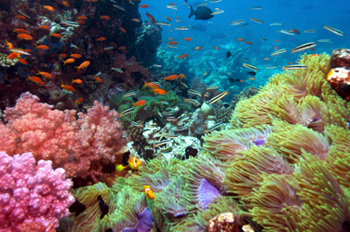
Coral Reefs Are Doomed, Says Scientist
The world’s reefs are on a trajectory to collapse within a human generation and there is nothing that can be done to reverse it, according to an op-ed in The New York Times, by Roger Bradbury, an ecologist specializing in coral reefs.
Bradbury criticizes the, “There is still hope” message being espoused by scientists and envrionmentalists.
Just last week, a consensus statement signed by about 2,700 scientists at the International Coral Reef Symposium in Australia called on governments to take immediate action to reduce carbon dioxide emissions, pollution and overfishing to save the world’s coral reefs.
But Bradbury says scientists and policymakers need to wake up to the fact that these trends aren’t going to be reversed and that it’s time to start pouring resources into what needs to be done once the critical ecosystems are gone.
Overfishing, ocean acidification and pollution have two features in common. First, they are accelerating. They are growing broadly in line with global economic growth, so they can double in size every couple of decades. Second, they have extreme inertia — there is no real prospect of changing their trajectories in less than 20 to 50 years. In short, these forces are unstoppable and irreversible. And it is these two features — acceleration and inertia — that have blindsided us.
What will be left? A hard, slimy bottom and waters full of jellyfish.
What we will be left with is an algal-dominated hard ocean bottom, as the remains of the limestone reefs slowly break up, with lots of microbial life soaking up the sun’s energy by photosynthesis, few fish but lots of jellyfish grazing on the microbes. It will be slimy and look a lot like the ecosystems of the Precambrian era, which ended more than 500 million years ago and well before fish evolved.
Bradbury’s op-ed is creating an impassioned debate among scientists, not all of whom agree with him. Check it out on the NY Times Dot Earth blog here.
Read Civil Beat’s story last week about a scientist in Hawaii who is creating sperm banks for coral in light of the imperiled ecosystems that support 25 percent of marine species at any give time.
And here’s Civil Beat’s story about jellyfish invading Waikiki.
(Photo Credit: NOAA)