

Not Everyone Wants More Voters To Participate
Editor’s Note: This is the fourth in a series of stories examining Hawaii’s low voter participation rates. Read previous stories in the series as well as other initiatives Civil Beat is undertaking to understand why people don’t vote.
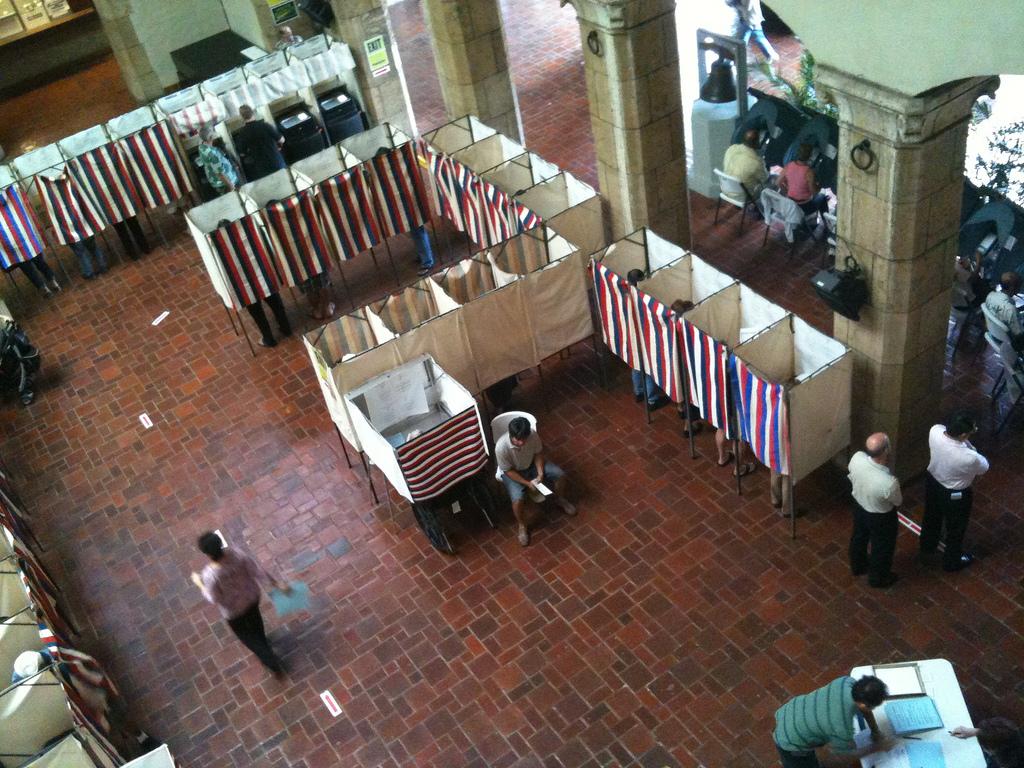
While Hawaii languishes at or near the bottom among the states in voter turnout, several other states have established enviable records of high voter participation.
High-turnout states in recent elections have included Minnesota, Maine, New Hampshire, Colorado, Oregon, Washington and Wisconsin, among others.
In the 2008 presidential election, for example, Minnesota led the way with overall voter turnout of 77.8 percent, while Hawaii was at the bottom with just 48.8 percent of the eligible population casting ballots.
Voter participation in these states has been bolstered by policies to make it easier to register and vote. These have included liberalized absentee ballot rules, including permanent absentee ballots, online voter registration, election day registration, and in a few cases, all-mail balloting.
But at the same time Hawaii is seeking ways to boost voter participation, new conservative majorities in many of the high-turnout states are moving to slam the door on the voting booth with highly partisan legislation tightening requirements for registration and voting.
Justified as erecting barriers to voter fraud, the proposals include measures to eliminate last-minute or election day voter registration, and to impose strict new identification requirements for anyone trying to register or vote.
In Hawaii, an effort earlier this year to tighten voter ID requirements died in the Legislature without a hearing.
According to the Brennan Center for Justice at New York University, at least 180 bills to restrict who can vote have been introduced in 41 state legislatures since the beginning of 2011, including Hawaii, and at least 24 laws have been passed. Some are expected to affect the outcome of the 2012 elections.
“When I look at high turnout states like Minnesota, Wisconsin, New Hampshire, Michigan, all are facing voter suppression legislation, either pending or on the governor’s desk,” said Keesha Gaskins, senior counsel for the Brennan Center’s Democracy program.
State’s with high turnout rates among African-American voters are also facing similar new restrictions, Gaskins said.
The Brennan Center and other critics say these will result in disenfranchising those who are younger, more mobile and less affluent. Rigid new requirements would also tend to discourage less frequent voters, those who don’t regularly turnout for every election, along with students, and minority voters.
Hawaii GOP Proposal Dies
Here in Hawaii, the House Minority Package submitted by Republican legislators earlier this year included HB 2221, which proposed to significantly tighten voter identification requirements. The bill died without a hearing.
Republican state Rep. Barbara Marumoto, who is retiring this year after serving her East Honolulu district since 1978, defended the bill as “reasonable,” and said it wasn’t intended to discourage voters. Her House district, which included an area from Kalani Valley to Diamond Head prior to this year’s redistricting, was one of the state’s top turnout areas during the 2010 election.
“I have no problem proving who I am,” she said. “I do that when I get on a plane to Kauai. You certainly don’t want people voting who aren’t who they say they are.”
Hawaii law requires voters to produce a photo ID if requested by poll workers, and no significant problems have been reported.
However, Annelle Amaral, a former state legislator and Democratic Party activist, says the requirement is unnecessary and leaves the door open for possible voter suppression.
“You don’t need to ask for a picture ID,” Amaral said. “You can ask them for the last four digits of their social security number, for example.”
“The system benefits people who own property, who are stable, and it impacts poor people and younger people who tend to move around a lot and may not have a current ID with their most recent address,” Amaral said.
A closer look at several high-voter turnout states shows maximizing voter participation is no longer universally seen as a goal, but increasingly as a partisan problem.
Minnesota
Minnesota has allowed people to register and vote at the polls on election day since 1973. It has recorded the highest voter turnout in every election since 1996, and has been at the top in all but four elections since 1980, according to Smart Politics, an online news site affiliated with the Humphrey School of Public Affairs at the University of Minnesota.
But this year, legislators passed a proposed constitutional amendment requiring all voters to produce an approved government-issued ID. It would make additional technical changes that would have broad effects.
“The Minnesota amendment is incredibly restrictive and has far-reaching consequences,” according to Keesha Gaskins of the Brennan Center. She said new procedural requirements could indirectly make the state’s election day registration impossible in the future.
The amendment will be on the ballot in November, when voters will have a chance to approve or reject it.
The language that will appear on the ballot is being challenged in court by the Minnesota League of Women Voters and the American Civil Liberties Union, who say it is oversimplified to the point where it fails to let voters know what they are voting on.
Sherri Knuth, public policy manager for the League of Women Voters of Minnesota, described the amendment’s three parts.
First, it requires voters to produce one of a limited number of government-issued IDs. Second, if a voter can’t produce one of the required IDs, they would be allowed to vote a provisional ballot, but appear at an election office within a few days with the proper paperwork.
“A lot of provisional ballots are never counted in states that already have a similar requirement,” Knuth said.
The third part contains language requiring all voters to prove “substantially equivalent eligibility.” The League of Women voters believes this technical language will render the state’s long-standing election day registration process unworkable.
Knuth believes the Minnesota legislation originated with the American Legislative Exchange Council (ALEC), which provided its members with a model “Voter ID Act.”
Public interest advocates in other states contacted by Civil Beat also pointed to the role ALEC has played in encouraging conservative legislators to pursue these restrictive measures.
ALEC describes itself as a “a nonpartisan public-private partnership of America’s state legislators, members of the private sector and the general public” to advance the principles of “free-market enterprise.”
But Common Cause, the nonpartisan public interest watchdog, called ALEC “a corporate lobbying group masquerading as a public charity,” and has filed a complaint asking IRS to audit the group’s political activities.
ALEC attorney, Alan P. Dye, called the Common Cause claims “patently false” and said they were being made “by liberal front groups that differ with ALEC on philosophical terms.”
In a press release, Dye said: “The current complaint mostly ignores applicable law and distorts what it does not ignore. After three decades of counseling clients on nonprofit and federal disclosure requirements, it’s clear to me that this is a tired campaign to abuse the legal system, distort the facts and tarnish the reputation of ideological foes.
Maine
Maine has regularly ranked in the top five states in voter turnout, but in 2011 the state’s new tea party-backed governor, and a new conservative majority in the Legislature, voted to repeal the law allowing for new voters to register on election day.
In response, a coalition of community advocacy and nonprofit organizations rushed to collect the signatures to put a “people’s veto” on the November 2011 ballot.
“Maine voters overwhelmingly support our existing laws making voter registration accessible on election day,” said Laura Harper, director of public policy for the Maine Women’s Lobby. “It’s widely supported by women, and widely supported by voters, but we hadn’t tested that until the Legislature decided to pass a law removing access on election day.”
When the votes were counted, over 60 percent of the public voted to repeal the Legislature’s action.
Maine legislators, responding to the vote, decided not to revive a voter ID bill that carried over from last year. Instead, they approved a much more limited measure calling for a study of election procedures.
Harper struggled to explain how public officials misjudged the voters mood so badly.
“Our legislature went from completely Democrat to completely Republican, with a tea party governor,” Harper said.
“Part of their world view is that voting is a privilege, not a right,” she said. “They said, absolutely, if voters are going to have the privilege to vote, they should have the responsibility to register in advance.”
“Our view is different. Our goal is 100 percent participation so that every citizen who wants to can register and vote on election day,” Harper said. “Those world views immediately clashed.”
Summing up, Harper said: “As a native Mainer, I would say it’s part of our core values, of course we want to vote.”
New Hampshire
Legislators in New Hampshire, another state ranking among the tops in turnout during the past two presidential elections, voted in late June to override Gov. John Lynch’s veto of two election-related bills.
One bill imposes a new requirement that voters show a photo ID in order to register and cast their ballots. The second changes the voter registration application form and appears to mean that someone with a car registered out of state will not be able to vote in New Hampshire.
William Tucker, an architect and one of the editors of BlueHampshire.com, a progressive blog, said the bills undermine the state’s permissive election laws.
“Since the New Hampshire primary, many residents eat and breathe politics here,” Tucker said. “There’s very high interest. One of the things contributing to our high voter turnout has been same-day registration.“
“New Hampshire made it easy for someone who is not following politics that closely, but on election day wants to have a say,” he said. “You can register on the day of the election, and a utility bill would be enough to show you are resident and able to vote.”
“Suddenly we’ve seen lots of barricades put into place,” Tucker said.
Tucker said he believes the bill tying voter registration to motor vehicle registration is aimed at dumping college students from out of state off the voter rolls.
“It’s an attempt to intimidate them and prevent them from voting,” Tucker said. “These bills are going to have an impact at the polls.”
The election issues reflect a partisan split, he said.
“Voter ID has become one of the items Republicans are pushing, up in arms about people stealing elections,” he said. “Of course, there’s no record of fraud. They seem to believe that Democrats couldn’t get the votes if they weren’t stealing the elections.”
But New Hampshire Republicans said the new law was needed because the votes of residents were being “diluted” by those from out-of-state.
After the vote to override the governor’s veto of the voter ID bill, House Speaker William O’Brien called the measure “a well-structured approach to ensuring clean elections.”
“New Hampshire now has one more tool to protect the integrity of the ballot box and guarantee that the ‘one person, one vote’ principle is not diluted by dishonest votes,” O’Brien said in a statement.
Voter ID Laws Face Legal Challenges
Keesha Gaskins of the Brennan Center said the Supreme Court in a 2008 case held that an Indiana voter ID law was not unconstitutional on its face.
“But that’s not the end of the story,” Gaskins said.
A 2006 survey sponsored by the Brennan Center found as many as 11 percent of citizens don’t have a government-issued photo ID, with senior citizens and minority voters disproportionately impacted. The survey found 18 percent of citizens between 18 and 24 don’t have a valid ID with their current address and name.
Courts in at least two states have found state constitutional violations, and legal battles are currently being waged in a number of states, including Wisconsin, Pennsylvania, Florida, Texas, South Carolina, and Colorado.
Ian Lind is a veteran political reporter and longtime Hawaii investigative journalist who blogs at iLind.net.
