

New Study Explains Great White Shark Presence in Hawaiian Waters

Photo courtesy of hermanusbackpackers
Amid widespread fixation with great white sharks, Hawaii researchers have published a study in the Journal of Marine Biology that sheds light on the species’ presence in, yes, Hawaiian waters.
The research also outlines a new method to distinguish between the great whites — what the study simply calls “white sharks” — and mako sharks.
The University of Hawaii at Manoa‘s School of Ocean and Earth Science and Technology’s Kevin Weng and the state Department of Land and Natural Resource aquatic resources division’s Randy Honebrink did the study.
The study, entitled “Occurrence of White Sharks in Hawaiian Waters,” can be found here.
Very little is known about great whites’ migration patterns, according to a UH press release. The same goes locally, though Native Hawaiians before Western contact used the sharks’ teeth for weaponry and other purposes.
What satellite tracking shows, however, is that the few great whites that are found in Hawaiian waters typically migrated from the waters boarding California and Mexico. The study suggests that great white sharks swim in Hawaiian waters during longer parts of the year than previously thought.
It also explains that males tend to come between December and June, while females are around throughout the year, indicating that their time here corresponds with their two-year reproductive cycle. (Warmer water temperatures are thought to speed up fetal development.)
From the press release:
The authors reviewed all available sources of information relating to white sharks in Hawaii, including newspaper accounts of shark attacks, shark control program catch records, photos and videos from various sources, and satellite tracking data. Only data that could be confirmed as pertaining to white sharks was included in the analysis. In cases where information was insufficient for positive species identification, the sightings were eliminated. …
The study also emphasizes that mako sharks, which are commonly mistaken for great whites, have pointier noses. Misidentification of great whites, according to the study, has been a recurring problem.
The viral video showing two fishermen off of Kaena Point actually featured a mako shark — not a great white, as news media widely reported.
Mako shark:
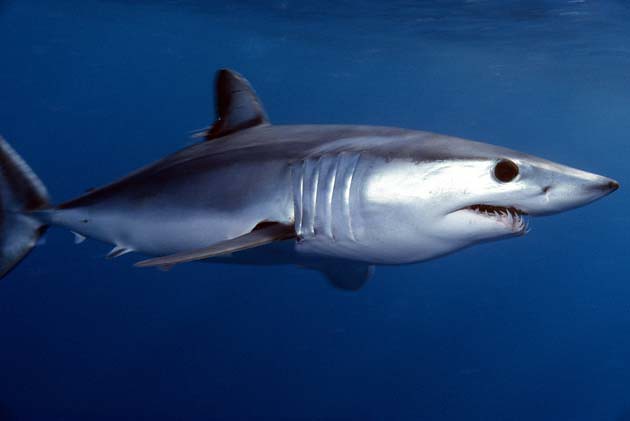
Photo courtesy of jidanchaomian
— Alia Wong

