

Civil Bytes: There’s Something Better Than Dreams of Silicon Hawaii?
The islands’ tech future should celebrate the state’s diversity and traditions, and be representative of the population.
White guys in garages. Mountain Dew. Fluorescent light seeping into empty pizza boxes.
When I think of the startups in Silicon Valley, what immediately comes to mind is an overwhelming beam of whiteness, sameness, privilege and youth.
An exuberance to take all of the world’s most minuscule problems and contrive digital solutions.
To go from mom’s tiny garage to a gigantic Google or Facebook acquisition, then to high-five as awkwardly as possible.
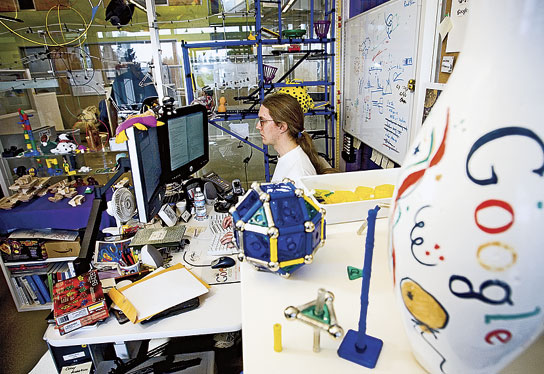
An employee on the Google campus works and lives the dream.
Adrian Libotean on Flickr.com
When Google reluctantly released their employee diversity numbers in May, it didn’t surprise me: 70 percent of Google’s employees are male, 61 percent are white, 79 percent of all leadership positions are held by men and there are no women in top-level executive positions. Just 1 percent are African-American and 2 percent are Hispanic.
The ripe young median employee age is 29, with an average salary of $107,000 — just enough money to keep the blacklights in the garage on.
In tech parlance, we’d call this composite Google employee a “brogrammer.” He’s young, well-educated, sports a pastel popped collar, and he’s willing to wear whatever free T-shirt you throw at him.
The problem isn’t specific to Google, though. According to Mother Jones, “Silicon Valley’s race and gender disparities … are wider when limited to executives and top managers, and more dramatic when compared to the makeup of the state workforce.”
In 1990, across the U.S., 34 percent of computer workers were women. That number has actually fallen noticeably, as women now make up 27 percent of the tech workforce and just 22 percent of all software developers — the position that is the lifeblood of the tech startup.
Similarly, even as people of color are the fastest growing userbase for smartphones and social media sites, they only make up roughly 7 percent of the tech workforce.
So why is there such a disparity between consumption and creation?
What I Refuse to Download
Couch crashing, photo sharing, e-dating, buying truffles with your iPhone, catching an informal cab, dog sitting — the majority of startups coming out of the valley make me yawn.
Most are thinly veiled attempts to combat the malaise of not having real problems. Others are poorly conceived attempts at solving the real or perceived problems of others.
“There’s a ‘monoculture’ that pervades the valley,” Alexis Ohanian, co-founder of Reddit, said. “People build startups to solve the problems of one specific set of people, namely, those living there. But if you’re elsewhere, you can create something that caters to your own community.”
Valley startups, in effect, are only eating a very small — albeit delicious — piece of the pie.
“Despite the fact that tens of millions of American Android and iPhone owners are struggling to make ends meet,” writes Neal Ungerleider at Fast Company, “startups disproportionately target the young, suburban/urban, and middle-to-upper-class.”
Why replicate the blandness and frivolous non-innovation of the monoculture in Silicon Valley, especially in a place like Hawaii where diversity and nuance are everywhere?
“If technology is designed mostly by … males, who make up roughly half our population, we’re missing out on the innovation, solutions, and creativity that a broader pool of talent can bring to the table,” says Kimberly Bryant, founder of Black Girls Code.
So, is this the future? A world where a woman with an African-American-sounding name is 50 percent more likely to have her resume ignored and where a startup named Qwerply or Borklr can procure millions of dollars in venture funding without batting much of an eye?
Consider me unenthused.
A Plea for Hawaii Tech: Don’t Take the Bait
Often, the question is asked: What city is the next Silicon Valley?
I’ve spent hours in the shower contemplating this very question.
Forbes never tires of trying to answer it, crowning the next valley after valley — New York City, Los Angeles, Austin, Seattle, San Diego…
Here some people would like to think — or dream — that it could be Hawaii.
But, recently, I’ve been asking myself a different, more important question. Why?
Allocating startup money can be controversial, and it raises a lot of questions. Why try to resemble something we’re not? Why replicate the blandness and frivolous non-innovation of the monoculture in Silicon Valley, especially in a place like Hawaii where diversity and nuance are everywhere? Why strive for maximized cash flow if it calls for a corresponding reduction in kuleana?
Moreover, why isn’t Forbes asking the most essential question of all: What makes every tech community valuable in its own right, for its own community?
Why not shoot for something unique and meaningful here in Hawaii, instead of striving to become second best, or less?
“Leaders and policymakers do the public a disservice by exalting Silicon Valley as the ultimate goal, then asking entrepreneurs to pursue the same path of the Bay Area’s high-growth, high-tech startups,” Ross Baird of Village Capital writes. “Silicon Valley-style companies create a ton of wealth, but they rarely create jobs at a meaningful scale.”
Instagram, for example, which was acquired by Facebook for $1 billion, employed only 12 people. Another startup, WhatsApp, acquired by Facebook for $19 billion, employed a whopping 55. (For those who don’t know me, that’s sarcasm.)
It’s clear that the value of an acquisition is reserved for the lucky few. The value for the community at large, if any, is in the infrastructure left behind and in the passing chance that the innovation is somehow geared toward solving real, tangible local issues.
Hawaii Is Unique — Diversity Is Key
According to the Esri Diversity Index, California is the second most diverse state. It’s baffling and unfortunate, then, that this diversity hasn’t spread into the valley itself, either in terms of resources or ideas.
The only state with a higher diversity index? Hawaii.
Let’s not make the same mistake.
In Honolulu, there’s a 79 percent chance that any two people, chosen at random, will belong to different races or ethnic groups. As a local entrepreneur, you’re forced by sheer probability to cater to a customer who’s not exactly like you. Yet that suspension of insulated comfort is fertile ground for new ideas and new solutions.
“Living in a society where we encounter different backgrounds and professions in our daily routines makes for a more tolerant society,” writes tech columnist Steven Johnson. “It also makes us smarter, more original in the ideas we have – and in the companies we create.”
The potential for Hawaii’s tech scene to celebrate this diversity as its source of entrepreneurial insight is, in my opinion, unrealized but promising.
I, for one, would much rather participate in a startup community that boasts successful female and minority entrepreneurs — especially since we are in a state with no majority — and that focuses on solving local problems without getting bogged down in creating Instagram or Snapchat ripoffs.
After all, why not shoot for something unique and meaningful here in Hawaii, instead of striving to become second best, or less?

