

New Hawaii Law Eliminates Life Imprisonment Without Parole for Juveniles
Recognition that children, when sentenced for adult crimes, are constitutionally different from adults.
House Bill 2116, signed into law today by Hawaii Gov. Neil Abercrombie, eliminates sentences of life imprisonment without the possibility of parole for juvenile offenders.
The measure was introduced by state Rep. Karen Awana.
“Hawaii is one of a shrinking number of states that still allows life sentencing without parole for juvenile offenders,” she said via press release.
Awana added, “In addition, it has been uniformly rejected by the international community and it’s time we remove this law from our books. Right now the United States is the only nation in the world that allows children to be sentenced to life imprisonment without parole.”
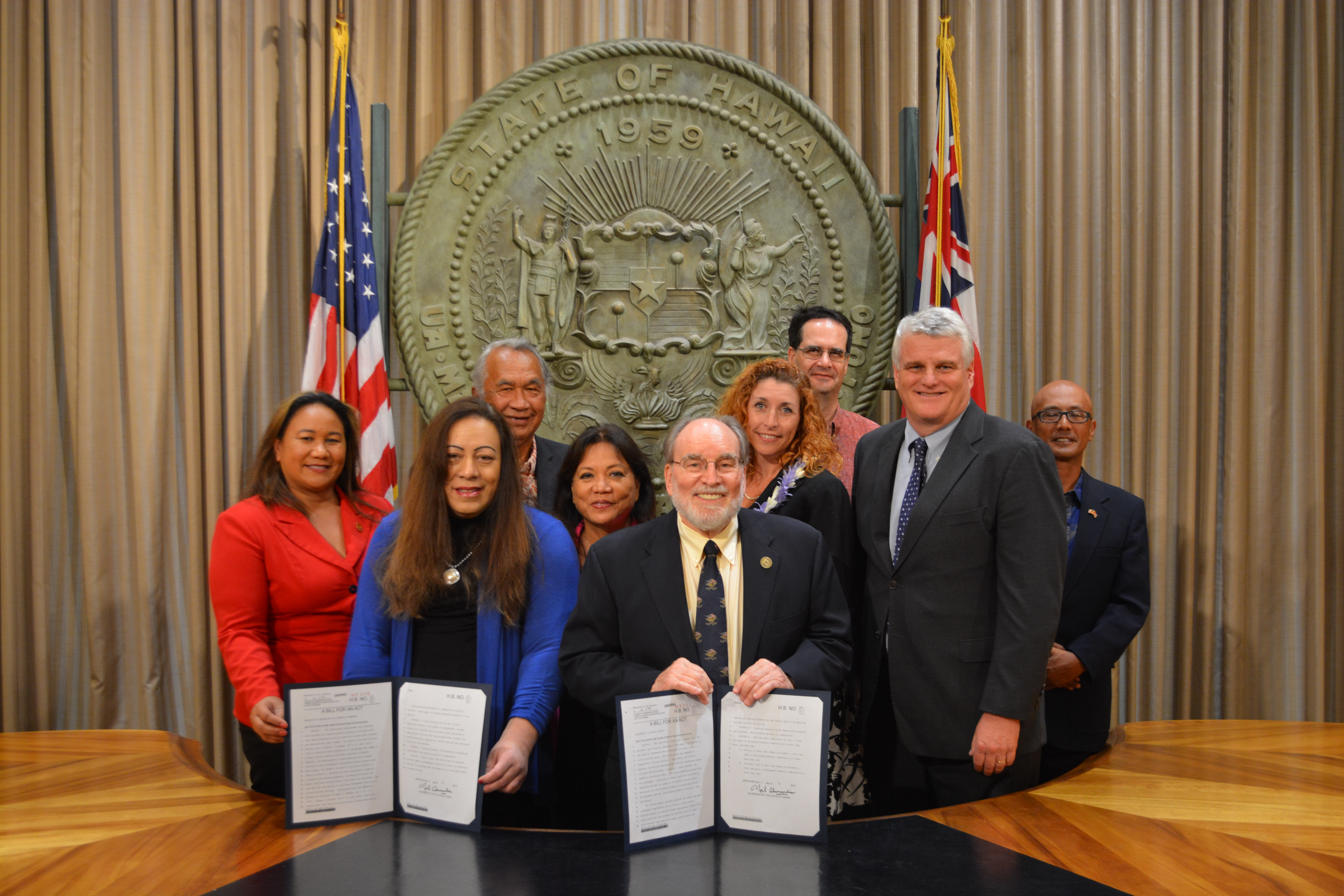
Gov. Neil Abercrombie and supporters of the new law changing sentencing of juveniles, July 2, 2014.
House Communications Majority
Hawaii’s current law, according to the state House of Representatives, establishes that persons who are convicted of first degree murder or first degree attempted murder are to be sentenced to life imprisonment without parole — regardless of age.
“The changes to the law would maintain a mandatory life sentence for those above 18 years old, but would sentence persons under the age of 18 years old at the time of the offense to life imprisonment with the possibility of parole,” the House explains.
Another measure that is now law — House Bill 611 — aims to protect the health of minors by making it unlawful for tanning facilities to allow individuals under age 18 to use tanning equipment utilizing electromagnetic radiation.
The law allows the Department of Health to impose fines of up to $250 for a first violation and $500 for subsequent violations.
“Young people are especially susceptible to the risk of skin cancer from ultraviolet radiation,” said Rep. Gregg Takayama, who introduced the bill.
Also signed into law today was House Bill 2490, which, according to the Abercrombie administration, focuses on Hawaii Youth Correctional Facility beds on serious juvenile offenders – “a practice shown to produce the best public safety returns and reductions in recidivism.”
The press release adds, “By diverting the placement of youth with lower-level offenses from HYCF, the policies are projected to cut the facility’s population by 60 percent over the next five years, saving an estimated $11 million in the facility’s budget. Through this measure, the state also invested $1.26 million of the anticipated savings this year to expand proven programs, including mental health and substance abuse treatment, in Hawaii’s communities.”
Read Civil Beat’s Youth Correctional Facility Cleans Up Its Act.

