

A History of Hawaii Hurricanes Since 1843
Say “hola” to Iselle and Julio. And how’s your supplies situation? Water? Batteries? TP?
With two storms nearing the Hawaiian Islands — Iselle followed by Julio —local folks are loading up on supplies to ride out any potential crisis.
Hawaii 24/7 has this report on the more than three dozen hurricanes or tropical cyclones that have had an impact here over the decades.
“Hawaii typically records four or five hurricanes each year, although as many as 11 have occurred, including during the 1992 and 1994 seasons,” the report explains. “Formal records were not kept before the 1950s.”
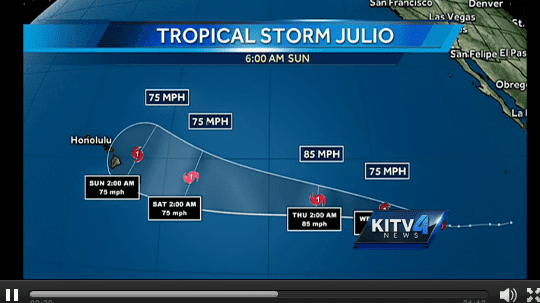
Screen shot from KITV, Aug. 5, 2014.
KITV
Highlights:
- September 1843: The earliest report of a tropical cyclone that could have affected Hawaii was made in 1843. On Sept. 23, a German ship recorded a cyclone (known later as the “Cyclone of the Lark”). No further records are available, but extrapolation of its forward movement predicted that it would make landfall on the southern coast of the Big Island.
- November 1982: Hurricane Iwa was one of Hawaii’s most damaging hurricanes. Although it was only a category 1 storm, it passed just miles west of Kauai, moving at a speed of nearly 50 miles per hour. Severe property damage was inflicted on the island; up to $250 million (a record for that time). Iwa was the most damaging hurricane to hit Hawaii until Hurricane Iniki took over the title 10 years later.
- September 1992: Hurricane Iniki caused more damage than any other hurricane to affect Hawaii since records began. It hit Kauai as a Category 4 on Sept. 11. Iniki caused almost $2 billion in damage, mainly to Kauai. It remains the second costliest East/Central Pacific hurricane on record, only behind Hurricane Paul in 1982. Six died as a result. Iniki brought winds of 140 miles per hour.
Hurricane season runs June 1 to Nov. 30 each year. Read more at SOEST’s hurricane website.

