

Civil Bytes: WTF, Internet? Pursuing Truth in the Digital Age
The power and the danger of the Internet rests in its vast flexibility. It can be used for good, and it can be used for the not-so-good.
In March, when famous grunge musician Courtney Love posted the potential coordinates of the missing Malaysia Airlines flight, I was hopeful. I mean, heck, why not?
This is the age of the Internet. Anything is possible. With the right keystrokes and an eye for digital detail, even a nearly forgotten grunge musician can save the planet.
Of course, as we all know now, she didn’t find the plane. No one did. In the aftermath, hoards of digital do-gooders had taken to the Internet, scoured thousands of square miles of satellite imagery in the hopes of unearthing that missing plane, but nothing.
Six months later, boundless heartache, and still no plane. Not even a fleck of wreckage.
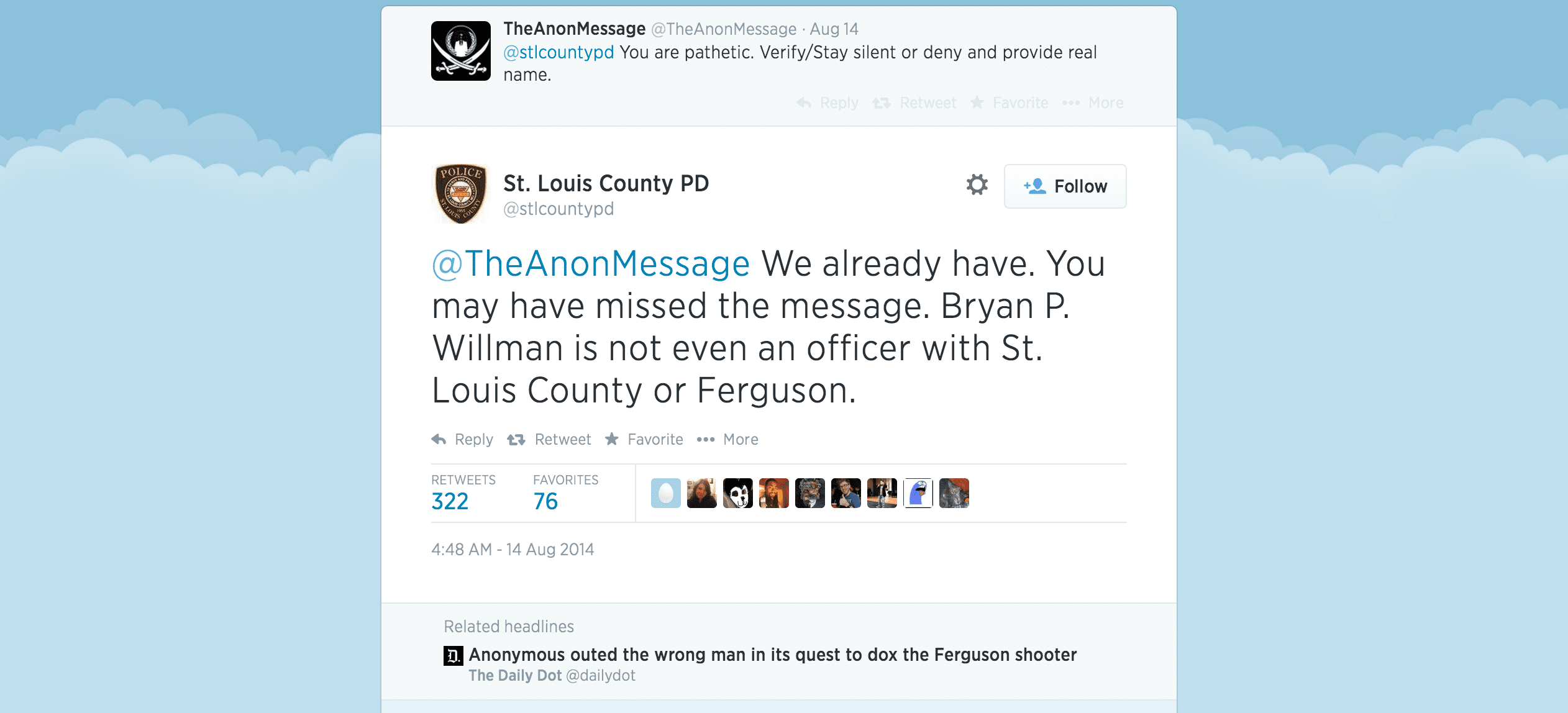
The St. Louis County Police Department’s Twitter account responds to an Anonymous member, who falsely accused the wrong man as the police officer who shot Michael Brown in Ferguson, Mich.
Almost a year earlier, two pressure cooker bombs exploded during the Boston Marathon, killing three people and injuring nearly 300 others.
Fuelled by anger and intrigue, users of social media sites like Reddit, 4Chan, and Twitter combed through publicly available video footage and photos of the scene, hoping to unravel the mystery.
The results of that digital sleuthing? Subpar, to say the least.
Several innocent bystanders — mostly minorities carrying backpacks — were accused of being murderers and terrorists. Their lives were instantly in danger. The FBI, pressured by the widespread diffusion of shoddy half-baked misinformation, quickly released photos of the Tsarnaev brothers, the real suspects, with the aim of quelling a witch hunt. But that disclosure came at a cost, with a carjacking and two potentially preventable shootouts to follow.
“An outpouring of tweets and blog posts have also been circling the social sphere,” wrote Lynsea Garrison at BBC, three days after the bombing. “Many of the messages are ones of support, but several expose a xenophobic undercurrent in the American response to the tragedy. Tweets with racist expletives blamed ‘sand monkeys’ and ‘towel heads’ for the attacks, while the word ‘Muslim’ even trended on Twitter.”
The digital pastime of crowdsourcing seemed to be hitting a limit of applicability, lending lots of noise but no real signal, leaving two disasters arguably worse than if simply unsolved.
The touters of the egalitarian-utopian-spectacular Internet (myself humbly included) had some explaining to do.
When tragedy struck, we were left with more questions than answers, more concerns than condolences. The tool we loved had only left us more befuddled. Our mantra that the “Internet could do anything, anywhere, and fast” had some obvious #caveats and #pitfalls.
Hey Internet, Cool It
Quite often the Internet is seen as the great equalizer. It lends voice to the voiceless. It offers free insight where once was only the ominous paywall of Virgin Records, Blockbuster, or the likes.
But equally true, especially in times of turmoil, is the fact that the Internet is a source of unchecked amplification. It riles fears and anxieties. It strips the polite veneer from our ideologies and holds a mirror up to our darker, more often hidden prejudices.
Such is the strange paradox of the Internet. We tweet and snap face-affirming selfies because we assume hoards of onlookers clap somewhere in the digital ether. Yet, in the same breath, we erupt with unbridled hatred — the kind of vile thoughts usually reserved for Ann Coulter or our closet journals — thoughts we wouldn’t dare admit to ourselves, let alone an audience of a million strangers.
The ideal of the Internet as an epicenter of diversity is giving way to an internet of partitioned back-pats and ice bucket drenchings. If only I could unlike.
It didn’t come as a surprise, then, when a recent study by the Pew Research Center revealed that the Internet is, by and large, diminishing political participation, contributing to the polarization of the United States, and stifling debate and opinion about public affairs.
The ideal of the Internet as an epicenter of diversity is giving way to an Internet of partitioned back pats and ice bucket drenchings. If only I could unlike.
As a software developer and as a Netflix subscriber, I’m obliged to stare at the Internet for hours on end. But I’m becoming more cautious of the tool I love. Or, at least, I’m cautious of accepting its positive impact prima facie.
Instead, while staring, and especially if I start to slightly feel anything, I give myself a reality check. The same reality check I force upon myself when driving and concluding that another driver deserves to be annihilated. I acknowledge the irrational emotional amplification, and I try to subdue it.
HBGary and the Art of Astroturfing
In 2011, technology security company HBGary was contracted by the U.S. government to create a tool that could produce thousands of fake social media profiles at the drop of a hat. This capability, called astroturfing, could be leveraged by the government to amplify favorable opinions and potentially sway favorable civil unrest.
In a leaked letter, HBGary explained how the software could conjure false consensus:
“We will create a set of personas on twitter, blogs, forums, buzz, and myspace under created names … These accounts are maintained and updated automatically ... Using the assigned social media accounts we can automate the posting of content that is relevant to the persona … In fact using hashtags and gaming some location based check-in services we can make it appear as if a persona was actually at a conference and introduce himself/herself to key individuals as part of the exercise, as one example. There are a variety of social media tricks we can use to add a level of realness to all fictitious personas.”
This kind of posturing is anti-democratic at best, despotic at worst. I’d expect no less from, say, Target or Walmart in their relentless campaign to sell me poorly stitched socks, but I’d prefer not to be synthetically swayed when it comes to my sociopolitical leanings.
If anything, though, HBGary’s astroturfing lends credence to the idea of an Internet of amplification: we’re swayed by the social consensus, whatever it is, often to act impulsively, even if that consensus is largely fabricated.
Michael Brown: Unease Made Easy
On August 9, from my Macbook, I watched streaming video of the unrest in Ferguson as it unfolded.
Spurred by Michael Brown’s shooting, the online “hacktavist” group Anonymous attacked Ferguson City Hall’s website and phone lines, crippling the city’s ability to respond to surging outrage.
Anonymous then posted the name, home address, and Social Security number of St. Louis Police Chief Jon Belmar, telling him to “run, Jon, run.”
Anonymous also threatened to release Belmar’s daughter’s information if Belmar didn’t divulge the name of the officer who shot Brown. They gave him one hour to comply, but he didn’t budge.
Let’s leverage the Internet with some sense of caution and restraint.
Thousands of death threats flooded in, many directed at no person in particular.
On Aug. 14, Anonymous released what they said was the name of the police officer who killed Michael Brown. In fact, the alleged killer was neither the shooter nor a police officer.
The irony here — of a group claiming to value anonymity above all else in turn revealing the private, personal information of innocent people — shouldn’t go unnoticed. And the unrest in Ferguson, though justified, has been made exponentially worse by a digital desire for immediate access, and a backlash of rage heightened by Anonymous’ antics.
Let’s Tread More Lightly
The power and the danger of the Internet rests in its vast flexibility. It can be used for good, and it can be used for the not-so-good.
As the digital world becomes more and more pervasive, our adoration should be met with an equal measure of mindfulness.
For those of us who love the Internet — for those of us who searched for HA 370, who scoured photos of the Boston Marathon bombing, who hacked private records to reveal a police chief’s personal info, I beg of you: Let’s leverage the Internet with some sense of caution and restraint.
It’s a powerful but blunt tool, and justice may be better served with a keener eye toward patience and constructive dialogue.

