

Oahu Has History of Being Spared from Major Storms
Good luck and prevalent weather patterns have combined to spare Hawaii’s population center from any direct hits.
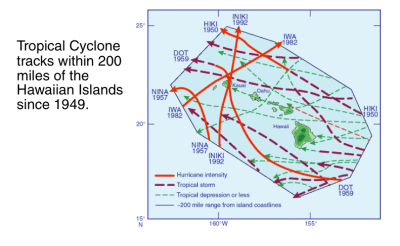
Most of the major storms approaching the Hawaiian Islands have skirted Oahu, where nearly 75 percent of the population lives and with its dense buildings and infrastructure has the highest risk for major damage.
In fact, Hawaii’s “Gathering Place” has never been directly hit by a hurricane in recorded history, which dates back to the early 1800s, according to Steven Businger, a professor at the University of Hawaii’s meteorology department. At most, Oahu has experienced some weak tropical storms, he said.
University of Hawaii, SOEST
That’s not to say that Oahu has escaped unscathed from the dozens of hurricanes that approach the islands annually. While Hurricane Iniki missed a direct hit on the island, large surf caused damage to the Waianae coast, for instance. In 1957, Hurricane Nina produced record winds in Honolulu and in 1986, Hurricane Estelle caused flooding.
By contrast, Kauai has taken the brunt of hurricanes in recent decades — Hurricane Iniki in 1992 had sustained winds of 130 miles per hour and caused $2.3 billion worth of damage.
Businger attributes this in part to bad luck. But he also notes that the trade winds are blocked by the mountain chains of the islands, so storms passing just south of the Big island — a common route — have a tendency to curve northward and head toward Kauai.
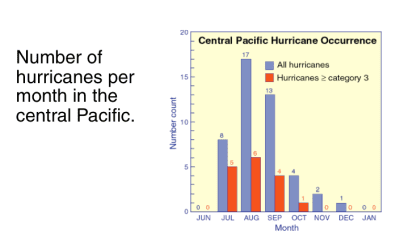
He said that in general, the Big Island is at the greatest risk of major storms making landfall.
University of Hawaii, SOEST
As for the current storm approaching Hawaii — Hurricane Iselle — which is expected to weaken into a tropical storm before making landfall on the Big Island on Thursday, Businger said that Oahu probably won’t experience major damage.
“I think we are going to see rain here and a little blustery weather, but I don’t think it is going to be too bad,” he said.
Still, he said it’s important to be prepared and emphasized the risk of flash flooding.

