

Eric Pape: Hawaii Politicians and Their Signs of Hypocrisy
The same people who can alter the popular billboard ban are allowed to advertise themselves on our roadsides.
It is a point of pride for many in the islands that Hawaii has no billboards.
In the rest of the country, people in traffic end up as captive audiences, staring at huge elevated signs for, say, an iPad Mini the size of a house.
But on Oahu we take our traffic with a side of rainbows, which stretch from the Koolau mountains all the way to the sea.
Few people want advertisements intruding on such sights.
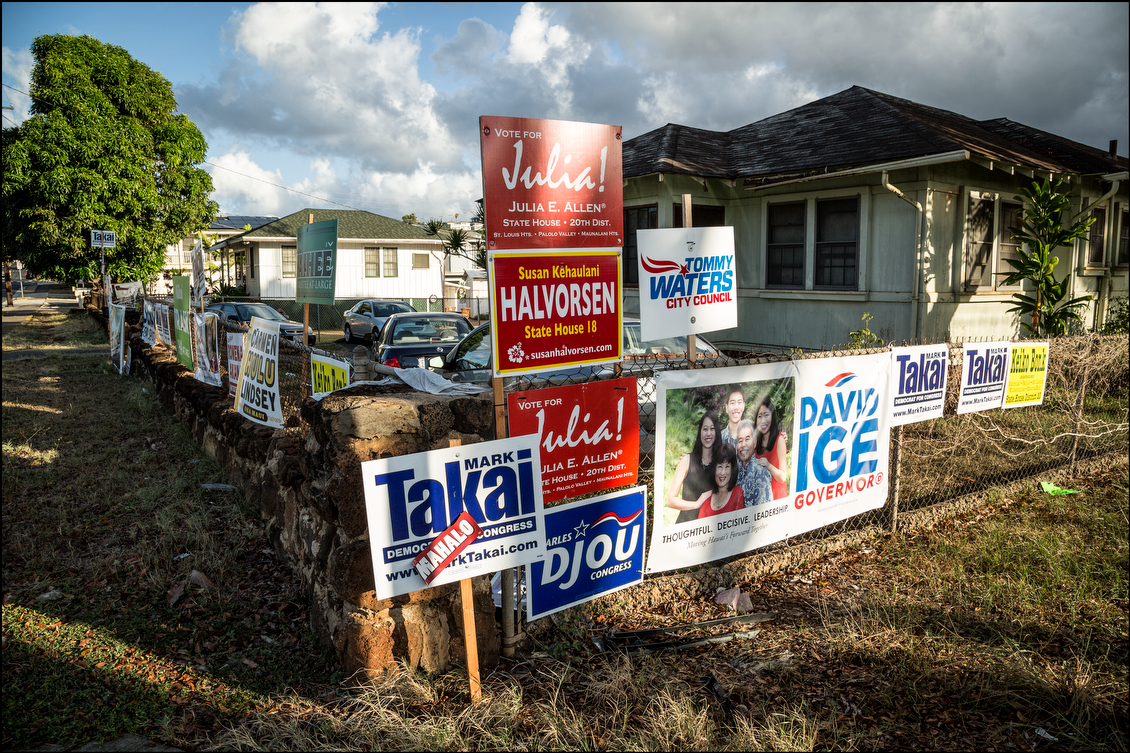
Campaign signs along a residential fence on Waialae Avenue.
PF Bentley/Civil Beat
While there may not be any consumer billboards on our streets, there are signs all around the islands right now advertising a very different type of product.
The “products” are politicians. The signs are made by their supporters or, more often, their campaigns.
Posting and waving political signs and banners may have a long tradition in Hawaii, but is it still effective? Does seeing numerous signs in favor of an individual help convince voters that there is a critical mass of support for the candidate, and that people should climb aboard the bandwagon?
Signs throughout the islands for the cash-flush re-election campaign of Neil Abercrombie didn’t stop the governor from getting trounced by David Ige, who had relatively little money and few signs.
Efficacy and aesthetics aside, there is also the question of whether or not such signs improve the quality of political debate. Does highlighting the ‘USA’ in Colleen Hanabusa’s name, for instance, tell voters anything relevant to her candidacy or the issues at stake?
But there is a more troubling issue. The whole reason for posting political signs is to seize our attention, usually while we are navigating twisting mountain highways, coastal roads or the hectic streets of Honolulu.
Signs throughout the islands for the cash-flush re-election campaign of Neil Abercrombie didn’t stop the governor from getting trounced by David Ige, who had relatively little money and few signs.
From a public safety perspective, roadsides and crowded intersections are not the best places for a driver’s eyes to be deciphering political messages. And at least one politician, state Rep. Chris Lee, has witnessed an accident that he attributed to sign waving.
Such issues are part of why the Honolulu City Council passed a resolution in 2010 that limits the size of political signs to 4 feet by 2 feet and restricts their display to a maximum of 120 days before Election Day, and 30 days after. The measures were put in place after the council became convinced that signs were increasing “not only in quantity, but, even more disturbingly, in size,” according to a 2010 report from the Committee on Zoning.
Marti Townsend, the executive director of the environmental non-profit group The Outdoor Circle, noted that the resolution is not binding and “nobody follows it, as far as I can tell.”
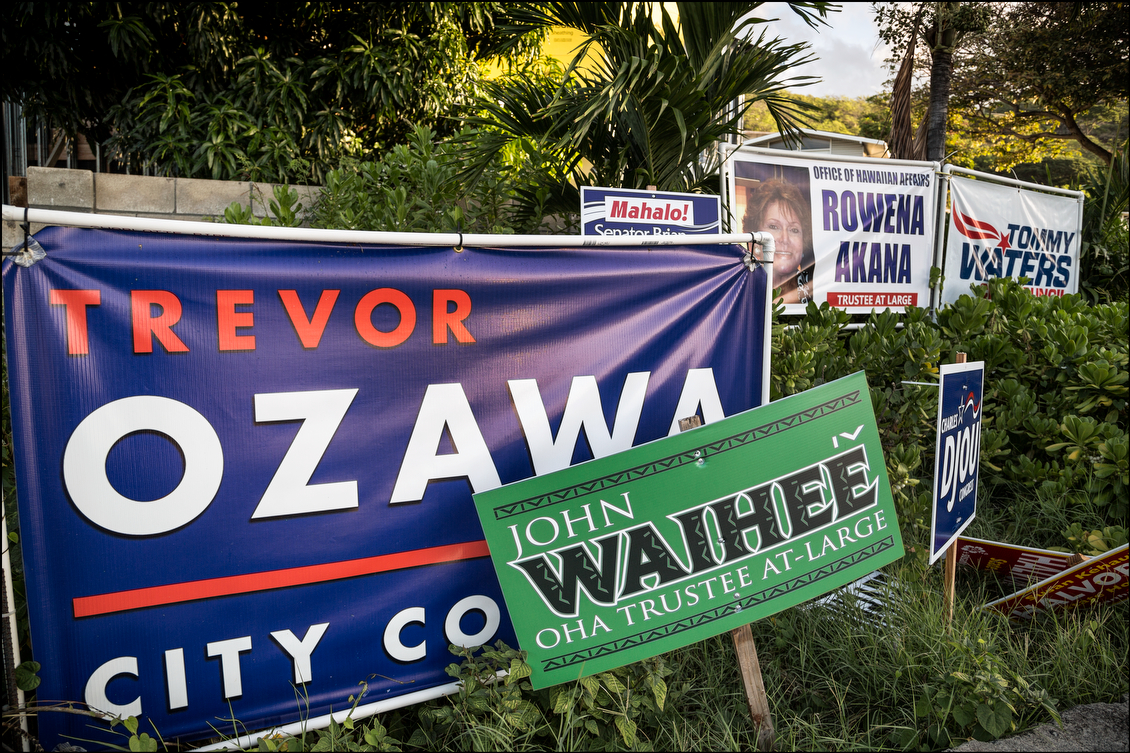
Campaign signs along Kalanianaole Highway in Aina Haina.
PF Bentley/Civil Beat
Honolulu accepts campaign signs, which are differentiated from consumer advertisements of commercial products, on free speech grounds. But Oahu does have regulations against visual blight and dangerous distractions for drivers, while protecting the natural beauty around us.
The lack of enforcement is, Townsend said, a problem. There is no single individual or structure monitoring such campaign paraphernalia. In fact, as things stand, it is generally up to people like you to report violators.
The average person, though, is unlikely to know that violations on agricultural lands — where no such signs are permitted — need to be reported to one group, and overly large signs on residential property to another.
There is something sort of archaic about Hawaii’s ban on billboards, given that advertising, like so much of the rest of our modern world, has gone mobile — in both senses of the word.
Advertisements on cars, trucks and vans often drive up alongside us in traffic. Mayor Kirk Caldwell wants to spread similar rolling advertising to the outside of public buses, to help raise money for the city. (Bus riders already face ads inside.)
The very politicians who have the power to re-legalize billboards, or continue the current and popular ban on them, are many of the same people who put up signs to influence the voters of Hawaii.
The mayor has repeatedly emphasized that such ads will be different from roadside billboards, which he is against because he respects the consensus over the longstanding ban.
The difference between the mobile advertisements and the aerial banners Caldwell has recently attacked is that the sky is widely recognized in the islands as a communal place that should remain untouched.
The Outdoor Circle argues roadsides should also remain clear of such signs, but Townsend holds out hope that the move toward greater voter outreach in the online world will result in candidates shifting their resources and energy away from political signs.
Until then, a troubling irony will remain: The very politicians who have the power to re-legalize billboards, or continue the current and popular ban on them, are many of the same people who put up signs to influence the voters of Hawaii.
Hawaii’s elected policy makers should reflect on the message this sends.

