Turning Out the Lights in Hawaii in a Show of Real Power
Tropical Storm Iselle caused substantial damage to electrical flow on the Big Island, highlighting our need to continue the shift toward alternative energy.
The recent devastation caused by Hurricane Iselle and the subsequent loss of power to tens of thousands in the Puna District of Hawaii Island showed that our dependence on fossil fuels can debilitate our communities.
This recent disaster reminds us that preparedness and alternative energy sources can make all the difference when the electrical grid goes down.
In 2012, Hawaii imported 93 percent of the energy it consumed and, in 2013, the state had by far the highest electricity prices in the nation. For many of us, especially Kanaka Maoli, our dependence on unsustainable energy sources is not in alignment with our values to malama honua (care for the earth). But it is easy, convenient and it becomes our everyday life.
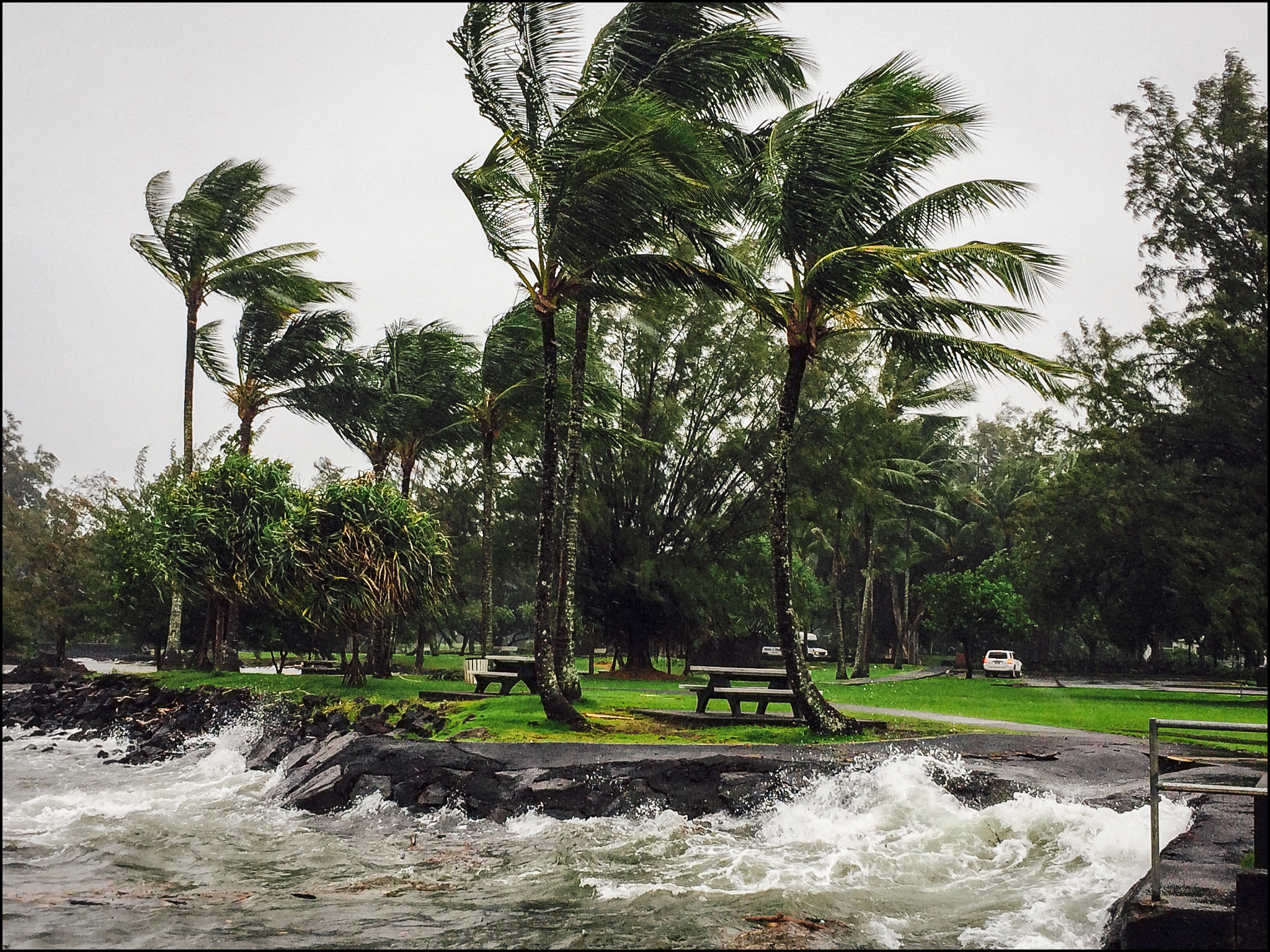
Tropical Storm Iselle, seen here driving winds and waves onto the Big Island on Aug 8, damaged electrical infrastructure, highlighting the need for more alternative power sources to achieve energy security.
Chris Leonard/Sunbums
Nelson Ikaika Fernandez works as the Palolo STEM Outreach Coordinator for the Palolo Discovery Science Center teaching youth about solar energy, aquaponics, water management, climate change and energy efficient practices. He has reminded us that Kanaka Maoli are natural engineers and we need to work overtime in learning to use the technology available to us so we can be the bridge between our ike kupuna (ancestral knowledge) and our modern world.
Uncle Les Kuloloio, credited for being at the forefront of the 1970s’ Hawaiian renaissance and currently with the Polynesian Voyaging Society’s Malama Honua Worldwide Voyage, recently spoke at a small workshop organized by Loli Aniau, Makaala Aniau (LAMA), which translates as “climate change, climate alert.” The LAMA project is housed within Hawaiinuiākea School of Hawaiian Knowledge.
His talk focused on how ancestral observations can inform us in these modern times on how best to navigate the changing climate. “Our ancestors were rememberers — participators — keen observers and responsible stewards of our environmental resources.”
So what can we do as everyday people? How can we become more conscious in the way we use the precious resources of our aina?
By becoming a kilo honua (earth observer), you and your ohana can start to become aware of your energy use and identify opportunities for decreasing your dependence on unsustainable energy sources.
“The combustion of fossil fuels to generate electricity is the largest single source of CO2 emissions in the nation” — The Third National Climate Assessment,
To help begin this process, LAMA is organizing a series of Lights Out Events, called “Hoa i ka lama.” These events are inspired by Earth Hour, a worldwide “lights out” movement uniting millions of people around the simple act of turning off their electricity as a symbolic act to show their awareness and care for the planet.
Join us on the next full moon — Sept. 9, 2014 — to “Hōʻā i ka lama”by making a pledge to yourself, your ohana, and community to enjoy an electricity-free evening.
These events are a way to raise awareness around the global issue of climate change and encourage simple, conscious efforts to malama aina (care for the land). Turning our attention to the night sky is also a way to show our collective support for the Polynesian Voyaging Society’s Malama Honua Worldwide Voyage.
Why a “lights out” event?
According to the recently released report, The Third National Climate Assessment, “The majority of the warming at the global scale over the past 50 years can only be explained by the effects of human influences, especially the emissions from burning fossil fuels (coal, oil, and natural gas) and from deforestation.”
“The combustion of fossil fuels to generate electricity is the largest single source of CO2 emissions in the nation.”
Completely eliminating or significantly decreasing the use of electricity during the Hoa i ka lama event is another step forward in curbing our over-dependence on fossil fuels and channeling our human propensity to live, love, and thrive in a world powered by local, renewable energy sources.
“Hoa i ka lama” means to ignite the torch. It refers to that source of knowledge that we all carry within us that has been passed on to us by our kupuna (elders) and to channel our collective energy towards a sustainable future.
LAMA believes that individual changes in behavior have the power to effect global change that will protect Mother Earth for generations to come. It is our hope that this small action will inspire our communities to support clean energy initiatives and return to a way of life supported by the guiding principle of mālama aina and living in balance with nature.
What will my family do when the lights are out?
We have lots of ideas, such as going outside and teaching one another about the stars and moon phases, gathering your ohana and sending good energy to our navigators on the Malama Honua voyage, having a moonlit dinner, planning a picnic with your loved ones, planting a garden with the moon cycle, making music, etc.
To learn what others are planning for the Hoa i ka lama event and how this initiative contributes to other LAMA projects, click here. You can learn about projects like the “Lamaku Naauao” project to help build the capacity of the Native Hawaiian community to participate in decision-making and plans to adapt Hawaii’s food and energy systems to the impacts of climate change.
 GET IN-DEPTH
REPORTING ON HAWAII’S BIGGEST ISSUES
GET IN-DEPTH
REPORTING ON HAWAII’S BIGGEST ISSUES
Community Voices aims to encourage broad discussion on many topics of community interest. It’s kind of a cross between Letters to the Editor and op-eds. This is your space to talk about important issues or interesting people who are making a difference in our world. Column lengths should be no more than 800 words and we need a current photo of the author and a bio. We welcome video commentary and other multimedia formats. Send to news@civilbeat.org. The opinions and information expressed in Community Voices are solely those of the authors and not Civil Beat.