

Teachers, Let’s Start Talking
There is no voice stronger or more genuine than that of a teacher. We need to hear them in policy debates.
One February afternoon in 2013, as I was stressed and anxious over a round of Hawaii State Assessments my fourth graders were in the middle of taking, a group of policy makers offered me a chair at their table.
I was one of two active teachers serving on a 15-member task force created to ask questions and give feedback on the Educator Effectiveness System (EES), which at that time was in its pilot phase. I admittedly arrived to the meeting with a bone to pick and with the attitude that it was “us” (teachers) versus “them” (policy makers).
I walked out of that meeting with a renewed sense of responsibility to both my fellow teachers and our students to advocate for teachers working with policy makers, as I had several revelations:
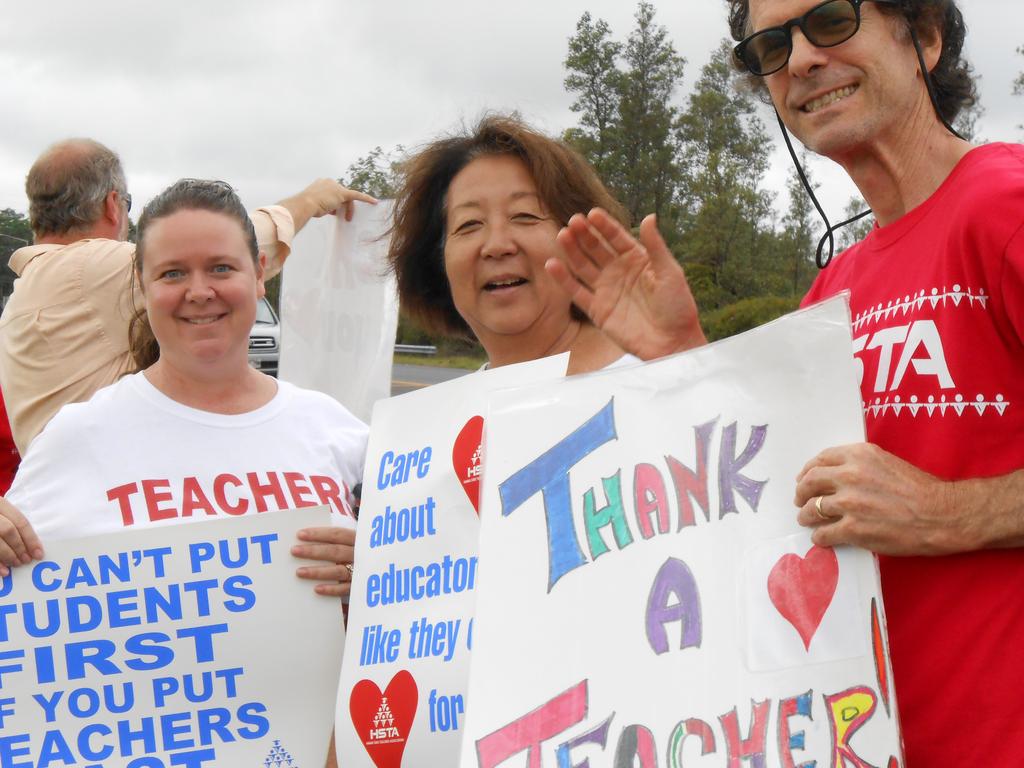
Pahoa teachers sign-waving as part of the Work to the Rules campaign.
Susan Kay Anderson
The first revelation was that policy makers do put time, effort, research, and much thought into their decisions. Honestly, as a teacher, I didn’t see that. Changes felt sudden and sometimes impulsive. Yet on this task force, I heard about the data that was previously pored over and analyzed, the expert opinions that were sought out, and the critical questions that had been asked. The one crucial piece missing had been consulting meaningfully with teachers.
Another revelation was our different mindsets — teachers think about the group of children in front of them, while policy makers think about the thousands of children they have never met.
During that task force meeting, I passionately talked about the number of factors that affected my students’ achievement — one boy was homeless, a girl had chronic absences, and another was going through a transition while his parents went through a divorce. Then I was gently reminded to look at the growth of my class as a whole. Margins of error were built into the system; a system designed for overall student growth and achievement.
The truth is, we need both perspectives. Teachers need to understand the intentions and goals of decisions that are made, and policy makers need to understand how those decisions are really impacting teachers and their students.
Most importantly, I left that meeting knowing that policy makers do listen. There is no voice stronger or more genuine than that of a teacher. As I talked about my children, I saw that they began putting faces and hearts to the numbers on their charts. They may not have made changes in policy that day, but this past June, after a year of feedback on the EES from many teachers and principals, significant changes were made. We are being heard.
I truly believe that for successful education reform to take place, we need to stop the “them” versus “us” mentality.
Don’t we share the same goal? What do we want for our students?
At the beginning of this school year, our Kaimuki Complex Day ended with a 2014 Kaimuki High School graduate, Jade Yim Pham, sharing how her experiences at Palolo Elementary, Jarrett Middle, and Kaimuki High School helped shaped her. Jade, who immigrated to Hawaii when she was 3 and overcame many heart-wrenching struggles, is now heading to Corban University, expense-free. She received over $100,000 in scholarships and is entering a special scholars program with 22 credits.
In Jade’s speech, she brought me to tears with these words, “…school was the one place I felt like an awesome kid because of my teachers who believed in me…Thank you to Palolo Elementary for being my light and encouraging me to achieve success…Jarrett provided the most safe and supportive environment I had experienced yet…. our teachers persevered to challenge us to strive for the highest…Kaimuki High School provided me the opportunities to grow as an individual and as part of a community…At Kaimuki, I discovered a home away from home.”
This is where the conversation with policy makers needs to start. With our precious Jade and all those like her, who achieved great success with the help of great teachers, because really, isn’t this our common goal? Policy makers may be armed with numbers and research, but teachers are armed with real stories and are the key to real answers.
Policy makers need those stories to make sound decisions based on the realities of teaching. And although they need to think about the “big picture” and improving the system as a whole, they also need our individual children on their conscience.
A lot has changed since that February 2013 meeting. With the recent creation of teacher leader positions, work groups, and the Hope Street Group fellowship positions, I believe that policy makers are ready to really listen to us. Teachers, let’s start talking.
 GET IN-DEPTH
REPORTING ON HAWAII’S BIGGEST ISSUES
GET IN-DEPTH
REPORTING ON HAWAII’S BIGGEST ISSUES
Community Voices aims to encourage broad discussion on many topics of community interest. It’s kind of a cross between Letters to the Editor and op-eds. This is your space to talk about important issues or interesting people who are making a difference in our world. Column lengths should be no more than 800 words and we need a current photo of the author and a bio. We welcome video commentary and other multimedia formats. Send to news@civilbeat.org. The opinions and information expressed in Community Voices are solely those of the authors and not Civil Beat.
