Public and Private Resources: The Discrepancy
It’s possible to create a teacher-led approach to education that retains the best and the brightest.
This is the second of two parts on public vs. private school issues.
Building on Monday’s column about Learning First’s Punahou and Public Education Collaboration Day, there is clearly a discrepancy of budgets and resources between public and private education. With one in six Hawaii students in private schools, it is time to discern the reason why.
So how do both entities spend money?
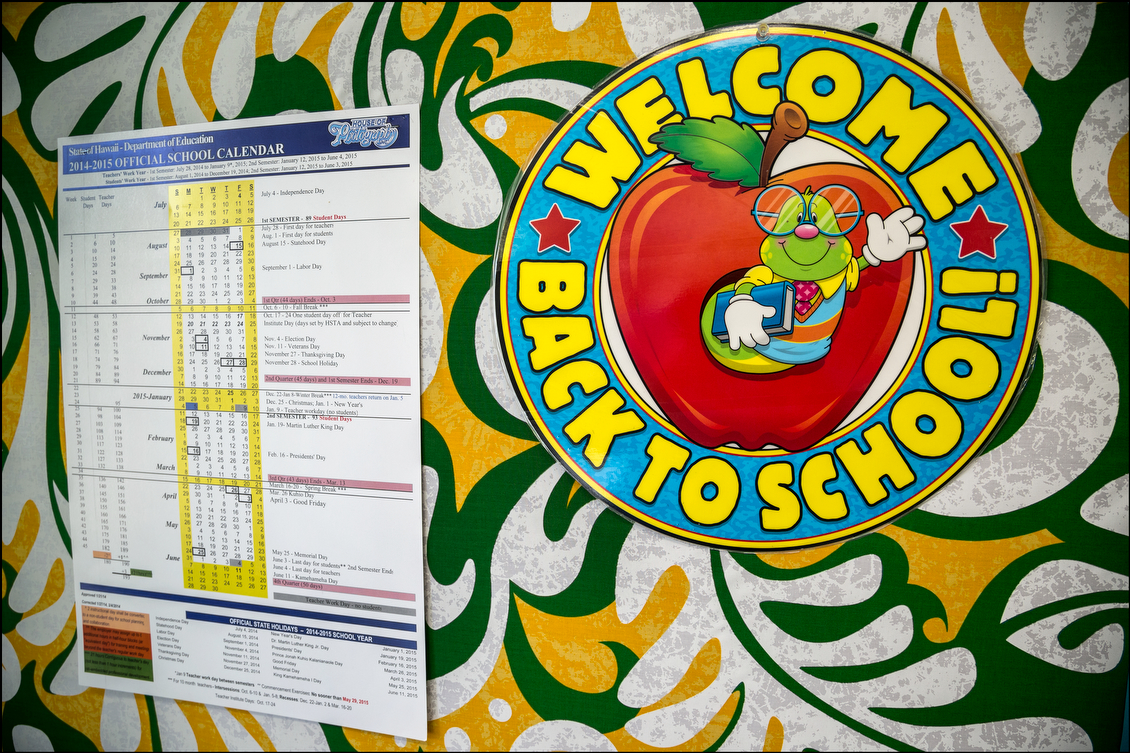
Signs in the main office at Ala Wai Elementary School on August 21, 2014
PF Bentley/Civil Beat
That’s not exactly the most transparent question to answer. According to the Hawaii Department of Education website, budgeting is broken down into six “buckets” known as “EDNs.” The EDNs are known as EDN 100, EDN 150, EDN 200, EDN 300, EDN 400, and EDN 500. The total budget is comprised of $1.7 billion from federal and state moneys, as well as from other “special funds.”
So how are these funds divvied up to support student achievement and teacher retention and satisfaction?
EDN 100 is the largest portion of the budget, with 58 percent allocated for School Based Budgeting, which includes per pupil spending of $11,924, as well as money designated for Free and Reduced Meals, JROTC, ELL programs, Athletics, and Alternative Learning Centers.
Then comes EDN 150, which comprises 23 percent allocated for special education. Utilities are in the EDN 400 and take up 12 percent of the budget for school utility bills. According to the Department’s website, “The remainder of the budget is spread among EDNs 200, 300 and 500 for expenses such as instructional supports, statewide testing, administrative support (personnel, technology and fiscal), community programs such as A+ and adult education, complex area administration, as well as the Board of Education and Office of the Superintendent.”
As a private institution, Punahou is not required to make the budget public. However, there are some numbers available and based on the general qualitative data, it is possible to draw some conclusions.
Punahou’s tuition costs $18,450 per student. All student tuitions are subsidized, with a minimum of $4,000 provided to each student from fundraising. That brings the total cost for a Punahou student’s education per year up to $22,450.
Attracting and retaining high quality teachers is a large part of the foundation of Punahou’s successful statistics. Competitive compensation and benefits program is the top in the state for educational institutions. Furthermore, teachers are encouraged and provided the freedom to create curriculum, collaborate with colleagues, and find solace in knowing that they have access to any instructional resources they feel would benefit student learning.
Additionally, a strong faculty professional development program is offered to all employees. Educators can apply for faculty sabbaticals, learning fellowships, summer curriculum grants, annual individual discretion grants, and faculty travel for participation at professional conferences.
Along with a strong faculty that is valued and fairly compensated, Punahou has made a commitment to 21st century learning through expanding its technology availability and use. Punahou’s One to One Computing Program has partnered with Apple, Lenovo, and the Global Online Academy to ensure that students have access to classes anywhere, anytime. Teachers can upload 100 percent of the curriculum to distribute to students electronically. Punahou has successfully created a “Green” campus that saves money on paper and ink, and ensures that teachers utilize their time for meaningful planning and assessment instead of copy machine jams.
What’s more, all of Punahou’s buildings and facilities are air conditioned, up to date technologically, and furnished to foster student collaboration and comfort.
Given the qualitative data, it would appear that the public education budget in no way reflects a commitment to teachers and students as that of Punahou’s.
Punahou recognizes itself as a “private institution with a public purpose.” The administration and faculty welcome public education collaboration, though they would like it to be clear that they don’t have all of the answers, but they do have a model that supports students and faculty.
Public teachers that joined in on the experience that Learning First and Punahou educators created would like to create a statewide initiative called “The Punahou Model.”
There are many factors to consider, yet it is possible to restructure the education budget, reform Hawaii’s tax system, and create a teacher-led approach to education that retains the best and the brightest through competitive compensation and meaningful professional development, while fostering high student achievement for Hawaii’s keiki.
 GET IN-DEPTH
REPORTING ON HAWAII’S BIGGEST ISSUES
GET IN-DEPTH
REPORTING ON HAWAII’S BIGGEST ISSUES
Community Voices aims to encourage broad discussion on many topics of community interest. It’s kind of a cross between Letters to the Editor and op-eds. This is your space to talk about important issues or interesting people who are making a difference in our world. Column lengths should be no more than 800 words and we need a current photo of the author and a bio. We welcome video commentary and other multimedia formats. Send to news@civilbeat.org. The opinions and information expressed in Community Voices are solely those of the authors and not Civil Beat.