

Cloud Over Hawaii: The Need for Truth and Reconciliation
Living under a cloud of resentment can never be good for us. In the end, resentment is self-destructive.
There’s a cloud hanging over Hawaii – the weight of history. Over 100 years ago, the Hawaiian nation was subverted and destroyed. Hawaiian culture (not to mention Hawaiians themselves) was nearly wiped out and probably would have withered away had it not been for the Hawaiian renaissance of the late 20th century.
Native Hawaiians have not been the only ones to suffer in Hawaii, however. Asian immigrants later experienced their share of racism and social exclusion. Most of Hawaii’s Asian immigrants and their descendants were only able to improve their circumstances over the course of half a century.
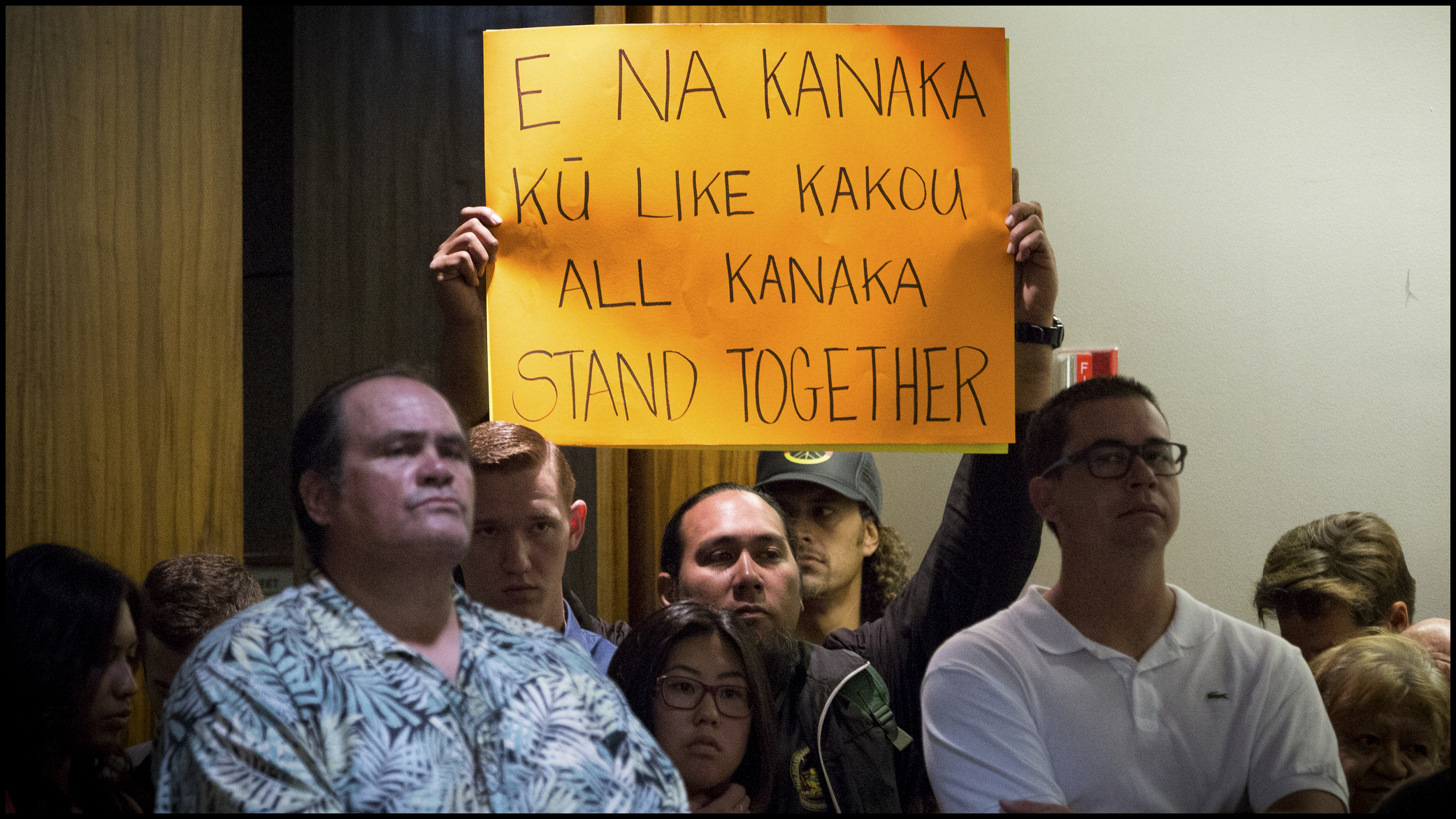
Concerns are raised at Interior Department hearings on whether the U.S. should establish a government-to-government relationship with Hawaii’s indigenous community, June 2014.
PF Bentley/Civil Beat
Why is this past suffering relevant? It is relevant because in many cases its effects are still with us today; they linger in the form of the relatively low socio-economic status of many Native Hawaiians, for example.
Past injustices are not only relevant for their direct economic, social and political effects, however. They are also relevant, in my view, because their effects linger in the form of resentment. Even some of the offspring of the purported perpetrators of past injustices seem to feel resentment; whether justified or not, they may feel unfairly accused.
Resentment feeds resentment. Yet we need to face the future squarely by dealing with the past, no matter how painful it may be. As Peter Apo says in a recent column in Civil Beat: “Until there is closure to the Hawaiian question, Hawaii can never be whole.”
The purpose of this article is not to find fault with any particular group or individual. Much of that ground has already been covered, even if redress has been incomplete, insufficient or non-existent, in many cases. The purpose of this article is instead to point out that living under a cloud of resentment can never be good for us. In the end, resentment is self-destructive.
That’s why I would like to propose that Hawaii establish a “Truth and Reconciliation Commission” led by unifying figures and representative of all the people of Hawaii. Much as was done in South Africa and is being done in Canada, the purpose of this commission would be to unearth the truth, but to do so in such a way that there can be space for reconciliation, and perhaps even forgiveness.
This is not a New Age pipe dream. Reconciliation could have many tangible – and perhaps even immediate – benefits. It might lead to greater cohesion in our community, which in turn could enable us to solve practical problems such as the lack of affordable housing, limited economic opportunities and transportation gridlock.
On an individual level, reconciliation could release the huge amount of negative energy that I feel is currently locked away within many people, and within Hawaii as a whole. Harboring feelings of anger or resentment consumes enormous amounts of energy – energy that could be better spent in moving us all forward.
In proposing that people let go of resentment, I do not mean to dismiss the pain and suffering of any individual or group. Nor am I proposing that they give up their fight for justice, far from it.
I do believe, however, that we need to “clear the air” and try to work together rather than continually fighting each other. Truth and reconciliation could afford people a degree of closure and healing, and in the process release a wellspring of positive and creative energy. Given all the challenges we face, isn’t this exactly what we need right now?
 GET IN-DEPTH
REPORTING ON HAWAII’S BIGGEST ISSUES
GET IN-DEPTH
REPORTING ON HAWAII’S BIGGEST ISSUES
Community Voices aims to encourage broad discussion on many topics of community interest. It’s kind of a cross between Letters to the Editor and op-eds. This is your space to talk about important issues or interesting people who are making a difference in our world. Column lengths should be no more than 800 words and we need a current photo of the author and a bio. We welcome video commentary and other multimedia formats. Send to news@civilbeat.org. The opinions and information expressed in Community Voices are solely those of the authors and not Civil Beat.
