NextEra: An Evening With the Illusionist
Like the movie, we are still seeing the magician on stage but in fact he has already left the building.
About 50 Molokai residents gathered last Thursday night at Kaunakakai School, looking for answers about our energy future. The occasion was a “meet and greet” with officers of NextEra, the Florida utility giant which is poised to buy out the HECO companies.
What we got was a crash course in flimflam and warm, fuzzy nothings. What we got was three hours of “truthiness” and retractable commitments. What we got was the last scene from the “The Illusionist,” where you are still seeing the magician up onstage, but he has already left the building.

PF Bentley/Civil Beat
The evening started badly because NextEra had removed all the chairs from the room. Evidently, the latest manipulation manuals stress keeping people moving, allowing only one-on-one interactions, and no public questions. Six or seven perky NextEra lieutenants were present in company shirts, assigned to chat congenially with each resident.
The room was lined with glossy posters, promising lower rates, clean energy, a radiant future, and true love. There was also the usual conspicuous commitment to “kuleana, malama, and pono,” those magical Hawaiian incantations which every bidder in the Hawaiian market is now professionally trained to display and pronounce.
Sensing our discomfort, Mr. Walter Ritte gathered the residents together and demanded a public question and answer format. A token table was pulled out for kupunas, and nervous Maui Electric Co. employees stepped up to moderate our questions.
NextEra CEO Eric Gleason then showed why he gets the big bucks. For 2 ½ hours he swatted away 50 different versions of the question, “What are your plans?”
Bobbing and weaving, engaging with each questioner, Mr. Gleason managed to tap dance his way through the entire evening without making a single commitment or revealing any specific plans. It was a bravura performance — except perhaps for those rare moments when he let his sincere contempt for everyone in the room show through.
At times Mr. Gleason appeared to be listening; at times he even seemed interested in dialogue; yet most of us were left feeling confused and unsatisfied, as if we’d been chasing a mirage, or sparring with a ghost.
It should be noted that the MECO employees who were present made every effort to continue their ongoing discussions with the Molokai community. They tried repeatedly to interject real answers. Mr. Gleason pushed them forward whenever it got hot, saying “their plans are our plans.”
It remained crystal clear, however, that NextEra will call the shots, and that, within NextEra, Mr. Gleason is The Great Dictator. (He called on one of his lieutenants only once; otherwise their role seemed to be purely decorative.)
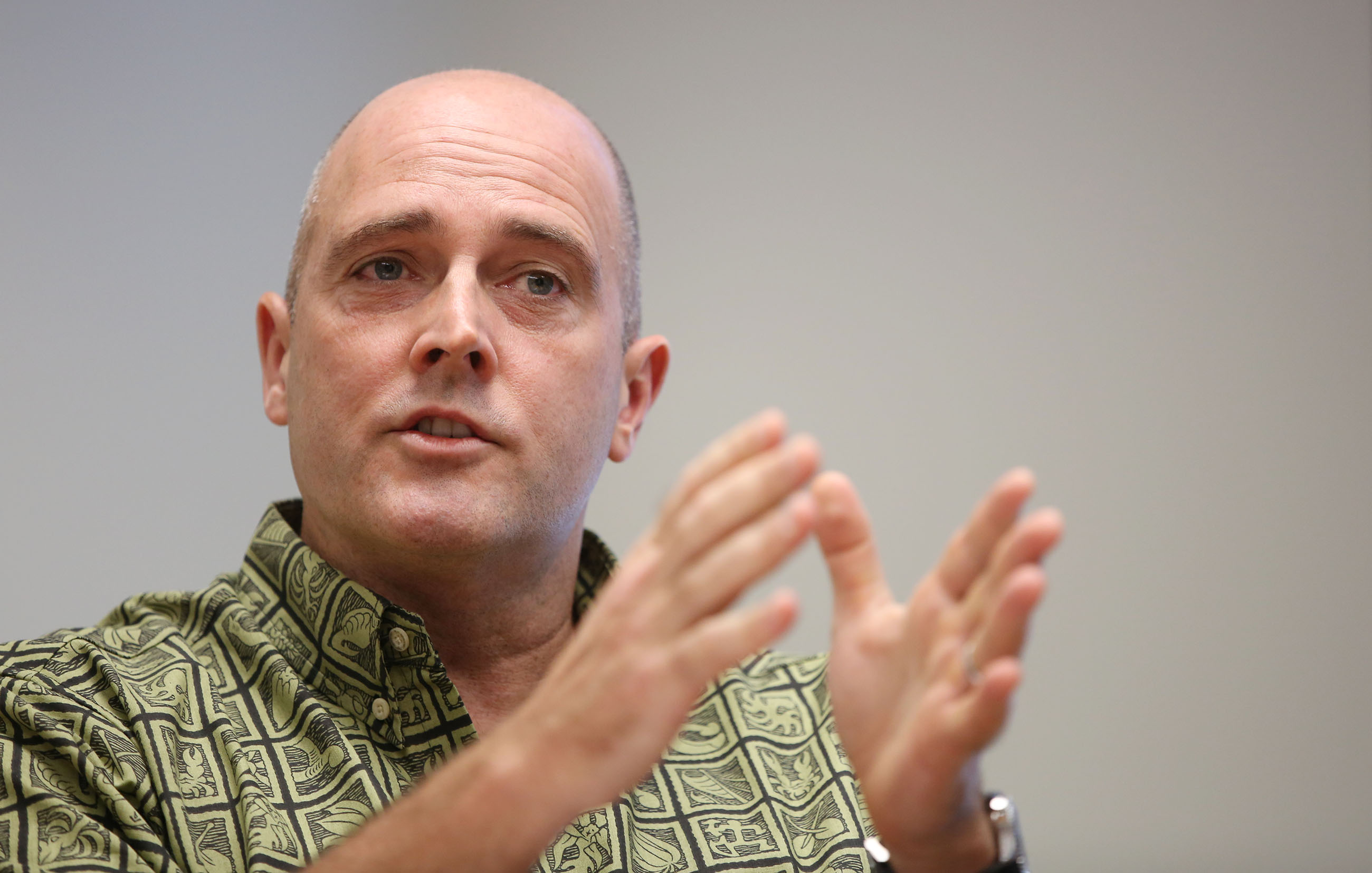
NextEra Energy President Eric Gleason speaks to Civil Beat’s editorial board, December 2014.
Cory Lum/Civil Beat
The one quite alarming truth to emerge from the meeting is that MECO has no better idea what NextEra is really going to do than the rest of us.
The NextEra we met could be the poster child for the dilemmas of regulation.
The concept of regulation is fairly simple: If electricity is a natural monopoly, then government needs to monitor that monopoly, ideally creating “the equivalent of competition” to insure quality, efficiency, affordability and customer service.
In practice, however, utilities typically work to “capture” the regulator, so they can enjoy the best of both worlds: captive customers and guaranteed profits on the one hand, and the right to keep secrets, cherry-pick opportunities, and evade expensive long-term investment on the other. When they want something, they petition government; when we need something from them, they become a private company, responsible only to their shareholders.
NextEra is clearly a master of the regulation game. Conspicuously missing from Mr. Gleason’s performance was any sense of responsibility, accountability, or even any real interest in the electricity business. He is here to make money, plain and simple; the details he will delegate to others.
He is taking over an old, politically entangled utility, with much obsolete and even dangerous plant and equipment, which is now being asked to re-invent itself. Yet he said nothing about bringing HECO up to industry standards, or about employee safety. He mentioned renewables a hundred times, yet he shared no ideas about the specific challenges facing our state. He showed no interest in exploring renewable options for Molokai. He dismissed with a quibble a proposal to use Molokai as a laboratory for innovation. He thought a Maui/Oahu cable could work, but didn’t seem to care one way or the other.
State leaders have been impressed with NextEra’s financial strength – something Mr. Gleason mentions again and again. No doubt our representatives are thinking of all the good things NextEra could do for us with all that money.
To the Molokai residents in the room, however, it seemed clear that NextEra is not here to give and spend, but to take. NextEra has read correctly that our commitment to 100 percent renewables makes Hawaii a great spot to fish for “green energy” tax credits; they have read correctly that customers used to paying 50 cents a kilowatt will demand very little of their utility; and they have read correctly that our PUC lacks the staff and resources to effectively monitor a corporation of their size.
The tragedy here is that, at least on Molokai, MECO has been doing a pretty good job of transforming themselves into “public servants,” who are ready and willing to work with the community to meet our energy challenges. Putting MECO under NextEra’s thumb will halt that progress, and roll the clock back to the days of self-serving monopoly. Mr. Matt Yamashita stated the basic issue, when he said that this buyout will close off Hawaii’s unique opportunity to meet our energy challenges in our own way.
 GET IN-DEPTH
REPORTING ON HAWAII’S BIGGEST ISSUES
GET IN-DEPTH
REPORTING ON HAWAII’S BIGGEST ISSUES
Community Voices aims to encourage broad discussion on many topics of community interest. It’s kind of a cross between Letters to the Editor and op-eds. This is your space to talk about important issues or interesting people who are making a difference in our world. Column lengths should be no more than 800 words and we need a current photo of the author and a bio. We welcome video commentary and other multimedia formats. Send to news@civilbeat.org. The opinions and information expressed in Community Voices are solely those of the authors and not Civil Beat.