

Curt Sanburn: My Trip to Paris
A museum show honoring French architect Le Corbusier provokes a few thoughts — and some news — about Honolulu’s evolving housing stock.
City apartments get used many times. They hang around. Someday, people who aren’t born yet will live in them. They’re just rented, even when they’re owned. For the long term then, Honolulu’s apartment buildings should be durable and humane places.
These were my thoughts as I explored Paris recently, marveling at the worn marble stairs and thresholds everywhere, and then as I wandered through the exhibition “Le Corbusier: Measures of Man” at the Pompidou Center. Presented on the 50th anniversary of the architect’s death, the rigorous, didactic show collects building models, paintings, sketches and writings of the prolific Le Corbusier (1887-1965), the man who has been called “The Architect of the 20th Century.”
Born Charles-Edouard Jeanneret in the Jura mountains of Switzerland, Le Corbusier, as he came to call himself, was perhaps the most influential (and most controversial) visionary and innovator in modern architecture. Early in his career he seasoned himself working for master architects like Josef Hoffman of Vienna, Auguste Perret of Paris, and Peter Behrens of Berlin. He visited monasteries in Tuscany and Greece that profoundly affected his notions of domestic simplicity, beauty and order.
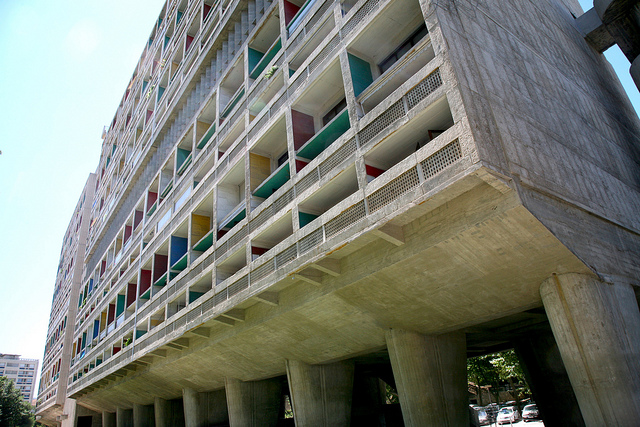
Unité d’Habitation in Marseilles, France, designed by the legendary Le Corbusier.
Vincent Desjardins via Flickr
A polymath, Le Corbusier was dazzled by the 20th century’s triumphant engineers and their streamlined works of the Machine Age — the automobile, the airplane, the steamship, the factory — at the same time that he advocated for better living standards for Europe’s urban masses. He envisioned ranks of soaring apartment towers set in park-like landscapes laced with speedy motorways to supplant the clotted streets and putrefaction of Europe’s ancient capitals. (It was a vision that proved to be his most imitated — and worst — idea.) “Architecture or revolution” was just one of his slogans.
On the gallery walls at the Pompidou, visitors silently study drawings, paintings, photographs and ephemera — sketches of the Acropolis, renderings of flat-roofed and stacked complexes of housing for factory workers featuring large outdoor spaces; photographs of brazenly stripped-down suburban villas rendered in white stucco with horizontal ribbon windows (in the 1920s!); a wooden model of the large, reinforced-concrete apartment house, Unité d’Habitation in Marseilles, its facade a syncopated beehive of grids and voids.
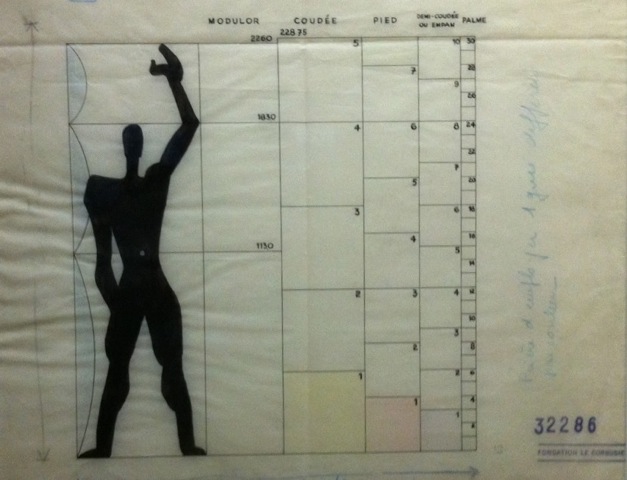
An example of Le Corbusier’s iconic “Modulor” or “Modular Man,” photographed in Paris. It represents an average human figure scaled to the architect’s own system of measures.
Curt Sanburn
Repeated, larger-than-life renditions of the primitivist “Modular Man” dominate the show: A sinewy, exultant male figure with one arm raised, in wood relief, or sketched or painted and marked up with colored geometric notations and calculations. The graphic expresses Corbusier’s system of measurement scaled to the average human figure, an update on Leonardo da Vinci’s Vitruvian man.
The exhibition catalogue says of the Modulor, “It is through the prism of this body — the human figure, measured in its corporality, but also in its perceptive and spiritual dimensions — that the exhibition proposes to reread the Corbusian work.”
Human, humane, Honolulu? I wonder about the human and spiritual dimensions of the so-called Ward Village in Kakaako, or is it just a mirage, a financial instrument “designed” to house offshore money safely?
The mind-boggling fact is that, right now in Kakaako, with all its construction cranes and plans for almost 30 towers, there’s just one fancy condo tower and one low-income tower going up that have any real cross-ventilation built into them; that take advantage of the trade winds to cool themselves; that give buyers and renters an outdoor room, a lanai, Hawaii’s most elemental and humane contribution to world architecture.
For the rest of it, according to several sources, the state-controlled district is on track to become a forest of hermetic glass boxes — with dank, chilled insides, barely opening windows, enclosed hallways, and the rest — that people will have no choice but to live in for a long time. It’s a premeditated crime when such a massive and taxpayer subsidized district, dedicated to housing thousands in the middle of Honolulu, denies most of its eventual tenants access to fresh air and the energy savings that come with it, never mind an enduring social contract.
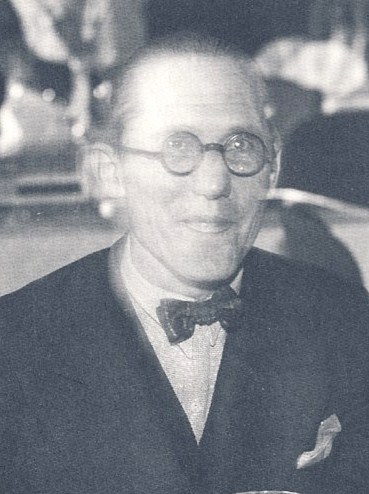
The architect Le Corbusier in Stockholm, Sweden, 1933.
Unknown via Wikimedia Commons
In the post-war period steel was still scarce, so Corbusier switched gears and rendered Unité in rough-cast concrete, an economy that launched the so-called “Brutalist” style in architecture worldwide. (Honolulu’s examples include the glowering, lava-like stoniness of the Bank of Hawaii headquarters on Bishop Street, circa 1968, and the bland Prince Kuhio Federal Building at the foot of Punchbowl Street, circa 1977.)
The 17-floor Unité, with its 337 apartments, features an extremely inventive and difficult to explain arrangement of two-floor units that span the width of the monolithic slab. The program allows for views of both the Mediterranean and the distant Alps from the same apartment … and robust cross ventilation. (The scheme guided architect Cesar Pelli when he drew up plans for Honolulu’s landmark Ala Wai Plaza complex at 500 University Avenue in 1970.) Double-height living rooms, deep loggias (lanai), and open-plan kitchens are other welcome features designed into the Unité.
Anticipating today’s mixed-use apartment complexes by 60 years, Unité’s program also includes an interior shopping corridor or “street” whose exterior slatted brise-soleil, or sun screen, expresses its presence in the building’s otherwise gridded facade of lanai spaces. Corbusier observed the facade looked like a bottle rack. On Unité’s roof the architect put a kindergarten, a running track, a gymnasium and a theater, each element encased in glass and sculptural cast concrete, whose raw imperfections the architect likened to human skin.
Often imitated but never matched, the Unité, in all its 60-year-old stolidity, remains a durable and desirable living machine — and a touchstone for the rest of the rapidly urbanizing world as we figure out how to house billions efficiently.
Cross Ventilation: A Tropical Adaptation
The one naturally ventilated luxury condo tower going up in Kakaako is called the Vida 888, a 39-story, 262-unit, angled slab-on-a-pedestal on the mauka side of Ala Moana Boulevard at Koula Street.
The glassy building, its facade activated by the abstract patterning of its deeply incised lanai, is all about the views. It’s single loaded; that is, all the units face makai, with elevators and exterior corridors facing mauka, like many older Honolulu apartment buildings. Units are individually air conditioned but also have entry doors opening onto one of the building’s exterior hallways, which are, in turn, connected to exterior stairwells. Operable awning windows (an abbreviated update on the jalousie) are provided in all mauka-facing rooms. Vida’s two- to three-bedroom apartments range in price from just below $1 million up to $4 million.
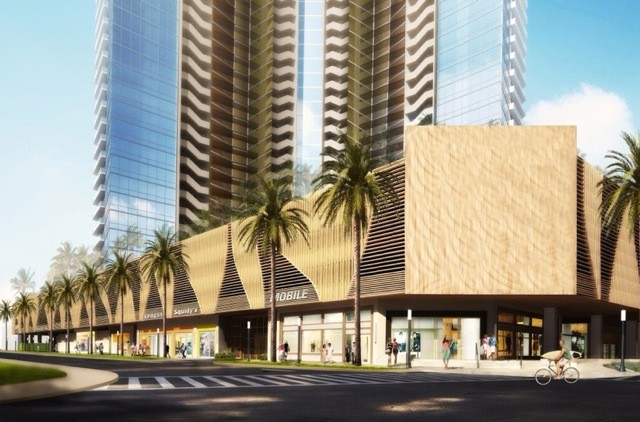
The Vida 888’s mauka facade displays the exterior hallways and stairwells that let the building and its inhabitants breathe.
Developed on former Kamehameha Schools land by a team of very busy kamaaina developers, the Kobayashi Group and the MacNaughton Group, the building was drawn up by its design architect, Bernardo Fort-Brescia of Arquitectonica of Miami.
In a phone interview, Fort-Brescia tells me he toured Honolulu and noticed how the older apartment towers “have those exterior walkways, but the newer, later buildings have been much more conventional with no tropical adaptation.”
He explains that his Miami-based international firm Arquitectonica has been exploring the mechanics of cross ventilation in tropical locations where the firm is active for some time. “Europeans and South Americans don’t like air-conditioning,” he says. “They want to feel the warmth. They love breezes.”
When Kobayashi/MacNaughton came to him with the Vida project, he told them that the project was an ideal candidate, that “instead of a double-loaded, traditional tower with an interior hallway, we should build something that has cross ventilation, a single-loaded building.” He got the OK.
We talk about the Unité d’Habitation and Cesar Pelli’s Ala Wai Plaza, and the influence that Corbusier had on Pelli.
“We lived in that era,” Fort-Brescia says, recalling his days at Harvard graduate school, “when we all admired the early modern movement. It was a complete movement with a social purpose and a functional purpose. Nothing was gratuitous, there was nothing you could not explain in functional terms or in environmental terms. Everything was designed for comfort and pleasure of a place. … It was not about shapes, ever.”
It should be a given that the people building our environment right now, our future homes, are making humane places for us to live. But for the most part they’re not. Texas-based developer Howard Hughes Development Company is shamelessly building an entire landscape of hermetic residential towers. The state and city seem to be allowing it to happen.
Is Kakaako ever going to be a community? If it’s true that Kakaako’s existing towers are operating half empty most of the time, as I was told by someone who knows these things, then the answer would have to be no.
The tide may be shifting. While I was in Paris, the board of the Hawaii Community Development Authority, the state agency that oversees Kakaako development, announced that it had chosen a developer, New York-based Bronx Pro Group, for a 17-floor, low-to-moderate -income rental tower at 630 Cooke St. containing 104 “micro units” of 300 square feet each.
The prefabricated units are arranged into two separate stacks for maximal activation of the site in all directions. Natural ventilation, a lanai, and passive day lighting and sun screeening technologies are built in. Modeled after similar projects in Seattle and San Francisco, the plan will, according to the HCDA board’s statement regarding its choice, “transfer innovative and replicable design and construction methods as a new building typology for Honolulu.”
For a period of 65 years, most units will rent for $750 per month, a rate made available to qualified customers earning up to 60 percent of the median Honolulu income, which translates to about $40,000 for a single person. Five apartments will be available at $345 per month for those residents who earn no more that 30 percent of the median Honolulu income, or $20,000.

