

Marshall Islands Put on Typhoon Formation Alert
The capital of Majuro looks like “a war zone,” says the republic’s foreign affairs minister. “Roofs torn off, huge blackout, ships ashore.”
The United States joint Typhoon Warning Center has issued a “typhoon formation alert” for the Marshall Islands, “saying a tropical typhoon is building between Majuro and Kwajalein, the two most populated atolls in the nation,” according to this report from Radio New Zealand International.
The center has warned boaters of hazardous surf conditions “that will coincide with a rising spring tide cycle resulting in coastal inundation of up to two feet along south and west facing shores on Majuro, Jaluit and Mili atolls through Saturday evening.”
The Republic of the Marshall Islands, population about 54,000, is located about 2,400 miles southwest of Hawaii. Many of its citizens migrate to live and work permanently in the United States under a 1986 treaty called the Compact of Free Association.
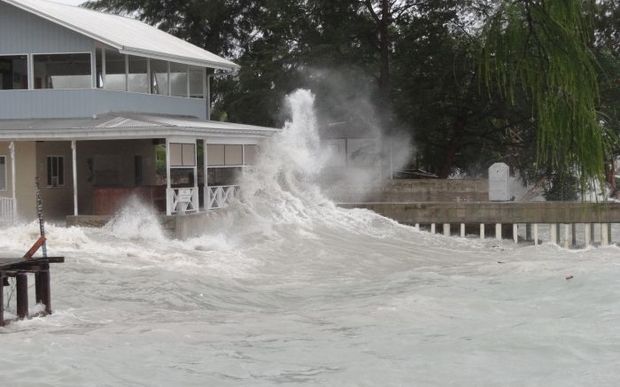
A shoreline bar and store on Majuro is blasted by high waves kicked up by a tropical depression that was building to typhoon strength July 3 in the Marshall Islands. The waves caused major damage to the capital atoll’s three-mile downtown lagoon shoreline.
RNZI/Giff Johnson
Kwajalein is home to the Ronald Reagan Ballistic Missile Defense Test Site, which typically employs several thousand Americans.
The Marshall Islands “is an isolated, sparsely populated, low-lying Pacific island country consisting of approximately 70 sq. miles of land spread out over 750,000 sq. miles of ocean just north of the equator,” says the U.S. State Department. “These characteristics make it vulnerable to transnational threats, natural disasters, and effects of climate change.”
Tony de Brum, the RMI’s foreign minister, tweeted the following Friday midday Hawaii time:
Just landed home. Majuro like a war zone. Roofs torn off, huge blackout, ships ashore. On alert for more tonight. TdB pic.twitter.com/nFpi1je6LH
— Tony de Brum (@MinisterTdB) July 3, 2015
De Brum has been making many public warnings about how the Marshalls are highly vulnerable to rising sea levels and superstorms that may be caused by climate change.

