The Public Has a Right to Know How Government Decisions Are Made
A judge ruled that officials don’t have to let the public in on their thinking behind important policy decisions. But that’s not what our public records law envisioned.
Where the public’s money and interests are at stake, doesn’t the public have a right to know what considerations public officials are taking into account in making significant government decisions?
We think so. In fact, we think it’s a principle worth fighting for. That’s why we went to court this week to challenge the Caldwell administration’s refusal to release memos sent to the mayor by city agency heads justifying their budget requests for fiscal year 2016.
But a Circuit Court judge ruled on Tuesday that some records are, in effect, none of the public’s business. While not taking a stand on the city budget documents, Judge Virginia Crandall determined that state and local agencies are allowed to keep “predecisional or deliberative” documents secret, because revealing them might lead to “frustration of a legitimate government function.”
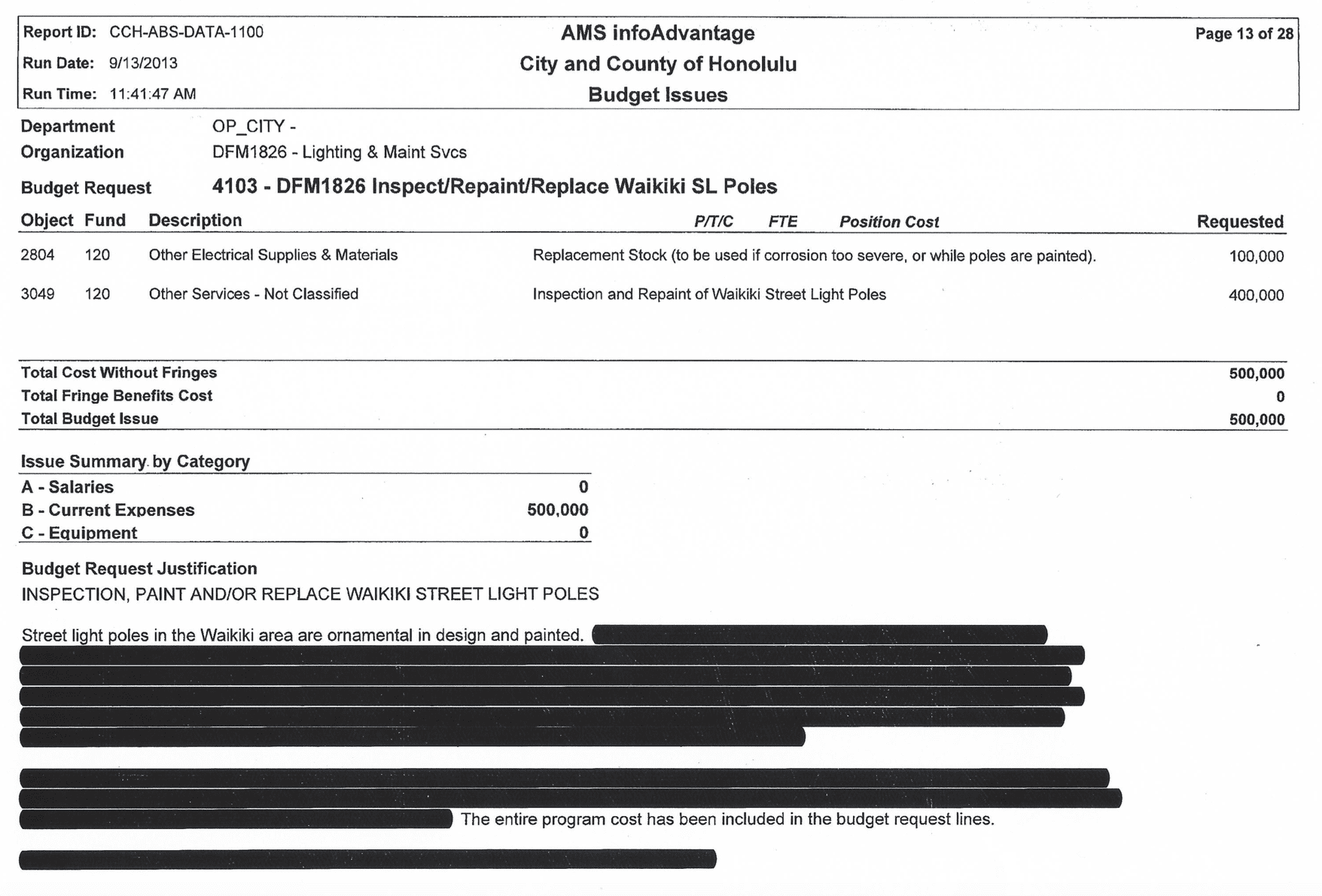
In this example of a “predecisional” budget document, the city has redacted nearly nine lines of a 10-line justification for $500,000 to inspect, repaint and replace streetlight poles in Waikiki.
Civil Beat Files
State law mandates that most information in government offices should be open to public review. But for more than a quarter century, the Hawaii Office of Information Practices has borrowed a principle from federal law — the “deliberative process privilege” — to keep information out of the public’s hands that is often necessary to understand how government works.
That principle isn’t included in state law, though it appears briefly in the original draft of the Uniform Information Practices Act, Hawaii’s public records law. Legislators later removed it before passing the law, proclaiming that in Hawaii, “the formation and conduct of public policy — the discussions, deliberations, decisions, and action of government agencies — shall be conducted as openly as possible.”
Hawaii’s not alone in rejecting the federal deliberative process privilege. Numerous other states have eliminated or severely restricted the government’s ability to withhold information simply because it is part of a pre-decisional discussion.
The OIP has wrongly undermined the public records law, Civil Beat argued Tuesday, with an interpretation of the UIPA that, in effect, adopted the deliberative process privilege. For years now, that interpretation, which Crandall affirmed on Tuesday, has been used to keep even mundane information under lock and key.
What sort of information are we talking about? For fiscal year 2015, the city’s fire operations department requested $1.9 million for restoration of a “non-holiday pay budget cut.” Why? It’s hard to say. The justification for that request in the “predecisional” paperwork that city officials ultimately provided was mostly redacted, save for the idea that “relations with the Firefighters union have severely limited the (Honolulu Fire Department’s) ability to train our personnel without incurring overtime costs.” Huh?
Government that seeks the trust of the people must earn it. Transparency in process is essential, and not just as it pertains to final decisions and outcomes.
In that same budget year, another city department requested $178,400 for “inspection of welds and anchor bolts on ballfield light poles.” Of the roughly eight lines of budgetary justification, nearly six were blacked out, leaving only basic details on the different amounts needed to inspect softball and baseball field poles around the island.
Asking for a greater level of transparency elicits a near phobic response from government lawyers.
“If the public views every idea that’s suggested by anyone in the government then people would be reluctant to give ideas,” declared Honolulu Deputy Corporation Counsel Derek Mayeshiro in court on Tuesday.
Added Deputy State Attorney General Dierdre Marie-Iha, whose office joined the city and county in an amicus brief, “Is decision making a legitimate government interest? Yes. Will it be hindered by placing deliberations in a fishbowl? Yes.”
Their concerns seem to be driven by an idea, left largely unexplained on Tuesday, that allowing the public greater access to the machinations of government would place government workers under such a degree of criticism and stress that creativity and brainstorming would cease; they’d be unable to do their jobs.
It’s an argument that understandably carries little weight with Brian Black, executive director of the nonprofit Civil Beat Law Center for the Public Interest, which represented Civil Beat in the matter.
“We shouldn’t have this situation where government agencies are allowed to withhold records simply because they want to avoid scrutiny,” said Black.
Civil Beat, of course, will appeal Crandall’s ruling on the deliberative process privilege.
We disagree with the city, the state and OIP that government decisions shrouded in secrecy somehow make taxpayers feel better and government operate more efficiently.
Government that seeks the trust of the people must earn it. Transparency in process is essential, and not just as it pertains to final decisions and outcomes.