Curt Sanburn: The Most Beautiful Church in the World
How a renowned Boston architect and a Honolulu pastor worked out their differences to create the Central Union Church — and Hawaii’s own Colonial Revival masterpiece.
As a kid, I spent a lot of Sundays inside Central Union Church on Beretania Street, that grandly steepled monument to New England’s Congregationalist missionaries and everything they wrought in Hawaii.
Dr. Crosby’s sermons lasted a long time, so I’d find myself looking up at the Roman barrel vault high above the altar with its painted sky-blue panes framed in white coffers. Or I’d ponder the simple trefoil cross rendered in white painted woodwork with the church’s motto, “Love Never Faileth,” carved in gold just above it. I’d study the palm fronds and little pineapples carved into the elaborate Corinthian capitals atop the 12 great columns that hold up the sanctuary — order, simplicity, beauty.
Meanwhile, through the always-open side doors and the arched paned-glass windows above them, the Manoa clouds, blue skies and sunny greenery of a Honolulu morning flooded in. To my tiny, prepubescent mind, it was the most beautiful church in the world.

Curt Sanburn
Little did I know or care, back then, that the church, built in what is called the Colonial Revival style and completed in 1924, was designed by possibly the greatest American ecclesiastical and collegiate architect of the early 20th century: Ralph Adams Cram of Boston.
It makes sense — right? — that Honolulu’s only traditional colonial church was drawn by a Boston architect. Switch out the blue basalt for brick, and Central Union could be plopped down on the Boston Common with little fuss, cheek by jowl with the brick-and-white-steepled Park Street Church, circa 1810. (It was at that church that the “Pioneer Company” of New England missionaries gathered themselves and prepared for the long voyage to the Sandwich Islands in 1819.)
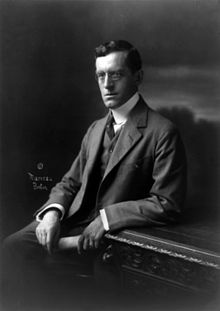
Nationally acclaimed architect Ralph Adams Cram designed Honolulu’s Central Union Church.
U.S. Library of Congress
“Boston Bohemia, 1881-1900” is the title of author Douglass Shand-Tucci’s acclaimed first volume, published in 1995, of his two-volume biography of the architect. Throughout the heavily notated 459 pages, the author takes great pains to build the circumstantial case that Cram, though married at 37 and the father of three, was in fact homosexual and, as a young man, moved in a largely homosexual circle of artists, poets and intellectuals.
Most sensationally, Shand-Tucci argues that Cram and his early professional partner in Boston, the talented draftsman and architect Bertram Goodhue, were lovers. Goodhue, of course, went on to become a great architect and graphic artist in his own right. Along with many Gothic Revival and Spanish Colonial Revival national landmarks, Goodhue coincidentally drew the iconic Honolulu Academy of Arts building in 1924, though it was not completed until after his death in 1927 by architect Hardie Phillips.
When I ask another Cram authority, Ethan Anthony, author of the monograph “The Architecture of Ralph Cram and his Office,” about Shand-Tucci’s claims, he answers dismissively and says that Cram’s granddaughter told him Cram actually had the opposite problem: Her grandfather was a womanizer, she said, “chasing them all over the country.”
Designer of Churches, Campuses
With various partners, Cram built a national reputation devising dozens of posh, Gothic Revival churches and school buildings across the country from 1882 to 1935. His firm’s first major commission was for the central campus of the U.S. Military Academy at West Point, executed in Gothic cliffs of blue-gray granite.
Cram’s stellar churches include St. Thomas Church on Fifth Avenue and St. James’ Church on Madison Avenue in New York City, not to mention the mountainous St. John the Divine cathedral, still unfinished, in Manhattan’s Morningside Heights.
Cram himself was supervising architect for Princeton University during its transformation into a Collegiate Gothic campus, now considered one of the most beautiful in America. In 1926, Cram appeared on the cover of Time magazine; at one point, his firm employed 65 architects and draughtsmen.
The Gothic Revival was a 19th-century, romantic and/or religious reaction to the pagan, classical forms of ancient Greece and Rome that had swept Europe beginning in the Renaissance through the 18th-century Enlightenment. This mega-trend is known generally as neoclassical style in architecture.
Neoclassicism was picked up in young America by influential architects like Thomas Jefferson, Charles Bulfinch and Benjamin Latrobe, and applied to churches, homes, schools, and other civic and commercial buildings by the truckload. By the late 19th century in America, it was all lumped together under the easy and inaccurate term, “colonial.”
Ralph Cram the bohemian railed against the chaste, unfeeling colonial style, which, by the 1920s, was having a distinct resurgence in the U.S., known as the Colonial Revival. In one of his many books, Cram jabbed at ecclesiastical neoclassicism: “Everything stopped after Wren,” he wrote, referring to the death in 1723 of London’s Sir Christopher Wren, architect for more than 50 churches including St.Paul’s Cathedral. “For a century and a half, religious architecture was non-existent. What our ancestors did in America was only crude imitation.”
Yet Cram’s firm obliged the demand for strait-laced colonial buildings by producing a city’s worth of them for its clients — including one Reverend Albert W. Palmer, the distant, letter-writing pastor of Central Union Church in the Territory of Hawaii.
By the year 1920, Central Union’s rapidly growing congregation decided to abandon its 31-year-old church building on Beretania at Richards Street, where the Hawaii State Capitol now stands, after downtown car and truck traffic had grown too noisy for the poorly ventilated church to abide. The Dillingham family, devoted members of the church, agreed to sell an eight-acre corner piece of its heavily gardened estate called Woodlawn, which was also located on Beretania but eastward, in suburbia, at the corner of Punahou Street.


The exchange of letters between Cram and Dr. Palmer — occasioned by Central Union’s desire for a new building and an arranged initial meeting between pastor and architect in Boston — reveals the tension that exists in any architect between pleasing clients and theological and artistic conviction. Palmer and his building committee wanted a “colonial church,” to honor Central Union’s heritage as veritable mother church for the New England missionary legacy, while Cram clearly despised Protestant, that is to say, New England, church architecture.
“Manifestly, it would be irrational to build in the midst of palms and hibiscus hedges the kind of church that would go perfectly well on the corner of Tremont and Park streets,” Cram wrote to Palmer, referring slyly to the same Park Street Church that, in fact, occupies that Boston corner.
“On the other hand,” he continued, “something of the Congregational idea must be preserved.”
After several cordial yet pointed exchanges by mail — about Palmer’s desire to build a “church in a garden,” about sight lines and the unity of minister, choir and congregation, and about the committee’s love for the spire of architect Ithiel Town’s Center Church (1812) in New Haven, the building most often mentioned as a model for Cram’s final design; and Cram’s concern about the appropriateness of holding on to the “old, and in our opinion, bad, features of Protestant architecture … for their day has passed … I don’t want to push you too far, however” — Cram and his wife traveled to Honolulu to inspect the site firsthand.
The trip persuaded Cram to line the sanctuary’s side walls with 10 sets of double French doors, “so that it became almost an open-air pavilion,” according to a church history published in 1988.
Eventually, everyone got on the same page, the final drawings were delivered, and the steel-framed sanctuary, clad in blue basalt stone quarried from nearby Moiliili, with a seating capability of 900 souls, was open for services by 1924.