Disaster: From Hurricane Katrina to Homelessness
I am a different person for having gone through Katrina. So I know Hawaii can prevail on homelessness, too.
Ten years after Hurricane Katrina I find myself thankful. Thankful, because for all the destruction that Katrina brought, I can’t look back without being reminded of the remarkable and selfless people with whom I went through the storm, and that has shaped the person I am today.
Ten years ago I was an undergraduate and part of a group of volunteer emergency medical technicians from Tulane University and the New Orleans parish that chose to respond to our community and nation’s largest environmental disaster.
We didn’t know the journey would place us directly in the path of the exodus that followed the levees breaking, or that it would take us to places as far afield as Waveland, Gulfport, Lake Charles, and countless other parishes, cities, and towns throughout the Southern U.S.

Hurricane Katrina caused massive flooding in New Orleans 10 years ago.
Kimo Carvalho
We couldn’t have known that our mass-casualty training intended to care for dozens would be used to triage, transport and treat thousands. We didn’t know that terms like “boat rescue” and “helicopter landing signals officer” would come into lexicon, let alone be added to our list of reproducible skills.
We probably would not have believed that we would briefly take over the preponderance of the 911 service for Gulfport, Mississippi, before responding to a second major hurricane, or that we would remain to help open the first wave of primary care popup clinics in downtown New Orleans weeks after the Federal Emergency Management Agency decided to respond.
We certainly didn’t know that we would be pushed to the limits of physical and emotional endurance for over 40 long and tireless days.
I am proud to have worked with a group of people who could have gone anywhere else when faced with disaster, but made the choice not to. Instead, we stayed because we had the will to drive back along empty highways into the heart of a region that many would soon attempt to write off.
When funding ran out, team members cashed in FEMA “evacuation money” intended to ease their relocation to anyplace else in order to stay in Louisiana and help others. They borrowed food from the 82nd Airborne, diesel fuel from the National Guard. They slept in private shelters, tents, and city ambulances.
Many of us including myself put off graduation, medical school, or turned down kind offers to attend other universities including University of Hawaii Manoa free of charge because the idea of leaving New Orleans and Tulane behind was simply unthinkable.
For these reasons, when I think about Katrina I don’t think about loss. I think about how a team of leaders put aside our bureaucratic protocols and pushed back against nature and the failures of man. Putting aside rules that prevented us from reaching across state, county and federal funding allowed us to make a difference and treat thousands of people in need of help when it really mattered. It was urgent and necessary for our survival. And I’m thankful for that.
As I sit in my office on a Saturday at IHS reflecting on this exact day 10 years later, I realize how thankful I am to the hundreds of government leaders, first responders, community volunteers and Disaster Response team members I had the privilege to work with.
I am a different person for having gone through Katrina. If there’s any chance that I’m better for it, it is only for having known such kind, resilient, and remarkable people during such an unimaginable time.
I can only hope that 10 years from now, I will once again say I am thankful we got through this together. Thankful and proud of the government leaders, department heads, hospital and public safety administrators, landlords, donors, public servants, and the tireless service providers who are on the front lines of homelessness each and every day. I can already say that I am thankful for the willingness to move forward and having perfect strangers who read about our news accounts provide the best possible assistance every day.
Like Hurricane Katrina, Hawaii can prevail on this. It can be further prevented. I have every bit of hope and confidence that it is possible to end homelessness and celebrate that fact another decade from now, having experienced what I did a decade ago.
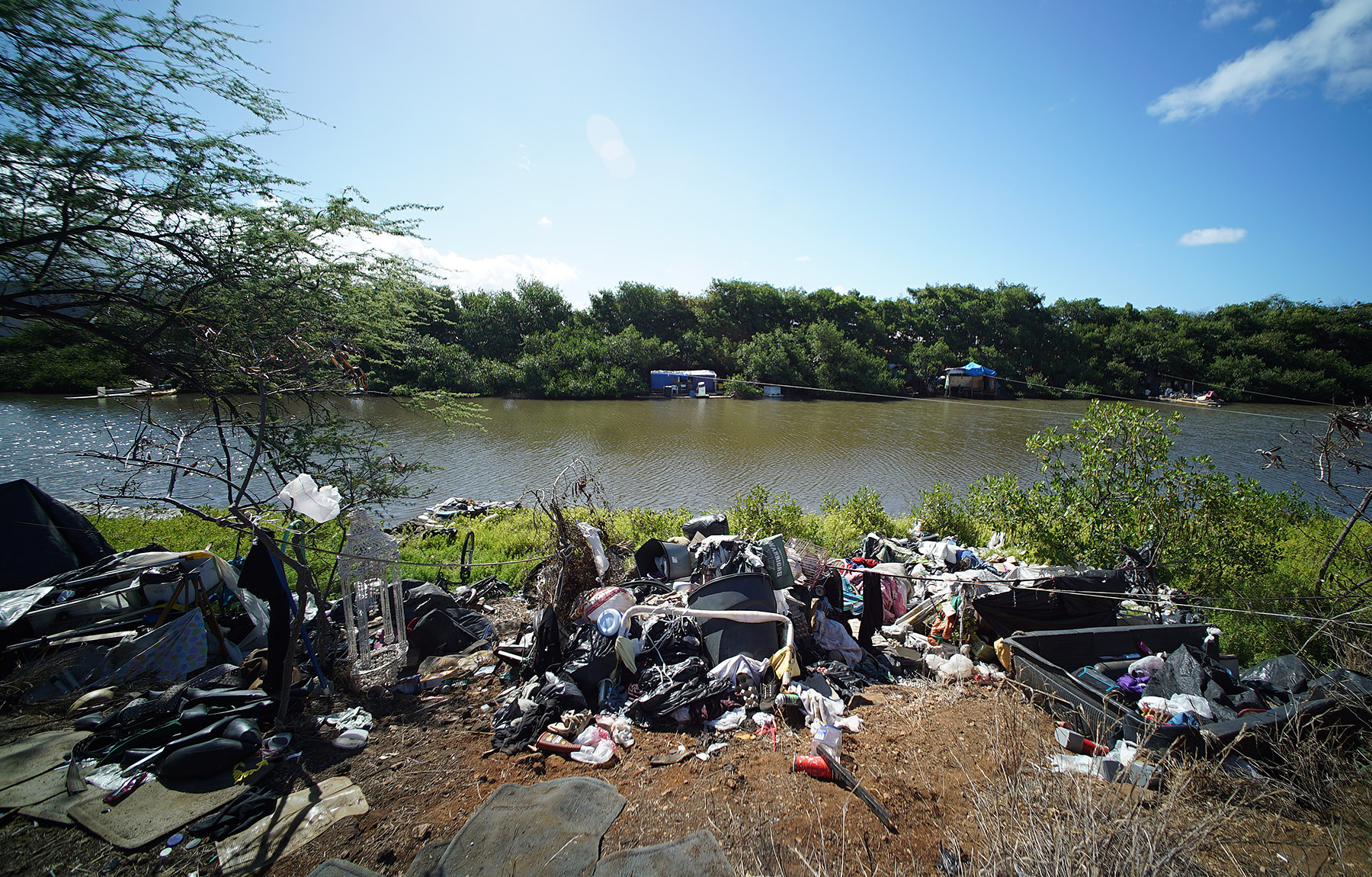
In this growing homeless camp, a handful of handmade structures are tucked along the shoreline near Keehi Lagoon.
Cory Lum/Civil Beat
 GET IN-DEPTH
REPORTING ON HAWAII’S BIGGEST ISSUES
GET IN-DEPTH
REPORTING ON HAWAII’S BIGGEST ISSUES
Community Voices aims to encourage broad discussion on many topics of community interest. It’s kind of a cross between Letters to the Editor and op-eds. This is your space to talk about important issues or interesting people who are making a difference in our world. Column lengths should be no more than 800 words and we need a current photo of the author and a bio. We welcome video commentary and other multimedia formats. Send to news@civilbeat.org. The opinions and information expressed in Community Voices are solely those of the authors and not Civil Beat.