

Ige’s Team to Relocate All Homeless Families From Kakaako by the End of Year
As the city gets ready to resume enforcement efforts in Kakaako, the governor’s leadership team is prioritizing the effort to help homeless families in the area.
Gov. David Ige’s leadership team is aiming to find shelter spaces for about half of all families now living at the Kakaako homeless encampment in the next 60 days.
Scott Morishige, the governor’s coordinator on homelessness, told reporters Tuesday that the leadership team is focusing on serving the needs of homeless families in Kakaako — with the ultimate goal of relocating all of them by the end of the year.
According to a survey conducted during the week of Aug. 3, nearly 300 homeless people — including 31 families — were living in Kakaako.
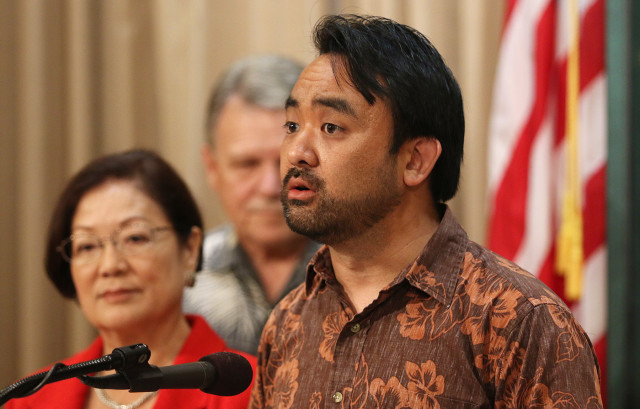
Scott Morishige, the governor’s coordinator on homelessness, says Gov. David Ige’s leadership team is focusing on serving homeless families at the Kakaako encampment.
Cory Lum/Civil Beat
Morishige said the leadership team has since helped 43 people — eight families and nine single adults — move into Next Step and Institute for Human Services shelters.
“I think this is a significant progress, and we’re happy to report this continued forward momentum,” Morishige said.
More people are expected to be relocated after Labor Day.
Mayor Kirk Caldwell announced last week that the city will resume the enforcement of the stored property and sidewalk nuisance ordinances in Kakaako on Sept. 8.
On Tuesday afternoon, the Honolulu Department of Facility Maintenance posted notices about the “phased enforcement” — on sidewalks around a one-block area mauka of Ilalo Street between Cooke and Ohe streets — and distributed handouts printed in English, as well as the Chuukese, Marshallese and Samoan languages, to the people in the area.
The upcoming Kakaako enforcement is part of a coordinated effort by the leadership team to tackle the state’s homelessness crisis — a strategy that could be applied elsewhere, Morishige said.
“This approach that we’ve started in Kakaako relies on coordination among service providers, the government and other community stakeholders — it really focuses on data, using the information that we gathered from the survey to better understand the needs of the population as well as the information about what shelter spaces are currently available,” Morishige said. “This is a model that we want to replicate in other areas of the island.”

