Monday Memo: Hoopili Ethics, Mountain Top Arrests, Bright Revenue Picture
New concerns about the City Council regarding Hoopili should be probed, more Mauna Kea arrests and more money for the state treasury.
HOOPILI INVESTIGATION? Allegations of ethical compromise raised last week by The Friends of Makakilo regarding the Honolulu City Council’s approval of the Hoopili housing development deserve immediate official scrutiny.
Specifically, the longtime opposition group to D.R. Horton’s 11,750-home project in West Oahu says hundreds of thousands of dollars in campaign donations that the developer showered on City Council members over three years irrevocably tainted their votes on Hoopili. The Friends of Makakilo called on the Honolulu Ethics Commission to rule on whether council votes approving the project were “compromised, biased, unethical and invalid.”
To be fair, the Friends of Makakilo analysis lumps in contributions from the developer with those from consultants and businesses connected to the Honolulu rail project, which will benefit the Hoopili project enormously. And none of the contributions, which represent up to 72 percent of three council members’ total donations, are illegal.

The Honolulu rail project runs through farmland in West Oahu that will soon become an 11,750-home community known as Hoopili.
Anita Hofschneider/Civil Beat
Still, is this any way to run a government — with elected officials free to vote on matters directly affecting campaign donors, without declaring a potential conflict of interest?
Kioni Dudley, president of The Friends of Makakilo, doesn’t think so, and along with calling for the commission to issue an opinion on the validity of Hoopili votes, he called for commissioners to change the regrettable decades-old opinion that lets council members off the hook for disclosure.
The worst offenders in Dudley’s analysis were Council Chair Ernie Martin, who took in $268,017 from Hoopili and rail interests — 59 percent of his total — and Councilwoman Kymberly Pine, whose $116,801 represented 72 percent of her donations.
Ethics Commission Executive Director Chuck Totto and commission members should live up to their official purpose of “improving and maintaining public confidence in government officials and employees” and make this matter a top priority.
DLNR officials remove a protestor from atop a hale on Mauna Kea. Screen Shot via DLNR video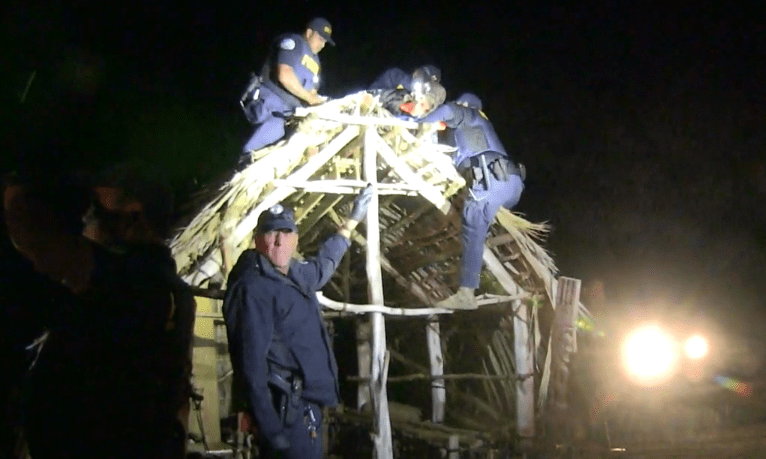
To insulate themselves against potential accusations of brutality or disrespect, DLNR officials quickly released video footage of the nighttime arrests to media the next morning, showing officers patiently cuffing and removing the eight, who were largely compliant. Only one had to be carried to the van waiting to transport them to jail.
The Protect Mauna Kea group joined the Office of Hawaiian Affairs in decrying the arrests. But such political theater is, in truth, the lifeblood of protest movements: Protect Mauna Kea’s Facebook page featured 11 posts related to the incident that drew more than 550 likes, hundreds of comments and shares and generously stoked passions on the Thirty Meter Telescope controversy.
The protestors themselves of course knew the arrests were coming. One young man armed with a video camera affixed himself to the rooftop of a simple hale constructed at the site, requiring the work of five officers to bring him down. As of Friday afternoon, the rather mundane DLNR video had amassed more than 5,600 views over just seven days.
Protestors are taking actions of conscience in their ongoing protests atop the mountain, meant in many ways to provoke the very government authorities that mean to allow the TMT project to go forward. We don’t blame them for that.
But neither do we blame DLNR or the administration of Gov. David Ige for their rightful enforcement of the law. More protest actions atop the mountain certainly lie ahead and more arrests will accompany them, as they should.
Officials discuss economic projections at a Hawaii Council on Revenues meeting.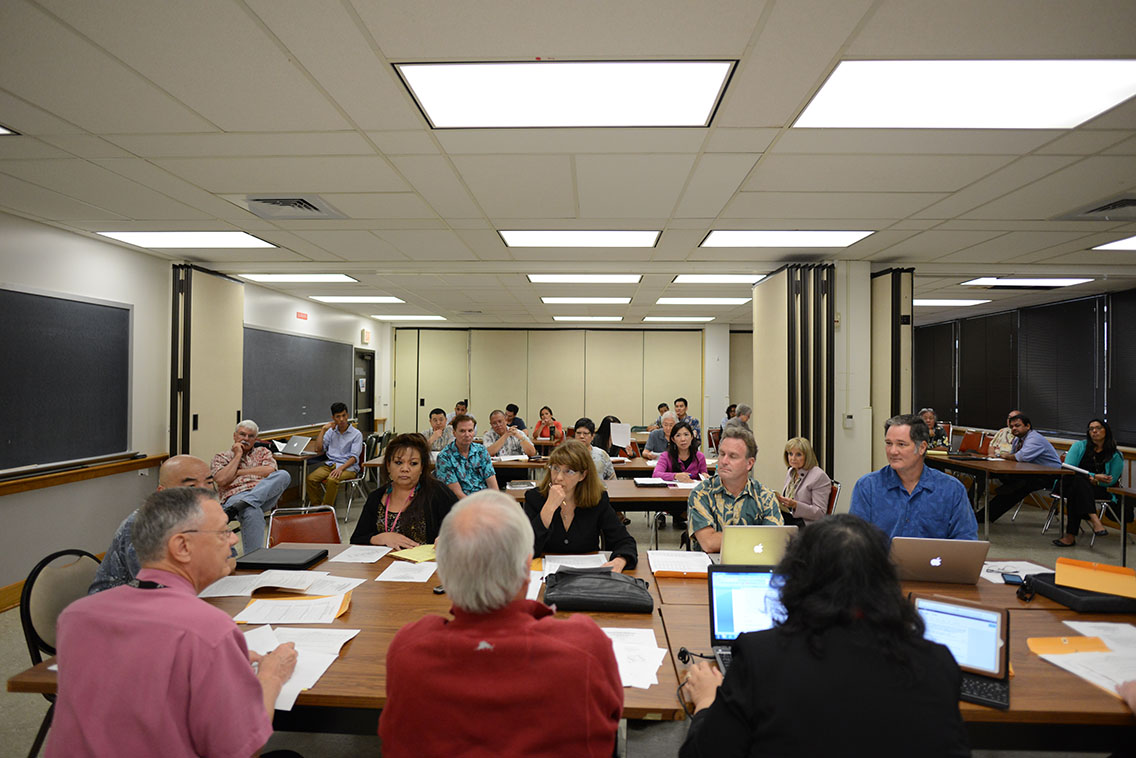
But dynamics underlying the revenue forecast should be enough to cheer residents throughout our island state. Strong performance in the tourism and construction sectors provided evidence of a solid state economy, despite a growth rate that has trailed the national average since 2008.
Despite concerns around instability overseas — particularly in China — state tourism officials now expect 8.7 million visitors this year. That represents an annual increase of 4.3 percent, up significantly from the 2.5 percent projected in May.
Those factors combined with a state jobs picture that is among the best in the nation, with only 3.7 percent unemployment against a national average of 5.3 percent, add up to an overall economic outlook that is modestly promising.
With revenue growth expected to continue for the next several years, what will Gov. David Ige and the Legislature prioritize for the next state budget cycle? Air conditioning and electrical infrastructure upgrades for Hawaii’s public schools? Affordable housing funding? Targeted deferred maintenance investments? We look forward to the governor’s supplemental budget proposal this December, when we’ll get the first chance to see what state priorities look like under a budget that is totally Ige’s.