

Should McKinley High Go Back To Being Called Honolulu High?
In Alaska, Mount McKinley is now Denali, thanks to President Obama. Should our high school revert to its old name, too? A petition drive is in the works.
It’s not the highest peak in North America, but venerable President William McKinley High School may become the second landmark to remove the 25th U.S. president’s name, if a petition drive started over the summer succeeds.
President Obama announced last week that the federal government would begin recognizing Denali as the name for what was previously called Mount McKinley — a change Alaska Natives and others have been pushing for decades. In that decision, it was roundly acknowledged that McKinley had little to do with Alaska or the mountain, the name of which a gold prospector changed virtually on his own.
But in Hawaii, it’s personal. Following the U.S.-backed overthrow of the Kingdom of Hawaii in 1893, McKinley annexed Hawaii in 1898 through what is today considered a dubious, unilateral process. But it was in tribute to exactly that annexation that McKinley’s name was affixed in 1907 to what was then Honolulu High School, according to the school website.
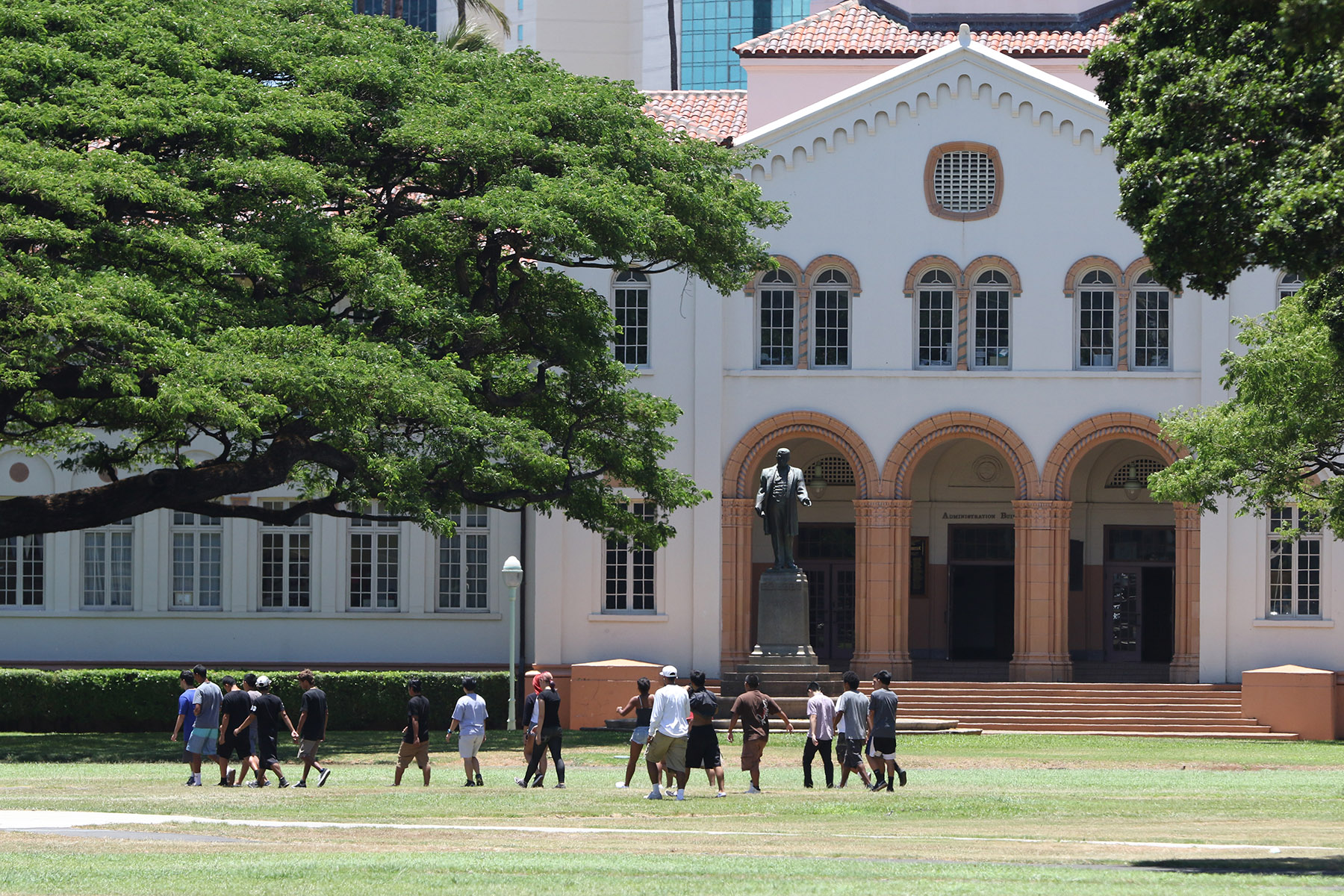
President William McKinley High School in Honolulu.
Cory Lum/Civil Beat
In the century since, Congress has passed a resolution, signed by President Bill Clinton 22 years ago, apologizing for “the illegal overthrow” of the Kingdom of Hawaii and for the “deprivation of the rights of Native Hawaiians to self-determination.”
The overthrow and annexation lie at the heart of ongoing efforts to establish a Native Hawaiian government. Some in the Native Hawaiian community would like to see the U.S. government simply recognize the Hawaiian Kingdom and withdraw from the islands.
For one Big Island resident, recent University of Hawaii graduate and writer, Aoloa Patao, the petition he started in June to rename McKinley High is the logical next point of focus. Under the title “Restore original name of President William McKinley High School” on the MoveOn.org website, the petition drew an initial spate of interest before leveling out at about 600 signers.
When he heard in August of the coming removal of McKinley’s name from Denali, he sensed an opportunity. After making inquiries to Alaska regarding that name change, Patao wrote a 2,300-word commentary piece making a case for Honolulu High School. Civil Beat published that piece Tuesday night.
“The plan is to get a little more support from the people, and then we’ll approach the (Hawaii) Board of Education” with a request to change the school name.” — Aoloa Patao, petition organizer
Those he’s shared the proposal with thus far have offered “a lot of positive feedback — no negative,” Patao said, and given broad community awareness of McKinley’s actions in eliminating Hawaii sovereignty, Patao isn’t surprised by the reactions.
“The plan is to get a little more support from the people, and then we’ll approach the (Hawaii) Board of Education” with a request to change the school name.
Like Denali, McKinley High is a landmark of some significance. It is one of the state’s oldest secondary schools with several of its buildings listed on the National Register of Historic Places. Its most prominent alumni include the late U.S. Sen. Daniel Inouye, Olympic gold medalist Duke Kahanamoku, celebrated war veteran and U.S. Congresswoman Tammy Duckworth (D-Ill.) and actor/wrestler Dwayne “The Rock” Johnson, to name a few.
While McKinley may be the most logical of Hawaii buildings or streets to consider renaming, it shouldn’t be the only one, according to Patao. He called out Dole Street running along University of Hawaii — named for Sanford Dole, the first president of Hawaii after the overthrow of the Kingdom of Hawaii — and Roosevelt High School as two other likely candidates. The namesake for the latter is Theodore Roosevelt, who briefly served as McKinley’s vice president and fought in the Spanish-American war, which made Guam, the Philippines, Puerto Rico and, briefly, Cuba possessions of the United States.
“All these places are hiding true history and celebrating the colonizers, the occupiers,” said Patao.
Civil Beat reached out to the Hawaii Department of Education for comment and for information on how existing buildings are renamed, but did not get a response.

