

Kakaako Encampment Braces for the Final Sweeps
There was no mass exodus Wednesday, but some homeless people were packing up in advance of Thursday and Friday sweeps.
With final sweeps set to begin Thursday, people in the densest parts of the Kakaako homeless encampment were preparing Wednesday for their looming eviction.
For the time being, though, the sidewalks along the streets near the Hawaii Children’s Discovery Center looked intact: packed with tents and plywood-reinforced tarp structures, with some debris spilling over to the streets.
But, by mid-afternoon, some people were beginning to pack up their belongings, fully aware that the sweeps were coming.
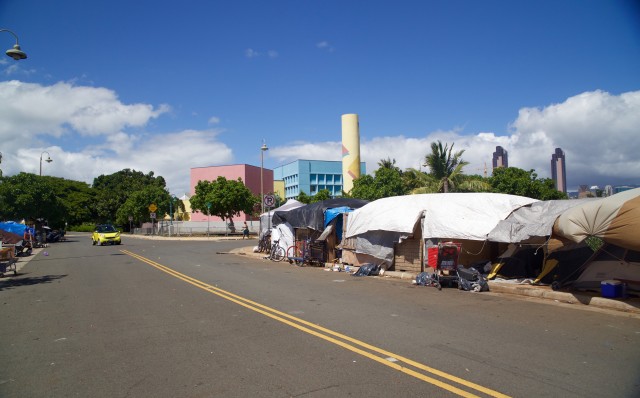
On Thursday, the city’s maintenance crew plans to clear Olomehani Street, along with parts of Ahui and Ilalo streets. On Friday, it’ll tackle Ohe Street and the remainder of Ilalo Street.
The two sweeps are the culmination of a month-long effort to clear out Honolulu’s biggest homeless encampment.
According to Scott Morishige, the governor’s coordinator on homelessness, about 100 people — including 11 families — are believed to still live in the areas. They account for about a third of nearly 300 people who were counted in a survey of the encampment in early August.
On Olomehani Street, a woman who only identified herself as Mary Jane said she and her husband had begun packing up their belongings. But they planned to wait until Thursday morning to figure out where to go.
“We’re willing to go to a shelter, but it’s hard to find one that accepts him,” Mary Jane said, pointing to their dog.
Meanwhile, Jeri Lewis was mourning: Within 24 hours, the tight-knit community of people living along Ilalo Street will be gone.
“We’re all friends out here. We’re like a family. We look out for each other,” said Lewis, who has stayed there for three months. “It makes me sad. But what can you do?”
Lewis said she was leaving soon to stay with in-laws. She was almost done taking down her tent and waiting for her friend with a car to help her move.
“I’m not going to wait until tomorrow and have them take away my stuff,” Lewis said.

