Mainland Poke: Disrespecting Our Culture Or Just Sharing Good Grindz?
As one of Hawaii’s most famous dishes pops up in more mainland restaurants, some here are wary of the trend. Don’t be.
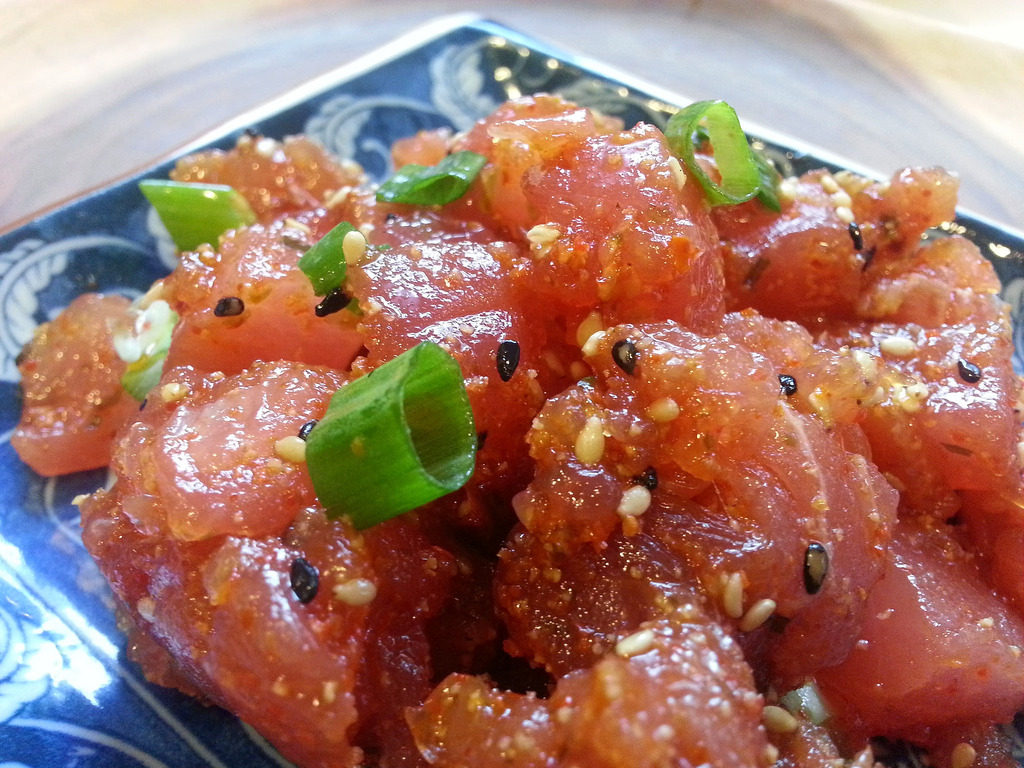
Cubed raw ahi. Hot white rice. Sesame seeds, shoyu, green onion.
You might know what I’m describing: poke. Pronounced “poh-kay” and named after the way it’s prepared — that is, “cut crosswise into pieces” — poke is a centuries-old dish central to the cuisine of Hawaii.
If you know what poke is, chances are you grew up in Hawaii, and you’re used to taking a half-pound of spicy ahi from Foodland to the beach, or to a party as a pupu. More recently, however, even if you aren’t from the state, you may have heard of the cherished food — it’s now all over the Internet.
Health-conscious food videos on Facebook show how to incorporate poke into a wrap, burrito or salad. News articles announce the opening of poke-themed restaurants in cities on the U.S. mainland — New York alone has gained three in the last six months. The food’s increasing popularity outlines what people in Hawaii informally and begrudgingly refer to as the “poke trend.”
Contrary to what you might expect, the surge of interest in the dish hasn’t made one in Hawaii too happy. In fact, it’s mostly invited criticism. People in Hawaii consider the trend appropriative and inauthentic. They say that the incorporation of poke into the menus of mainland chefs, who seem to have little regard for the food’s provenance or significance, is an oversimplification and misrepresentation of Hawaiian culture.
It’s a legitimate grievance, and one often made. Hawaii’s culture has been appropriated for centuries, with its complex traditions watered down and boxed up for consumption by a tourist-based economy. Though the poke trend may sound at risk for committing these same offenses, its differences highlight how harmless it is.
The main grievance against the poke trend is the fear that it’s yet another example of the misrepresentation of Hawaiian culture. When done properly, however, mainland chefs’ incorporation of poke into their menus presents an opportunity for exposure and education, not appropriation.
Take the new eatery Wisefish Poké NYC as an example. Wisefish Poké, which opened in February, is “dedicated to Hawaii’s much-celebrated raw fish dish,” as stated on its website. The restaurant serves traditional elements of poke (ahi, shoyu sauces, sesame seeds, cucumber and onion) and commits to only using sustainably sourced seafood, practices that honorably reflect the ideals of Hawaii.
If we evaluate the poke trend not as an isolated movement but as representative of a cultural phenomenon, it becomes clear why the trend isn’t one to fuss over.
In this way, Wisefish Poké — spelled with a diacritical mark above the e to ensure proper pronunciation — exemplifies what these burgeoning poke restaurants have a responsibility to do. The eatery respects the dish by maintaining ethical practices while using original ingredients. It also encourages interest in the food and its history by crediting its provenance. Restaurants like these seem to do little harm to the representation of Hawaiian culture in the urban mainland sphere.
Furthermore, if we evaluate the poke trend not as an isolated movement but as representative of a cultural phenomenon, it becomes clear why the trend isn’t one to fuss over.
Let’s take the surge in popularity of poke at face value. Hawaii created a way of preparing food that people enjoy. People enjoy it so much, in fact, that this style of preparing food has been adopted by other people, who tap into a strength of Hawaiian culture and share it in other cultures. They’re incorporating something fantastic from one demographic into another, inviting a conversation between the two.
Next, maybe it’s also important to acknowledge that a similar phenomenon of cultural mixing is responsible for Hawaii’s own food palate in the first place. Some of the state’s most distinctive and celebrated foods — spam musubi, chicken long rice, malasadas, katsu and purple sweet potato, to name a few — came about as the result of the same sort of cultural interaction that the poke trend takes part in.
When immigrants came to Hawaii from Japan, China, Portugal, Korea and the Philippines, among other places, they brought their styles of cooking with them, and Hawaii’s cuisine is an eager, hearty, generous, well-intentioned blend of these styles. In this way, even the most singular culture is revealed to be a delightful hybrid. The mainland, the “melting pot” that is America, hardly seems any different. What is the issue, then, in sharing with other people, just like those who shared with us?
When executed well, the adaption of poke into mainland menus invites cultural syncretism and interest in Hawaii’s culture. The dish is fresh, tasty and fantastic – why not spread the aloha?
 GET IN-DEPTH
REPORTING ON HAWAII’S BIGGEST ISSUES
GET IN-DEPTH
REPORTING ON HAWAII’S BIGGEST ISSUES
Community Voices aims to encourage broad discussion on many topics of community interest. It’s kind of a cross between Letters to the Editor and op-eds. This is your space to talk about important issues or interesting people who are making a difference in our world. Column lengths should be no more than 800 words and we need a current photo of the author and a bio. We welcome video commentary and other multimedia formats. Send to news@civilbeat.org. The opinions and information expressed in Community Voices are solely those of the authors and not Civil Beat.