Civil Geeks: Surveying The Skies To Safeguard Earth
Scientists map “Near Earth Objects” to try to detect those that might strike our planet.
It’s not a matter of whether it will happen, it’s a matter of when.
In February 2013, the public was mildly intrigued by the close approach of asteroid 367943 Duende, which came within 17,000 miles of Earth.
That same month, an extremely bright meteor known as a superbolide caught everyone’s attention as it burned up entering Earth’s atmosphere over Chelyabinsk, Russia.
Dashcams in Russia caught the experience in vivid detail as the Chelyabinsk meteor lit up the morning sky.

Although the two events were unrelated, the Chelyabinsk meteor was a complete surprise to the scientific community. This event brought home the fact that asteroids and meteors, which have been a part of Earth’s history since the dawn of the solar system, can enter our atmosphere at any moment.
Near Earth Objects
The threat of a massive asteroid or comet hitting the Earth has not escaped the members of Congress. In 1998, they established the Spaceguard Survey and called for NASA to discover, within a decade, 90 percent of Near Earth Objects (objects defined as having the potential to come within one-third of the average distance between the Earth and the Sun) with a diameter of 1 kilometer in size or greater.
Meager funding and the inability to fulfill the objectives set by the Safeguard Survey led to a second mandate in 2005 called the Near-Earth Objects Survey Act. This congressional mandate called for NASA to find 90 percent of NEOs of the size 140 meters (750 ft.) or greater by 2020.
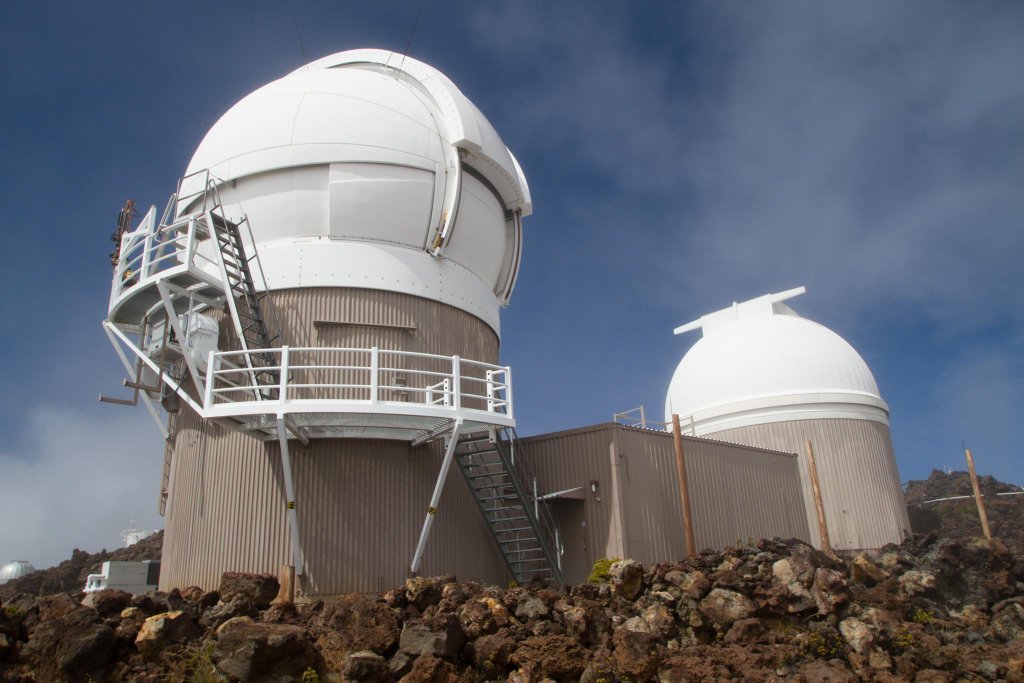
![The PS1 Observatory at dawn on Haleakala, Maui. Photo by Rob Ratkowski]](https://civilbeat-aws-dotorg.s3.amazonaws.com/wp-content/2016/06/DSC5157C.jpg)
In Hawaii, work started in 2006 to build the Panoramic Survey Telescope & Rapid Response System, or Pan-STARRS, on the summit of Haleakala on Maui. After a long period of commissioning, during which the installation, alignment and acceptance were completed, the Pan-STARRS 1 or PS1 telescope went into full operations in 2010.
The 1.4 gigapixel Pan-STARRS camera sits behind a 1.8 meter Ritchey-Chretien telescope. Every night it takes multiple snapshots of the night sky, with five different light filters. This accumulated mosaic of photos is not only a survey of the sky but a time-lapse view of the objects passing the field of view of the camera.
“If we compare images from one time period to another and detect movement of objects in a path, we have a potential candidate for an interesting celestial object,” said Ken Chambers, director of the Pan-STARRS Observatories.
For a moment I pondered the endless hours some poor grad student must spend looking through a magnifying glass at images of sky surveys to see if an object moved from one position to the other. Chambers reassured me that those tasks are relegated to image-processing programs running on the Institute for Astronomy’s supercomputer on Maui.
Massive Amounts Of Data
With the incredible amount of image data already gathered from PS1, measured in petabytes (1 million gigabytes), researchers working with Pan-STARRS are discovering new objects at a much quicker pace. Recent discoveries include the Lonely Planet – PSO J318.5-22, moving through space without a sun or planetary siblings, a NEO Halloween asteroid flyby and a cold remnant from our early solar system.
By the end of summer, the amount of data will soon double as Pan-STARRS gets ready to install a new camera which will establish Pan-STARRS 2 in an adjacent telescope dome. Similar to PS1, the new system will include a 1.8 meter Ritchey-Chretien telescope and 1.4 gigapixel camera.
Save The Planet
With the data already collected by PS1 and PS2 soon to go online, what happens when an NEO of extinction level mass has its crosshairs on Earth? Although the probability is small, it’s not zero; and it has happened before with the dinosaurs.
Rest assured, thought is being given major consideration to what to do if this were to happen.
As you might recall, in the movie “Armageddon,” Bruce Willis and his misfit team embedded a nuclear device in the asteroid to blow it apart. In the short time they had to respond that option might be acceptable but Chambers said that, in reality, this could not happen. There is the Outer Space Treaty which prevents the placement of nuclear weapons or any weapon of mass destruction in orbit or on a celestial body like the moon.
So, in lieu of working on a space worthy giga-ton neutron bomb, there are several major efforts to address the possible NEO threat.
NASA has the Asteroid Redirect Mission, which aims to send a high-tech asteroid gripper that a solar electric propulsion spacecraft could use to pull the asteroid into a non-Earth threatening orbit.
NEOShield-2 is a project funded by the European Commission, as part of Horizon 2020, to assess technologies to mitigate the impact of an Earth bound NEO. Interesting options include concepts known as the gravity tractor and the kinetic impactor.
Back in the US, former IfA alum and astronaut Ed Lu (who we had on Bytemarks Cafe in 2013) co-founded the nonprofit B612 Foundation. Its mission is to crowd-fund and build a space-borne telescope, called Sentinel, that would augment land based telescopes like Pan-STARRS and the future Large Synoptic Survey Telescope.

The LSST won’t be online for another 10 years, predicted Chambers. In the meantime, Pan-STARRS data not only holds valuable information about NEOs, but also about strange objects from the Kuiper Belt, brown dwarf stars, tailless comets, rogue planets, stellar explosions, black holes and a 3-dimensional time lapse of the universe.
Chambers said, “It’s useful in the practical sense for mapping incoming asteroids; but it’s enormously useful for understanding our universe, its structure and the way it evolved. We should know about our backyard; and the universe is our backyard.”