

Peter Apo: Herb Kane Helped To Rebuild The Hawaiian Nation
The work of one man was instrumental in making Native Hawaiians see themselves in a different light and overcome transgenerational trauma.
I grew up a pre-baby boomer in the ’40s and ’50s when it was not cool to be a Hawaiian.
There were hundreds like me who became somewhat involuntary victims growing up in the wake of a tragic socio-political-cultural history. Our Hawaiian world of transgenerational trauma was set in motion by immeasurable losses in every indicator by which the health and well-being of a society is measured.
The work of one artist, Herb Kane, helped change all that by making us see ourselves in a different light.
The Way We Were
In 1893 the Hawaiian Kingdom fell to a political coup d’état of annexation sympathizers. The loss of sovereignty was followed by the decimation of two-thirds of the Hawaiian population infected by common Western diseases from which we had no immunity.
The ranks of native leaders, cultural practitioners, and important orally perpetuated traditions were devastated. Hawaiian society went into a tailspin – a lost and wandering people without a reflection in the water.
It did not help that the prevailing historical images of ancient Hawaiian society were renderings of us by sketch artists who traveled with the early European explorers.
As parents will do in wanting their children to have a successful life, it seemed that becoming good Americans and assimilation into Western culture was the most logical path to recovery and the pursuit of prosperity and quality of life.
What ensued, from my perspective, perhaps inadvertently, was a shedding of what was left of our cultural skins — to become something other than a Hawaiian who by now was stereotyped as belonging to an ethnic class of indigents.
In our cultural deprivation it did not help that the prevailing historical images of ancient Hawaiian society were renderings of us by sketch artists who traveled with the early European explorers such as Captain Cook. These artists were tasked with producing generic imagery with little time to understand what they were seeing.
Absent scale and detail, these images of us and our culture made us seem like little more than cultural curiosities. To a young Hawaiian, these images did not help raise our self-esteem.
Wandering And Discovery
I left for college in 1957 without really knowing who I was. But I didn’t know that I didn’t know who I was.
I did sometimes reflect on being Hawaiian but had little idea of what that was supposed to mean. I learned to play the ukulele and guitar and sang a few Hawaiian songs, but beyond that I had little clue about what it meant to be a Hawaiian. I was a cultural vagabond who had totally assimilated myself in the pursuit of the American dream.
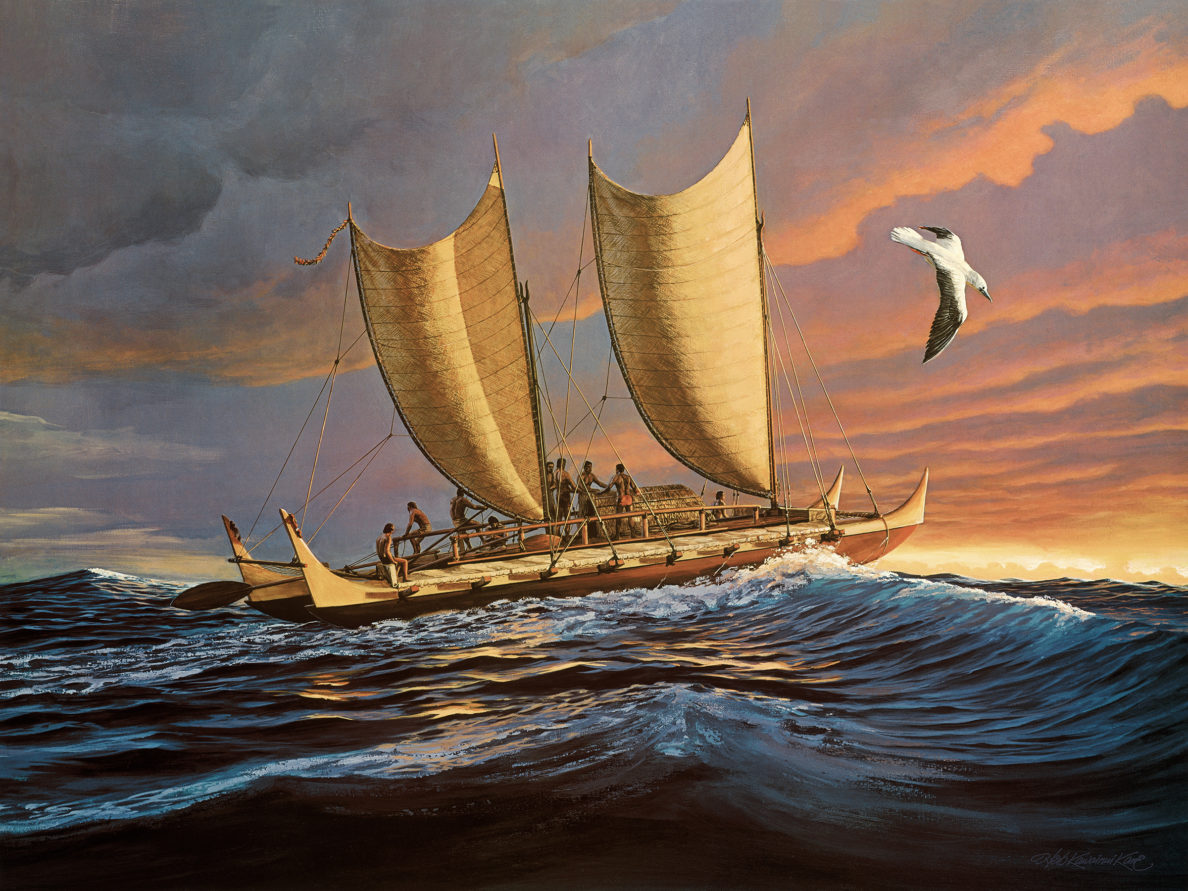
In 1975, I moved back to Hawaii. When I stepped off the plane at Honolulu Airport I was stopped in my tracks by a Herb Kane poster of the Hokule’a. There it was, a 60-foot double-hulled canoe majestically broaching a wave, crab claw sails rising high above the sea, feathered lei hulu flying from the top of a mast, warriors standing on the deck.
I had never seen such a stunning portrayal of a piece of my history and my culture. It changed my life.
The full-scale replica of a Hawaiian voyaging canoe was launched in March 1975. Herb Kane, the voyaging canoe builder partnering with anthropologist Ben Finney, was on his way to planting the seeds of a massive cultural renaissance that eventually swept the entire family of Pacific island nations.
The Hokule’a and everything it represented was transformational for me and hundreds of Hawaiians like me.
But Herb Kane the artist was just getting started. As the architect, historian and scholar began to unleash the power of his brush and pen, a cultural nation began to resurface in the pages of his books and canvas paintings. With his powerful images, stories, and characterizations of what constituted a Hawaiian cultural world, he defined for us, in great detail, the cultural nation of Hawaii. He made our reflection in the water reappear.
His storytelling through art and narrative lauded our ancestors and their fearless exploration of the vastness of the Pacific Ocean.
Many of his stunning images were deliberately conceived historical accounts of a nation punctuated with great human achievement: a nation of seafarers who explored, discovered, and settled over one-third of the Earth’s surface hundreds of years before the Vikings or Columbus.
His storytelling through art and narrative lauded our ancestors and their fearless exploration of the vastness of the Pacific Ocean while Europeans were afraid of sailing off the edge of the earth and marked the outer boundaries of their maps of the ocean with the words, “Beyond this place there be dragons.”
His architect’s training burst to the surface and his illustrator-style art forms accurately and to scale captured, in great detail, every major aspect of Hawaiian culture: the way we dressed, our science, our religion, our food production systems, our healing arts, warrior culture, shipbuilding, architectural forms, building materials and construction techniques, bird catching and feather art forms, fisheries management.
It goes on and on.
Herb Kane flung open door after door of our cultural legacy and unleashed a deep-seated longing for self-validation of who we are and where we came from. He fed our desperately held cultural passion to rebuild our lives and our identity. He helped us find our dignity and restored our honor.
Flashback: First Sign of Recovery
One day in the fall of 1975, six months after the Hokule’a was first launched, a rainstorm had passed over the Nanaikapono Elementary School campus in Nanakuli, a predominantly Hawaiian town.
The storm had left huge puddles of standing water. I observed several Hawaiian boys gathered around one of the larger puddles. They had removed their rubber slippers and poked chopsticks in the middle, to which they had taped crab claw-shaped paper sails.
They were staging their own Hokule’a sailing regatta!
At that moment it hit me that we were going to be OK. The massive cultural renaissance that ensued is still spiraling in every direction.
Today, whenever I visit a Hawaiian immersion school where children are speaking Hawaiian as their first language, I smile and think of Herb.
Unfinished Work
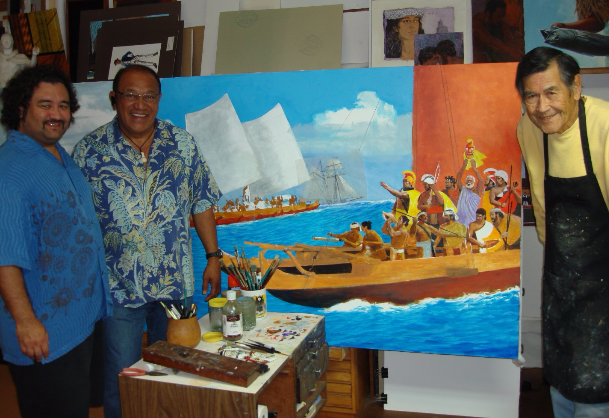
During the period of 2010-2011, Hawaiian architect Rob Iopa and I were blessed to be involved in the brokering of Herb Kane’s last art commission, which was to convert an old and famous sketch he had rendered of Kamehameha the Great’s invasion of Waikiki into a full blown canvas painting for the Royal Hawaiian Hotel.
This stunning piece of artwork hangs in a place of honor in the hotel near the entrance to the also historic Monarch Room.
The legacy he left was one of awakening a nation that we have yet to finish rebuilding.
There is a curious aspect to this painting. Although not perceivable to the untrained eye, some small details of the painting were not quite finished. When we first approached Herb to discuss this project his health was in decline and he was not accepting new commissions. But he thought this project to be special and agreed to do it although he was concerned that it might be a struggle to finish it.
Perhaps it is fitting that his last work was not fully completed. Fitting because the legacy he left was one of awakening a nation that we have yet to finish rebuilding.
It was also fitting that Herb Kane joined the pantheon of our most prominent of Hawaiian ancestors on March 8, 2011, because March 8 had also been the date of the inaugural launch of the Hokule’a at Kualoa Park.
Thank you Herb Kane, from a grateful nation.

