Reader Rep: Journalists Need To Do The Math On Rail
To keep from being bamboozled and to explain to the rest of us what’s happening, journalists must have solid math skills.
Numbers aren’t always as definite as you might think.
Numbers are rhetorical representations. They are easy to solidify into appealing forms and to manipulate to cover all sorts of questionable concepts. Reader (and citizen journalist) Natalie Iwasa, who describes herself as a certified public accountant, has been looking closely at the numbers on Honolulu’s elevated rail project, and she has many concerns about the technical ways in which those numbers are being kept, described and shared with the public.
Many of us, like Iwasa, have been aghast over the past few weeks, as the board of the Honolulu Authority for Rapid Transportation revealed its ridiculous bookkeeping, projections and cost-control practices. As Honolulu Star-Advertiser reporter Marcel Honoré documented, board members repeatedly asked each other and staff members how the agency’s numbers, especially during the past two years, so consistently have been wrong.
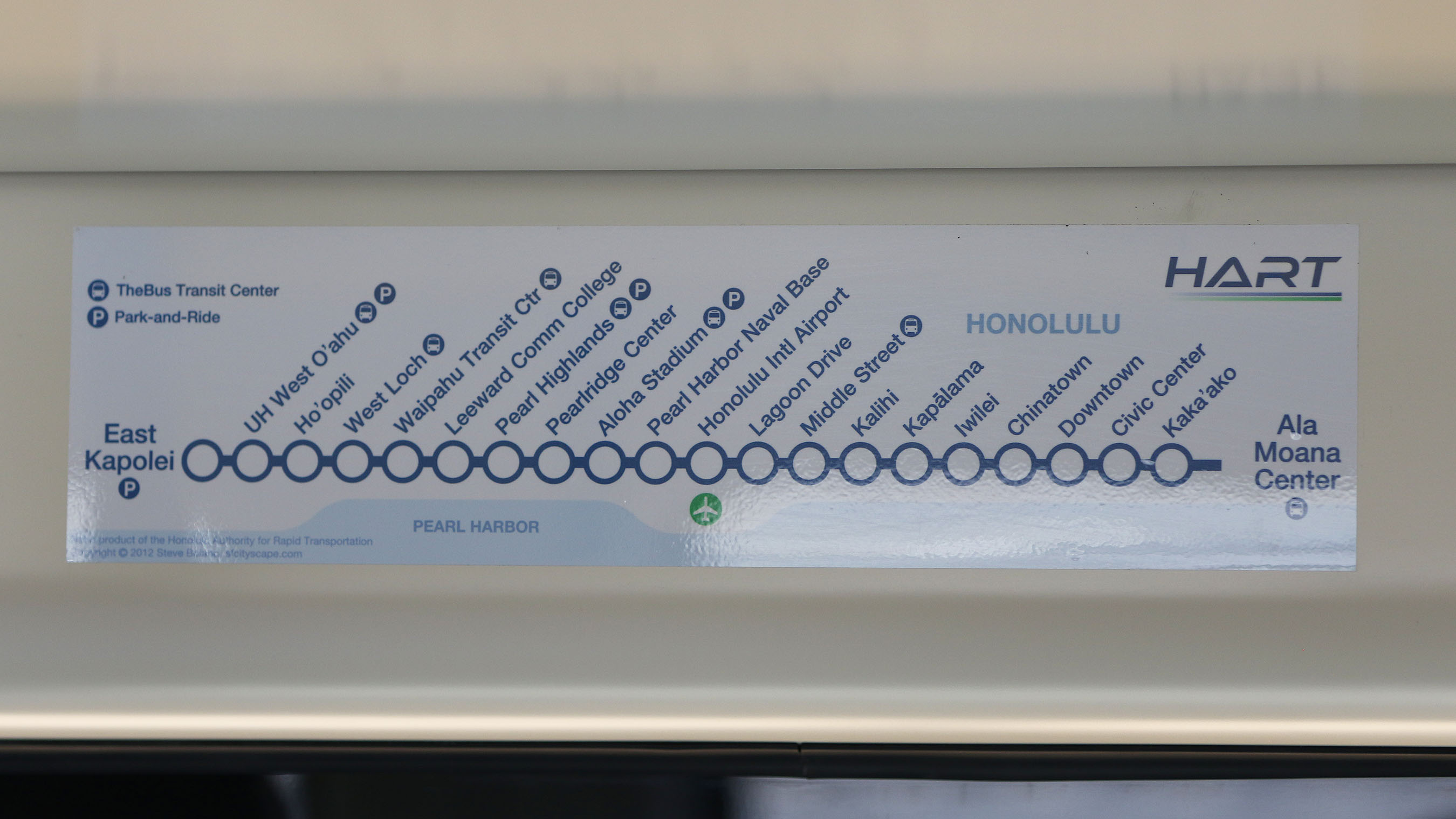
The estimated cost of the project in May, for example, was $6.9 billion. But a few weeks later that estimate had grown to more than $8 billion. Then, last week, those numbers jumped again to $10.8 billion.
A one-month increase of nearly $3 billion? Astonishingly, Dan Grabauskas, the agency’s executive director, shrugged the shifting numbers off as “bad luck,” based on rising real estate prices. That seems just like the kind of laissez-faire blather that would allow rampant out-of-control spending.
A Bill For What?
Now, $3 billion seems sort of small, when written in that Associated Press-style way, but looks a bit different when you put in all of the zeros: $3,000,000,000. With 1.4 million people in the state, that would equate to each of us, including children, getting slapped with a new bill this month for $2,143 (or a household of four finding an $8,571 bill on its doorstep), with no explanation of what, now, we are getting for our money. Therefore, the biggest and most unanswered journalistic question is: For what? Bad luck?
That’s not an answer that should make Hawaii journalists content. Civil Beat’s Nick Grube, with assistance from special correspondent Bob Porterfield and others, has been setting an example of the kind of work that needs to be done here with their ongoing series called “Off Track.” But more journalists need to join this pursuit and find out what’s going on.
Iwasa, for her part, pinpointed many poor accounting practices within the agency. She illustrated her assessment with one head-scratcher moment in a recent HART slideshow when the presenter did not even add up projected revenues correctly. That slide claimed HART had accumulated $6.827 billion in revenue, but the organization provided a more detailed list of the revenue on the same slide that actually showed an income of $6.828 billion.
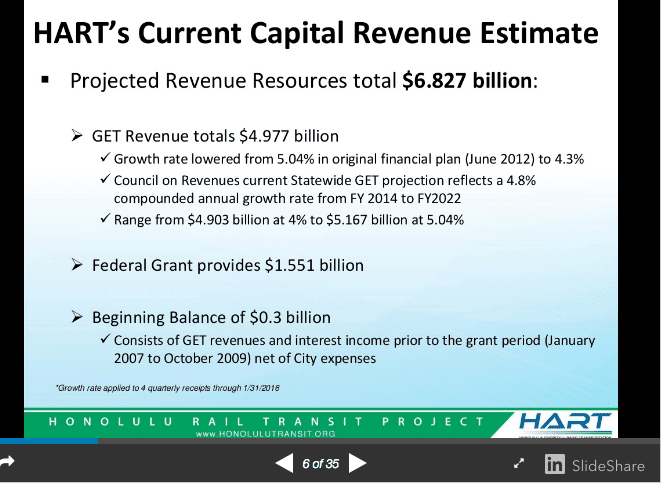
Iwasa also wondered why the federal grant was listed in this slide at $1.551 billion, when by all other accounts, including HART’s own, it has been described as $1.550 billion? Maybe this solves the mystery of the missing million ($1,000,000!), or that million is going to appear soon (hooray!), or maybe the revenue already has been lost and HART simply hasn’t told us about that yet (awww!).
But how confident do you feel, at this point, that HART is managing the public’s money properly, if it can’t even keep its most basic numbers straight in this or the many other cases that Iwasa documents?
Why Journalists Need Numeracy
Iwasa succinctly pops the “bad luck” balloon with her numerical criticisms. Her strategy of focusing on the numbers should provide a lead for local journalists to investigate this story more thoroughly through the accounting ledgers. But more needs to be done; it’s just not sufficient to say a budget is $3 billion higher without saying why.
“Facts are stubborn, but statistics are more pliable.” — Mark Twain
The number-crunching tools that journalists need to pick this budget apart and find out where the money went are readily available. Computer-assisted reporting has been a part of journalistic practices for decades, but new digital systems enable powerful kinds of data journalism. In this case and others, journalists would benefit from a better understanding of numbers, including basic statistics and accounting.
Without numerical literacy, they are vulnerable to all sorts of statistical manipulations, based on erroneous, hidden or misleading numbers that can be tossed aside as “bad luck.” Journalists can’t find the real stories behind this blunder without understanding how the numbers were created and getting past the facade many of those figures present.
Numerical literacy positions journalists to expose and disrupt political, corporate and societal corruption by bringing statistical truth to light and getting accurate information to their audiences. Without it, they are helpless puppets in the hands of the statistical manipulators.
Figure Out Your Starting Point
To begin to orient this story based on numbers, though, we need to know where to start the analysis. We could start at the place recommended by Panos Prevedouros, the chair of the University of Hawaii’s Department of Civil and Environmental Engineering. That would be 2004, when newly elected mayor Mufi Hannemann proposed 34 miles of rail for $2.7 billion. Prevedouros has kept track of some of the highlights and lowlights, as he saw them, in a timeline.
Or, we could begin with a slightly contracted and more expensive starting point. Honolulu City Councilwoman Ann Kobayashi summarized her understanding of the origins in an article last year by Dennis Hollier of Hawaii Business magazine, offering a thorough and thoughtful breakdown of the morphing costs and scope of the project. At the point Kobayashi bought in, the train was going to cost about $3.5 billion and connect the west side to Salt Lake and Waikiki And it was going to alleviate the traffic bottleneck in downtown Honolulu by providing a line up to the University of Hawaii Manoa (also serving large nearby schools, such as Punahou and Mid-Pacific), addressing some of the worst traffic concerns on the island.
A Honolulu Advertiser story in 2008, though, estimated the cost at $3.7 billion (Civil Beat reader “Big Daddy” pointed out), with project consultant Parsons Brinckerhoff warning that estimate could be “anywhere from 30 percent too low to 25 percent too high.” That means costs for this project should have ranged roughly between $2.78 billion to $4.81 billion.
Accounting For Inflation
Using an inflation calculator provided by the Bureau of Labor Statistics, the high end of that number would be about $5.35 billion in 2016 dollars, which is roughly what the general public had in hand as a cost estimate when it last had something of a say on this rail issue in 2012 by choosing pro-rail candidate Kirk Caldwell for mayor of Honolulu. So 2012 seems to be the turning point of this issue financially and a reasonable place to begin an investigation.
As Civil Beat’s Nick Grube reported at the time, the rail was going to cost $5.26 billion and be completed in 2019, connecting east Kapolei with the Ala Moana Center. (The UH line dream already had been dropped, but that’s another story.)
From there, under Caldwell’s watch, this project appears to have gone financially haywire. As Civil Beat’s Anita Hofschneider reported earlier this month, between 2012 and now, the rail costs ballooned first to $8.1 billion, then $10.8 billion; and the timeline was lengthened to 2024 before the rail line connects to, well, who knows where at this point? Middle Street?
Sometime during all this — The past month? The past two years? Since 2012? — this project financially derailed. And if you’re waiting for the HART board to figure out what happened and let you know, in detail, you might as well be loitering at the site of the ill-fated UH Manoa stop.
What, Me Worry?
This is the same local government culture that allowed more than 100,000 gallons of raw sewage to spill into the waters of Waikiki and the surrounding areas during a storm last year because of “miscommunication.” And the director of the city’s Department of Environmental Services, Lori Kahikina, shrugged the mistake off with an apology and a promise to hold a meeting to talk about ways to improve departmental communication.
When major screwups happen that affect public health and finances, public servants need to be accountable for more than a “sorry about that!” If you are waiting for them to own up to the mistakes, I’ll see you on the first train trip to Ala Moana. This is where journalists need to dig deeply and find out what happened. We need you, journalists!
When a public agency somehow miscalculates about $3 billion in public costs in a month and tries to deflect blame to “bad luck,” journalists are the only people left standing who can help us by doing the math, figuring out where the money went and uncovering the stories of what really happened. To understand the issue with escalating real estate prices along the rail, for example, journalists might want to follow Civil Beat’s Nick Grube’s lead and question Colbert Matsumoto.
The openings for great data journalism clearly are there in this fiasco, including the conflicting accounts of where the money has gone and a recent audit exposing all sorts of compelling questions. Citizen journalists, like Iwasa, can create openings on these issues, of course, but we cannot expect them to do it all.
Professional journalists in this community: It’s your turn to find out what exactly happened, to share that with the public, to force public accountability and to finish the job.